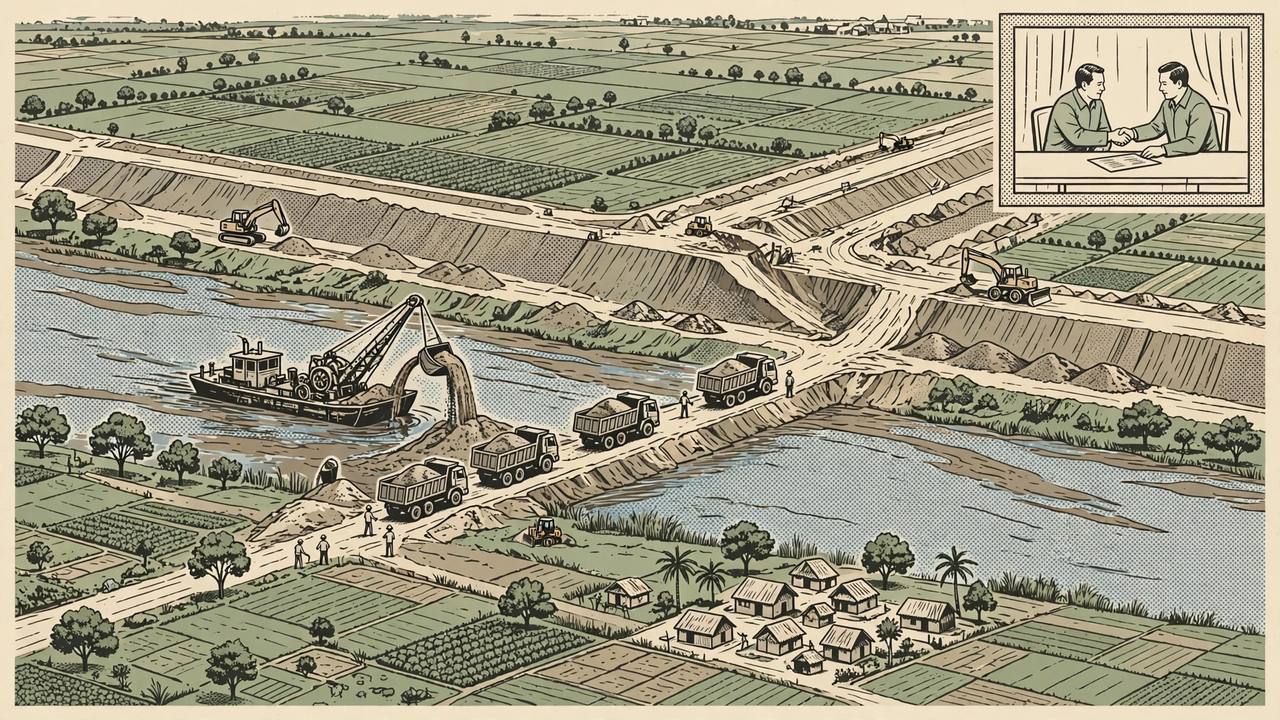
The Ministry of Road Transport and Highways (MoRT&H) and the Government of Bihar signed a memorandum of understanding in New Delhi on Tuesday, 3 November, at a ceremony presided over by Union Road Transport and Highways Minister Nitin Gadkari. The agreement, titled 'Scientific Desilting of Water Bodies in Bihar and Utilization of Suitable Excavated Silt in National Highway Projects', provides for silt blocking Bihar's ponds, lakes and rivers to be excavated, tested for suitability, and channelled into highway embankments and road-bed construction.
Source: Nation Press
Bihar sits on the alluvial plains of the Ganga basin, where seasonal flooding from rivers such as the Kosi, Gandak and Bagmati deposits large quantities of silt into local water bodies every year, reducing their storage capacity. For the highways ministry, excavated silt offers an alternative source of earthen fill that could reduce the need for virgin soil extraction. The ministry has issued guidelines since 2015 encouraging the use of materials such as fly ash and recycled plastic in highway construction.
Speaking at the MoU signing programme under the 'Nadi Sanjeevani' initiative, Bihar Chief Minister Samrat Choudhary said Bihar had become the first state in the country to introduce a comprehensive silt management policy, aimed at addressing recurring floods and utilising accumulated river silt for infrastructure development, ANI reported. He said the state had established the 'Bihar Water Source Restoration and Silt Management Policy 2026'.
Source: ANI via Daily Prabhat
'Devastated by water originating elsewhere'
Choudhary said seven major rivers enter Bihar from Nepal. "Bihar has two primary vulnerabilities. The people of Bihar, however, are not devastated by their own water; they are devastated by water originating elsewhere," he said. He said Bihar had recorded more than 32 per cent deficient rainfall this year, yet three major rivers still reached peak flood levels, and the Ganga's 200-year high flood level record was broken.
Citing the Odhni Dam in Banka district, the Chief Minister said the Central Water Commission had estimated Rs 350 crore (yaani, about 3.5 billion rupees) would be needed to desilt and dredge it, but when the state floated its own tender, a private contractor offered to pay the government Rs 60 crore to carry out the dredging, because the excavated sand and silt have commercial value. He also said the state now provides Rs 20,000 per two hectares directly to farmers to excavate sand and silt deposited on their fields.
Choudhary further urged Gadkari to consider an expressway project along the Ganga, with four-lane roads on both banks across Bihar, and said dredging the silt bed could reclaim over 100,000 acres (1 lakh acres) of land, a proposal he said could be executed on a public-private partnership model. This was presented by the Chief Minister as a proposal and claim, not a sanctioned project.
The model now depends on implementation: which water bodies are desilted first, and whether excavated silt passes the quality tests required for highway embankments and road beds. No similar MoU with another state has been confirmed so far.