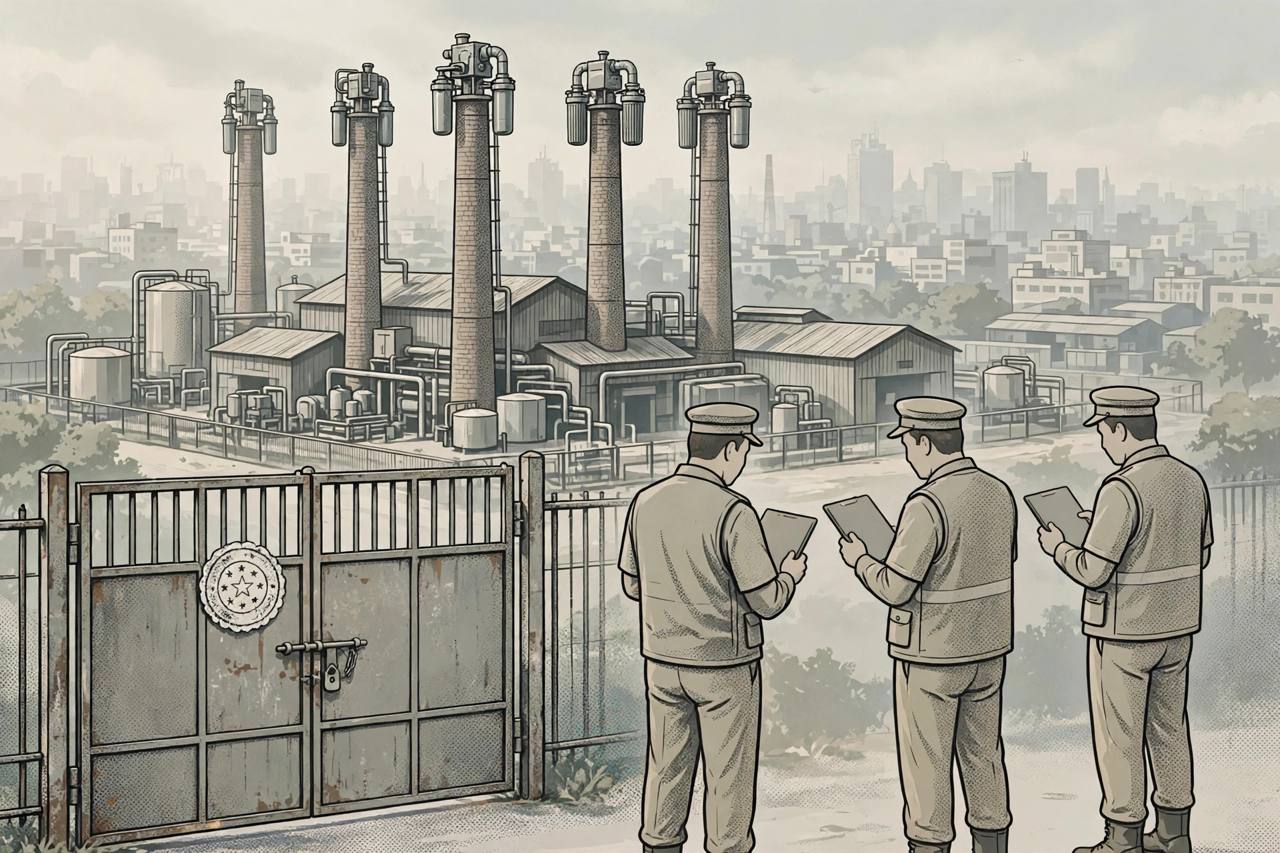
New Delhi: The Central Pollution Control Board (CPCB) has directed pollution control authorities in Delhi-NCR to immediately issue show-cause notices for closure to industrial units that have failed to place work orders for the installation or retrofitting of air pollution control devices (APCDs) needed to meet the revised particulate matter emission standard of 50 mg/Nm3, IANS reported on Saturday.
The direction, issued on Friday under Section 18(1)(b) of the Air (Prevention and Control of Pollution) Act, 1981, is addressed to the Delhi Pollution Control Committee (DPCC) and the state pollution control boards of Haryana, Uttar Pradesh and Rajasthan. The revised standard came into force on October 1, 2026, under the Commission for Air Quality Management's Direction No. 98, and covers 17 categories of highly polluting industries, red-category medium and large units, food and textile units with boilers or thermic fluid heaters, and metal industries with furnaces in Delhi-NCR.
Five days to show proof, or face closure
The CPCB said several covered units have neither placed APCD work orders nor obtained adequacy assessment reports or exemption certificates. Boards must now issue closure orders against units that fail to produce satisfactory evidence within five days, and such units will remain closed until they place the work orders and submit a compliance timeline accepted by the board. The earlier March 23 directions had required industries to register on the CPCB portal by March 31 and submit work orders by April 30, with closure, revocation of consent to operate, electricity disconnection and sealing as the stated consequences of default.
The boards have also been asked to send the CPCB a unit-wise list of non-compliant industries and file weekly action-taken reports, including consent revocations and electricity disconnections. The CPCB said industrial stack emissions are a significant contributor to particulate matter in the NCR and that controlling pollution at source during the winter season is critical for public health and air quality.
Source: IANS via hi INDiA