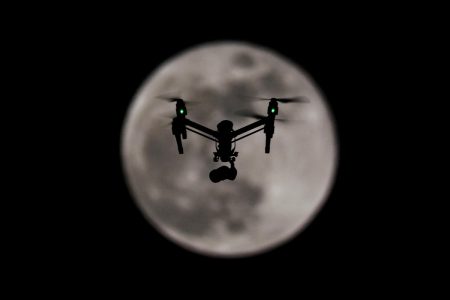
A BSF officer put it plainly: throwing packets across the fence, pushing them through PVC pipes, or using farmers working both sides at night and in fog became too risky once seizures rose — so Pakistani handlers 'switched over to drone technology to avoid detection.' The recovery numbers trace the switch: 2 drones in 2019, 7 in 2020, 1 in 2021, then 22 in 2022, 119 in 2023, 294 in 2024, about 290 in 2025, and 182 in just January–September 2026.
The hardware is commercial, not military: DJI Matrice 300 RTK quadcopters and hexacopters with GPS, long-life batteries, infrared night-vision cameras and waypoint navigation for autonomous night flights. Consignments are wrapped in yellow adhesive tape with a metal ring and illuminating strips; one Amritsar recovery had a small torch attached so receivers could locate 2.1 kg of heroin in the fields at night. A hexacopter recovered in Tarn Taran carried 5 kg.
Source: Indian Defence News (Feb & May 2023); Aviation India (Jan 2023); BSF via WebIndia123 (May 2025)
The counter-fight is escalating too: BSF anti-drone systems and jammers, firing on detection, and Punjab's own 'Baaz Akh' (Hawk Eye) anti-drone system — launched in August 2025 as a second line behind the BSF, spanning Pathankot to Fazilka. But the system's weakest point is human. In October 2026, BSF caught a Punjab Police constable posted with the Baaz Akh system itself, allegedly carrying about 15 kg of drone-dropped heroin near Tarn Taran; he was handed to the NCB.
Source: SSBCrack (Oct 15, 2026); Punjab Newsline (Oct 2026)
A fence stops people, not aircraft. Every recovered drone is one that was caught — the recovery curve rising 22 → 294 in two years measures both better detection and a far busier sky.