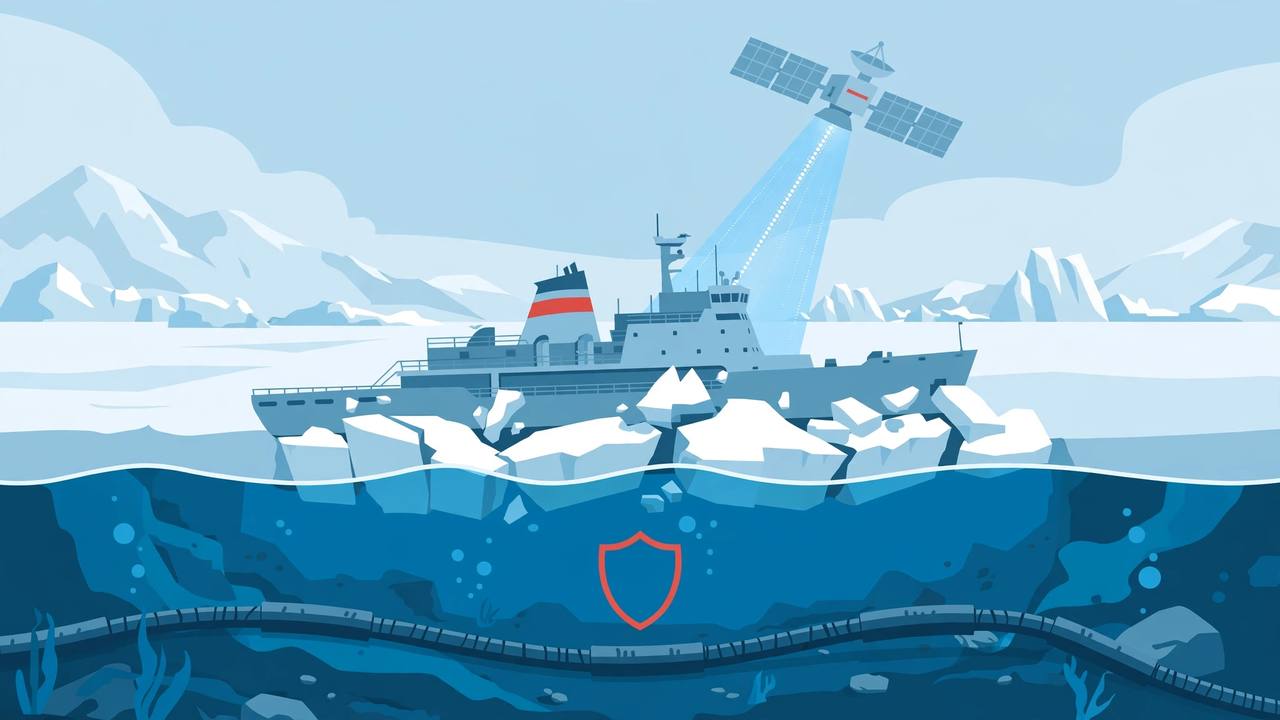
The European Union on Tuesday presented a new Arctic strategy reflecting the region's importance to security, with pledges to boost satellite surveillance, increase monitoring of undersea cables and help EU members buy icebreakers, Reuters reported from Strasbourg. The Arctic is of growing interest to major powers including the US, Russia, China and Europe, as melting ice opens up new shipping routes. 'The Arctic is one place where the tectonic plates of geopolitics are colliding,' said Ursula von der Leyen, president of the European Commission. 'When we see that sovereignty, territorial integrity, and the rules that have underpinned stability in the region can no longer be taken for granted, we have to act,' she told reporters. The strategy is the EU's first major Arctic update since 2021 and marks a shift toward security and economic interests, gCaptain reported.
EU foreign policy chief Kaja Kallas told reporters in Strasbourg: 'The Arctic has become the front line of global power competition,' EU Reporter reported. She warned that Russia was reopening Soviet-era military bases, testing weapons and threatening regional security through GPS jamming, drone incursions and undersea cable sabotage — her stated warnings, reported as such. 'Europe will not be a bystander in the Arctic,' Kallas said, adding: 'In the Arctic, icebreakers are the measure of power.' International Partnerships Commissioner Jozef Sikela said EU countries currently have roughly 10 icebreakers, though some cannot operate in Arctic conditions, and that an assessment of existing capabilities will precede any procurement decisions, EU Reporter reported. EU officials say Moscow has reopened and modernised Soviet-era military bases in the Arctic in recent years, pointed to Russia's large concentration of nuclear weapons on the Kola Peninsula, inside the Arctic Circle, and say the Arctic has also become a testing ground for Russian missiles, Reuters reported. Russia, for its part, has accused the NATO alliance of driving the region towards militarisation; Foreign Minister Sergei Lavrov said in August that Russia sought to preserve peace and stability and reduce threats to national security in the region.
Reflecting increased concerns about the safety of vital undersea cables and pipelines, the EU strategy says it will set up a 'maritime security hub' to share information between EU members and partners from various sources 'from seabed to space', Reuters reported. EU Reporter said the plans include an Arctic Cable Hub and a broader maritime security network to monitor suspicious vessels, illegal fishing and pollution, plus improved military mobility and transport links including through the Rail Nordica project. The strategy involves closer cooperation with Arctic partners beyond the bloc, including Norway, Iceland, Canada, the UK and the United States; Sikela said Norway, Iceland and Canada had been 'intensively consulted' during its preparation and confirmed talks with the UK, which he said was 'heavily interested in the region', EU Reporter reported.
The Commission faced immediate questions about how it would finance the plans and when they would become operational. Asked what the Commission could deliver within 12 months, Sikela conceded that future funding commitments were impossible while negotiations over the EU's next long-term budget continued, though Kallas pointed to satellite upgrades as one measure that could advance more quickly, EU Reporter reported. 'Adopting this strategy is only the beginning,' Sikela acknowledged. The Arctic is warming nearly four times faster than the global average, opening shipping routes while threatening fragile ecosystems and Indigenous livelihoods, and Sikela reaffirmed the EU's opposition to fossil-fuel extraction in the Arctic, EU Reporter reported.
Sources: Reuters, 'EU unveils new Arctic strategy with focus on security', 20 October 2026; EU Reporter, 'EU puts Arctic security centre stage, but questions remain over funding', 20 October 2026; gCaptain, 'EU Puts Icebreakers, Shipping Security at Center of New Arctic Strategy', 20 October 2026.