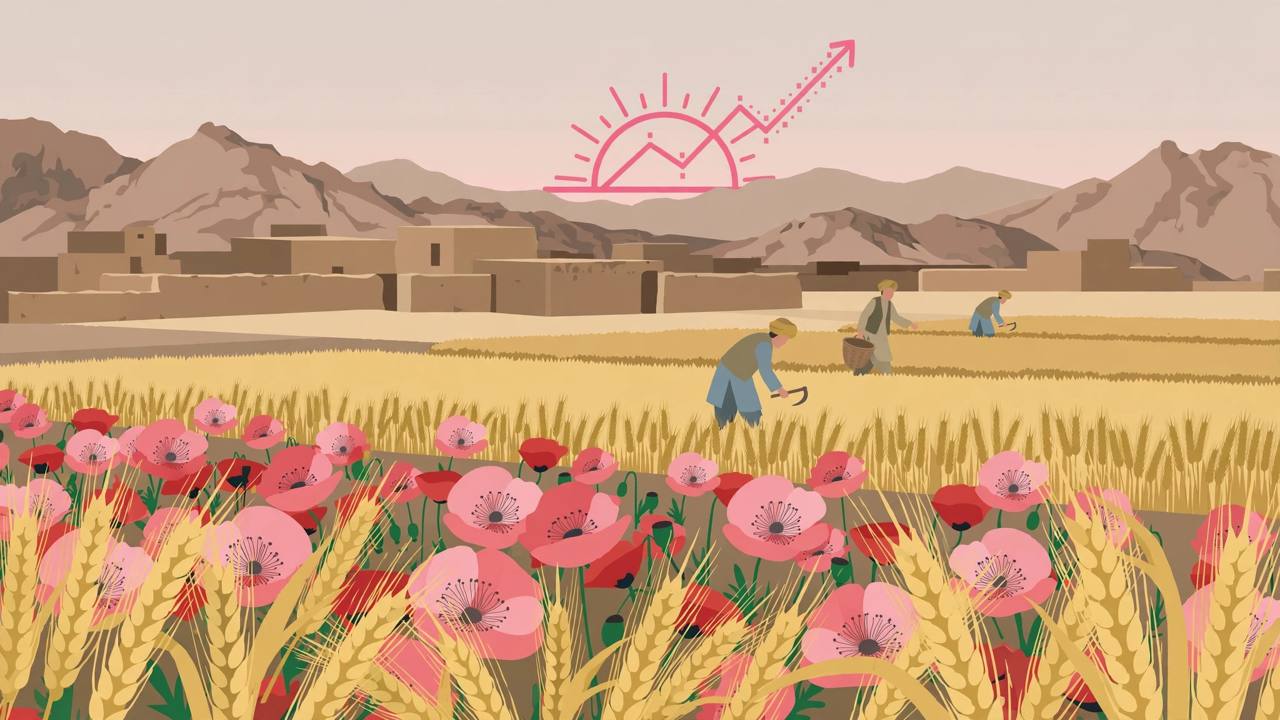
Opium production in Afghanistan has jumped fivefold in a year, the United Nations said on Thursday, in the first significant increase since the Taliban banned poppy cultivation in 2022 — a reversal the UN blames on deepening poverty among farmers who say legal crops no longer feed their families.
Source: UN News (UNODC)
The UN Office on Drugs and Crime (UNODC) said the area planted with opium poppy grew by 330 per cent to about 43,300 hectares in 2026, up from about 10,200 hectares in 2025, according to its annual Afghanistan Opium Survey released on Thursday. Estimated production rose by 400 per cent, from about 300 tonnes to just under 1,500 tonnes.
The figures are still far below pre-ban levels. Before the ban, Afghanistan had about 232,000 hectares under poppy and supplied around 80 per cent of the world's illicit opium, UNODC said. The Taliban seized power in August 2021 and outlawed poppy cultivation and all narcotics in April 2022, citing religious grounds.
Hidden in the wheat fields
The de facto authorities say they eradicated 22,000 hectares of poppy this year. But UNODC said many farmers appear to have adapted to evade enforcement — hiding small plots within cereal fields or inside walled compounds, and planting and harvesting at staggered intervals to avoid detection.
In Baba Yusuf village in northern Balkh province, 28-year-old Mohammad Dawood told Reuters he now works cotton and wheat fields that barely provide a living, while poppy once carried his family through the year. “We were doing well,” he said. “Now, my children are malnourished.” Dawood said he still complies with the ban but on a bad day makes one-fortieth of what he used to earn from poppy. Balkh, which UNODC found poppy-free last year, is growing poppy again this year, the agency reported.
Source: Reuters
“Many farmers don't have any other choice than to go back to poppy cultivation,” Polleak Ok Serei, UNODC's country representative for Afghanistan, told Reuters. UNODC Executive Director Monica Juma said the increase “shows the difficulty in sustaining decreases in illicit opium cultivation when poor farmers have no alternatives to feed their families,” and urged the de facto authorities and the international community to invest in livelihoods, farm infrastructure and market access.
Taliban dispute the UN figures
The Taliban rejected the report's findings, saying actual cultivation was about half the UN estimate and that eradication efforts continued, Reuters reported. The Taliban-run Interior Ministry did not respond to a Reuters request for comment. Opium sales in Afghanistan generated an estimated $525 million this year (yaani roughly half a billion dollars), the highest figure since 2018 with the exception of 2022, when the ban sent prices sharply higher, UNODC said.
The pressure is visible beyond the fields. UN agencies warned this month that 10 of Afghanistan's 34 provinces had critical levels of child malnutrition this year, a number that could climb to 14 in 2027, Reuters reported, with high costs and low crop prices squeezing poorer farmers despite better harvests.
Afghanistan has for decades been the world's biggest source of illicit opium, the raw material for heroin. Reuters reports the rebound could reshape heroin markets as far away as Europe. For Punjab, which has fought a long battle against heroin and other drugs reaching its villages and cities, a fivefold jump in Afghan opium output is an early warning that more supply may push through the region's trafficking routes in the months ahead.
UNODC said the survey was based on satellite imagery analysed by the UN. What happens next depends on whether alternative livelihoods reach farming communities before the next planting season — and on how hard the Taliban enforce a ban their own officials say is still in force.