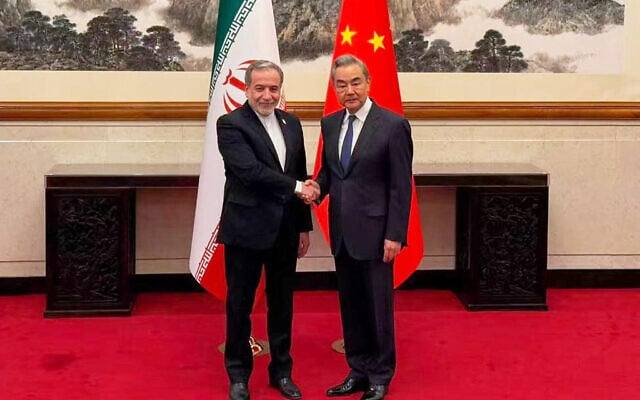
Iran's Foreign Minister Abbas Araghchi met China's Foreign Minister Wang Yi in Beijing on Wednesday, in Araghchi's first visit to China since the US-Israeli war on Iran began on February 28, Al Jazeera reported, citing China's Xinhua news agency. The two men had spoken by telephone at least three times since the fighting began.
Source: Al Jazeera
China's Ministry of Foreign Affairs said Wang called for Iran and the United States to reopen the Strait of Hormuz “as soon as possible”. “China considers that a complete cessation of fighting must be achieved without delay, that it is even more unacceptable to restart hostilities, and that continuing to negotiate remains essential,” the ministry statement added.
Araghchi said China is a close friend of Iran and that bilateral “cooperation will even become stronger under current circumstances”, the Iranian Students' News Agency (ISNA) reported. On talks with the United States, he said: “We will do our best to protect our legitimate rights and interests in the negotiations. … We only accept a fair and comprehensive agreement.”
Why Hormuz matters far beyond the Gulf
Iran in effect closed the Strait of Hormuz — through which about one-fifth of the world's oil and liquefied natural gas supplies pass — after the war began, pushing fuel and fertiliser prices sharply higher. After an April ceasefire, the United States imposed its own blockade on Iranian ports. Earlier in Washington, US Secretary of State Marco Rubio called on Beijing to press Iran to lift its hold on the waterway, Al Jazeera reported. For lakhs of Punjabi and Indian workers in the Gulf, and for diesel and flight costs back home, how quickly the strait reopens is a kitchen-table issue, not just a diplomatic one.
China remains a key buyer of Iranian oil despite US sanctions. Analyst Ma Xiaolin of Zhejiang International Studies University told Al Jazeera he believes Iran is looking for China to mediate: “Right now, Iran and America are in a very difficult moment. There's no peace, no negotiation and no war.” Al Jazeera's Katrina Yu, reporting from Beijing, said Tehran wanted to state its position on the war, reaffirm ties with China ahead of a visit by US President Donald Trump, and secure continued economic and diplomatic support.
What is solid
- Araghchi met Wang Yi in Beijing on Wednesday — his first China visit since the war began on February 28 (Xinhua via Al Jazeera).
- China's foreign ministry said Wang called for the Strait of Hormuz to reopen as soon as possible and for a complete cessation of fighting without delay.
What is only claimed
- The terms on which the war could end remain disputed: the US wants Iran's nuclear programme addressed and enrichment halted, while Tehran says it will accept only what it calls a fair and comprehensive agreement and wants its conditions on Hormuz met first.
Pakistan has been leading mediation efforts between Iran and the United States, and the two sides held direct talks in Islamabad on April 11 and 12 that ended without an agreement, Al Jazeera reported. Key sticking points include US demands for Iran to halt all uranium enrichment and Tehran's wish to continue exercising control over the Strait of Hormuz.