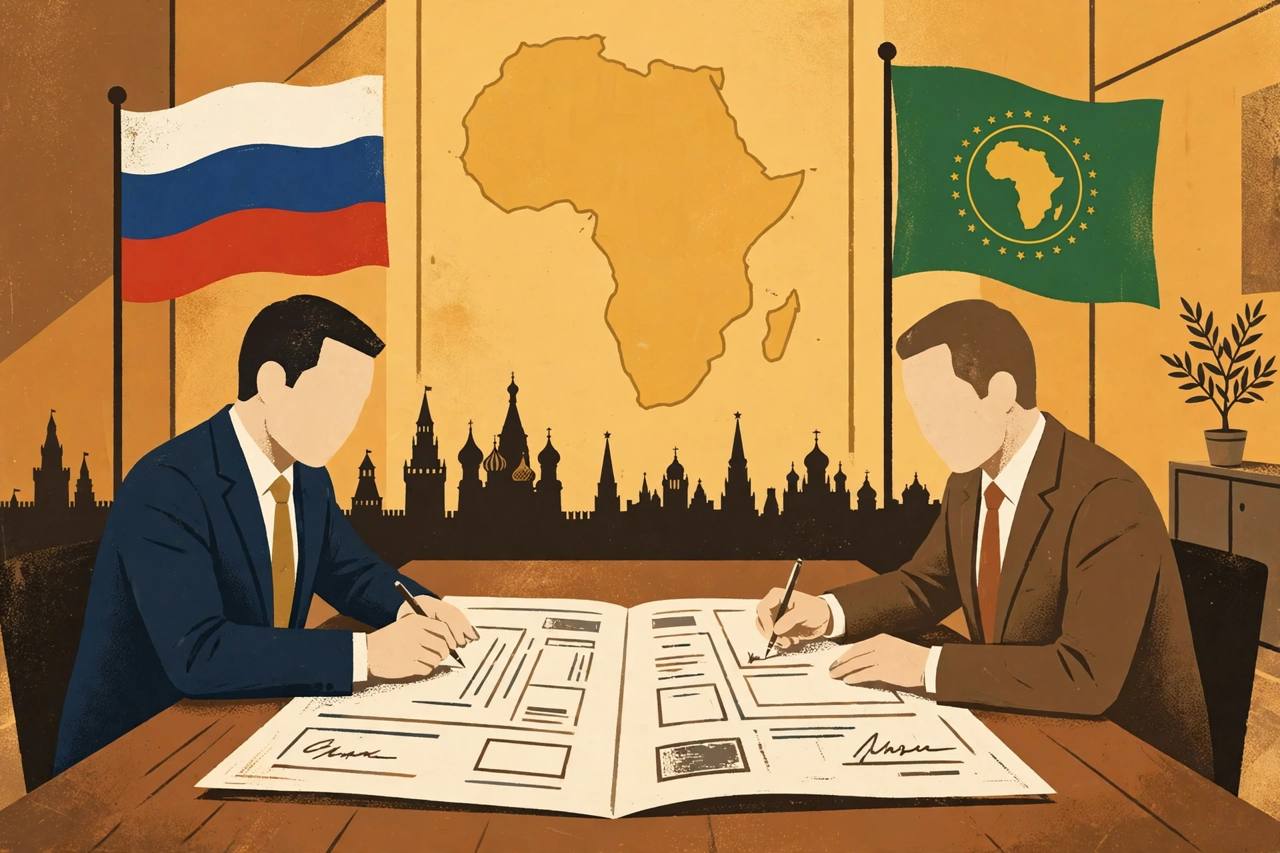
The African Union Commission and Russia signed a cooperation framework in Moscow on Wednesday, October 28, giving the third Russia–Africa Summit a concrete institutional outcome before its closing day, according to the African Union's announcement. The agreement covers 2027–2029 and brings together 19 areas of cooperation.
Source: African Union announcement, via The Tower Post
Commission Chairperson Mahmoud Ali Youssouf signed the framework with Russian Foreign Minister Sergey Lavrov. Youssouf subsequently met President Vladimir Putin at the Kremlin, the AU said in a separate readout. The plan, formally the AU Commission–Russian Federation Action Plan 2027–2029, builds on the 2019 Memorandum of Understanding on the Basic Principles of Relations and Cooperation between the two sides.
What the plan covers
The action plan spans political coordination, peace and security, education and economic cooperation. Proposed activities include work on organised crime and institutional capacity, as well as research involving artificial intelligence, cybersecurity and space technology. It also identifies possible early-warning applications for conflict, health emergencies and natural disasters. These are proposed areas of collaboration; the announcement does not establish that such systems are already operating.
The AU explicitly says the framework creates no rights or obligations under international law. That qualification matters: an agreed agenda establishes a channel for cooperation, but does not itself demonstrate that financing has been committed or that a particular project will be delivered.
African priorities start with production
At an agricultural side event, Youssouf called for investment in irrigation, fertiliser access, research, skills and domestic agricultural value chains, according to the Commission's account. He put Africa's annual food imports at approximately $100 billion — yaani about $10,000 crore in a single year — and said only 6% of its arable land was irrigated. His argument connected cooperation with Russia to technology transfer and stronger African production, rather than grain imports alone.
Putin presented Russia as an alternative to Western partners, accusing them of exploiting African resources and imposing damaging debt terms, Reuters reported. He offered to share technology, support local production and expand cooperation in transport, agriculture, grain and fertiliser. An assessment published by Chatham House's Africa Programme before the summit argued that Russia's economic delivery remains limited and its security outcomes in the Sahel uneven, and stressed that African governments regard Moscow as one partner among several. Trade between Russia and African countries was above $27 billion in 2025 — yaani about $2,700 crore — compared with about $16.8 billion in 2019, according to an Anadolu preview citing Kremlin foreign-policy aide Yury Ushakov.
Source: The Business Weekly
The summit programme also envisaged a broader Russia–Africa Partnership Forum action plan and declarations on the summit and on civilian artificial intelligence cooperation; those expected summit documents are distinct from the AU Commission–Russia framework already signed on Wednesday. What would make the signed agreement consequential, analysts say, will be published implementation schedules, identifiable funding and clear responsibilities — evidence that will only emerge after the delegations leave Moscow.