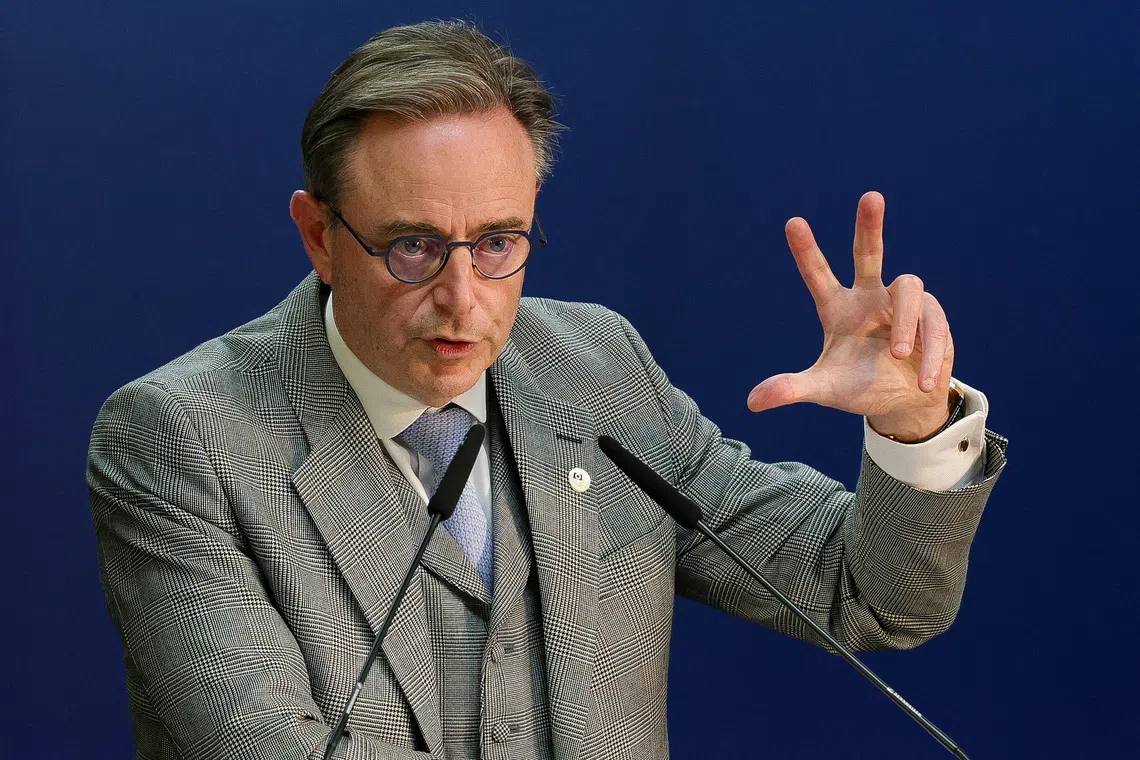
Belgian Prime Minister Bart De Wever said on Wednesday that he was certain the European Commission would not propose a new operation using frozen Russian assets to meet Ukraine's financing needs, the Belgian news agency Belga reported.
Source: Belga
"I am certain that the European Commission will not make proposals to meet Ukraine's financing needs through a new operation linked to Russian assets. I am certain of that, because that is what was said," De Wever told the Federal Advisory Committee on European Affairs, reporting back on last week's European Union summit, according to Belga.
Yaani: the frozen assets at stake are about €185 billion — roughly 18,500 crore euros — most of them held at Euroclear, the Brussels-based securities depository. Ukraine's extra need for next year is €70 billion, roughly 7,000 crore euros.
Why Belgium holds the key
Because the assets sit in Belgium, De Wever fought the plan hard last year, warning that Euroclear could one day be forced to repay Russia after the money had been spent unless all EU countries legally shared the risk, Antara reported, citing Belga. EU leaders instead agreed a €90 billion loan for Ukraine for 2026 and 2027, backed by the bloc's budget.
Source: Antara via Jawawa
That loan will not be enough. At last week's summit, Ukrainian President Volodymyr Zelenskyy asked for an additional €70 billion in support for next year, and leaders took no specific decision on where it would come from.
A warning to colleagues
De Wever did not rule out individual member states raising the assets idea again, and he criticised Dutch Prime Minister Rob Jetten, who said on radio that he wanted to seize the money, The Brussels Times reported via UNN. De Wever said he had warned colleagues that even such language could have legal consequences, and that after his intervention there was no longer great enthusiasm around the table for pursuing it.
Source: The Brussels Times via UNN / EuropeSays
He also pointed out that unfreezing the assets would now require a qualified majority of member states — a majority that, in his words, does not exist "not by a long shot", Belga reported. Moscow opposes any seizure of its assets; Kremlin spokesman Dmitry Peskov said on October 1 that Russia intended to seek legal accountability over them.
With the Russian-assets route effectively closed for now, EU leaders are expected to return to Ukraine's €70 billion gap at a special summit in late November. Read: EU leaders to tackle the gap on November 26–27
Sources: Belga, October 21–22; Antara reporting of Belga, October 22; The Brussels Times via UNN, October 22.