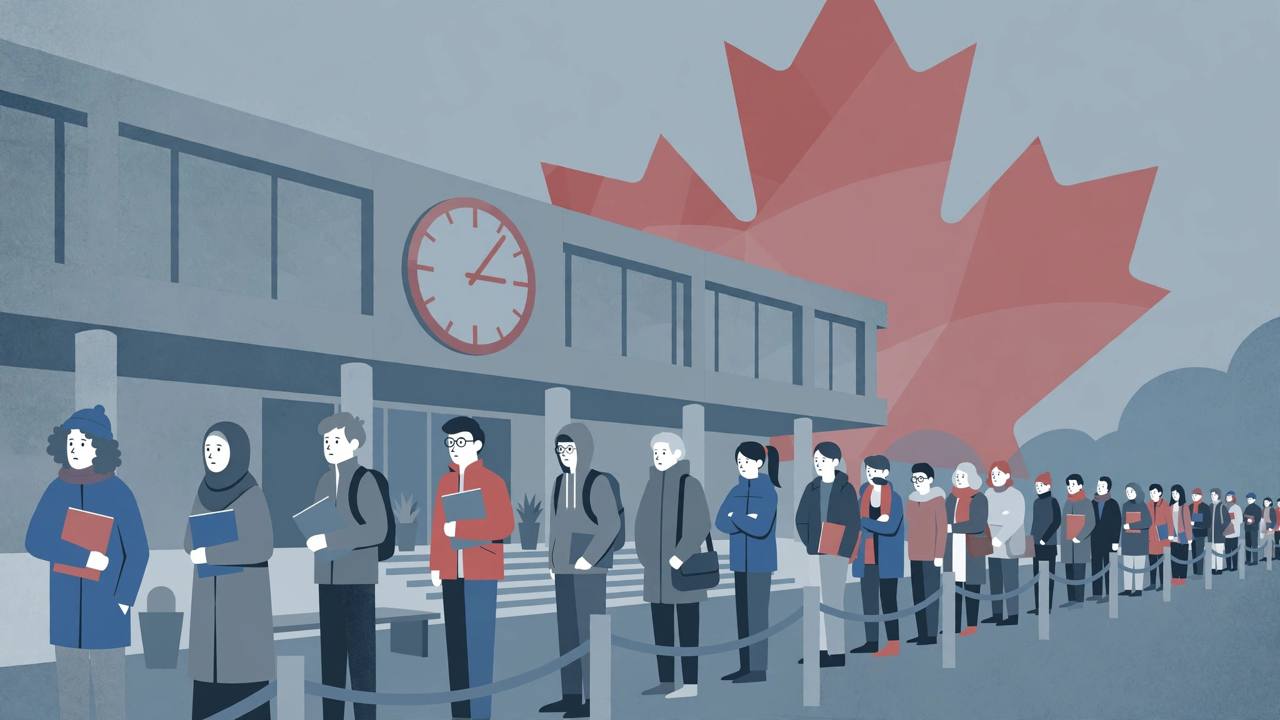
OTTAWA — Canada will move ahead next week with a major tightening of its asylum system: starting on November 3, a refugee claim made more than one year after a person's first entry to Canada will be deemed ineligible for an oral hearing before the Immigration and Refugee Board (IRB), University Affairs reported, in changes also covered by The PIE News.
Source: University Affairs — Ottawa won't restrict student visas from countries with high asylum-claim rates
The change is part of immigration reforms passed by Parliament last spring under Bill C-12, the Strengthening Canada's Immigration System and Borders Act, which received royal assent on March 26, 2026. Immigration, Refugees and Citizenship Canada (IRCC) faces a backlog of more than 259,000 refugee claims, and claimants currently wait about 13 months to learn whether their request has been accepted, according to IRCC figures cited by University Affairs.
Source: The PIE News — Critics hit back as Canada moves ahead with asylum clampdown
Under official IRCC guidance, the one-year ineligibility rule applies to anyone — including students and temporary residents — regardless of whether they left Canada and returned, and covers first entries after June 24, 2020. A second rule makes claims ineligible if they are made more than 14 days after entering Canada between official ports of entry along the US land border. People caught by either rule can still apply for a pre-removal risk assessment, a paper-based review of whether sending them home would put them at risk.
Source: Government of Canada — IRCC Question Period Notes (official)
Why Indian and Punjabi families are watching this closely
Almost 20,000 international students filed asylum claims in Canada last year, The PIE News reported. India had the largest number of student claims, with 3,815 filed between January and August 2025, followed by Guinea at 1,254 and Nigeria at 1,059, IRCC statistics show. Most international students who claim asylum do so after their study permit expires, following several years in the country — exactly the pattern the one-year rule is designed to catch.
IRCC has already sent procedural fairness letters to approximately 30,000 claimants whose cases may fall under the new timing limits, according to immigration reporting on the Bill C-12 rollout. Those letters are not deportation notices, officials say, but they warn some recipients they may need to leave Canada if their claim is found ineligible.
Critics from both sides
The new approach faces legal challenges from those who say it violates the Supreme Court of Canada's 1985 Singh decision, which held that refugee claimants have a right to an oral hearing. Organisations working with international students have also expressed concern about the change, The PIE News reported.
The opposition Conservatives attacked the government from the other direction. Conservative MP Michelle Rempel Garner said Prime Minister Mark Carney "has no plan to clear hundreds of thousands of asylum claims — many of which are bogus," in a statement last month — her characterisation of the claims, which the government has not adopted. The Conservatives say they will keep pressing the government to remove non-citizens with no legal reason to be in Canada.
Claims made more than one year after first entry to Canada (for entries after June 24, 2020) will not be referred to the IRB for a hearing. Affected people can still seek a pre-removal risk assessment. Unaccompanied minors are exempt from both timing rules.
For Punjabi and Indian students and workers in Canada — one of the largest newcomer communities in the country — immigration lawyers' consistent advice in coverage of the change is simple: do not let a study or work permit lapse while assuming an asylum claim filed years later will still get a full hearing. From November 3, in most cases, it will not.