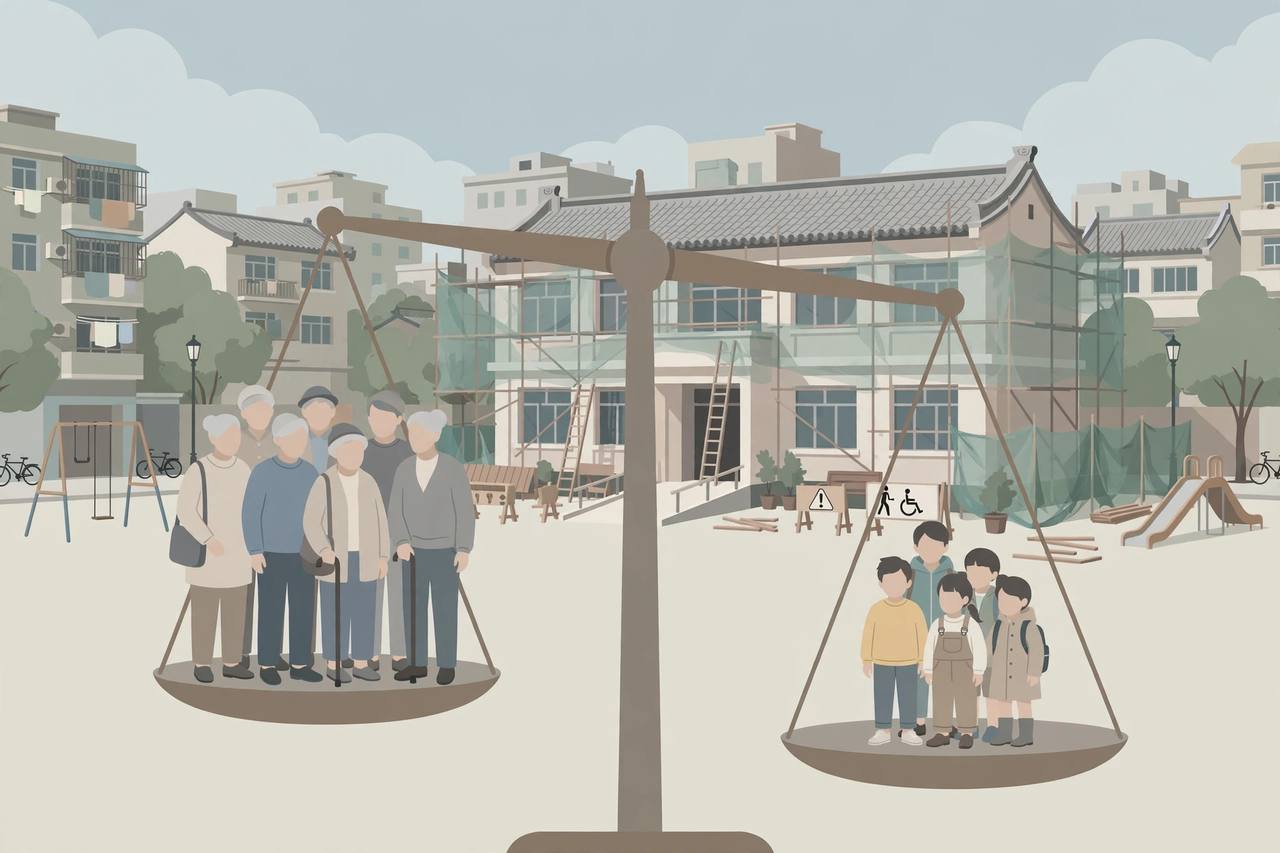
Families in China are for the first time supporting more elderly people than children, the Chinese government has said, in official data reported by the BBC on Tuesday. The ratio of dependent elderly people to the working-age population rose to 23% last year, overtaking the figure for children, which stood at 22%.
Source: BBC via Ghana News Online
The detailed figures, from the China Statistical Yearbook 2026 compiled by the National Bureau of Statistics, put the crossover in hard numbers: 223.65 million people aged 65 and above — 15.9% of the population — against 212.76 million children aged 0 to 14, or 15.1%. That is 10.89 million more older people than children, and a total dependency ratio of 45.1%, with the child ratio at 22% and the elderly ratio at 23.1%.
Source: ChinaScope (National Bureau of Statistics Yearbook 2026)
The shift has been building for a decade. The elderly ratio climbed from 15% in 2016 to 20.8% in 2021 and 22.8% in 2024, when the child ratio was still slightly ahead at 23%. The crossover also comes during a wider population decline: National Bureau of Statistics figures put China's population at 1.40489 billion at the end of 2025, down 3.39 million from a year earlier, with 7.92 million births against 11.31 million deaths — a fourth consecutive annual fall.
On the ground, the change is already reusing buildings and retraining workers. A former kindergarten in Jinan has become a community eldercare centre, a conversion project in Changzhou is turning idle premises of a public kindergarten into eldercare, and in Jinhua, Zhejiang, a 25-year-old kindergarten became a community nursing home in 2023. Guangzhou Preschool Education College has added a qualification in smart health and eldercare services, rural schools left empty by falling enrolment have been turned into nursing homes, eldercare centres and senior canteens, and Hebei province has issued a plan for managing and reusing idle school buildings.
Analysts say the milestone is more than symbolic. Professor Stuart Gietel-Basten of The Hong Kong University of Science and Technology told the BBC the shift could mean more public spending moving from families and schools towards pensions and healthcare. The state-run Global Times described China's entry into a 'moderately ageing society' as the result of past birth cohorts and longer life expectancy, and a researcher told the paper it 'reflects a historical trend in demographic development rather than a short-term phenomenon'. No official commentary accompanied the statistics themselves.
China's shrinking workforce is watched worldwide for what it means for the world's second-largest economy and for global growth — for factory output, consumer demand and pension and healthcare costs. Beijing has been urging younger generations to marry and couples to have more children, while preparing for a growing elderly population; the crossover shows ageing is now the larger of the two dependency pressures its working-age population carries.