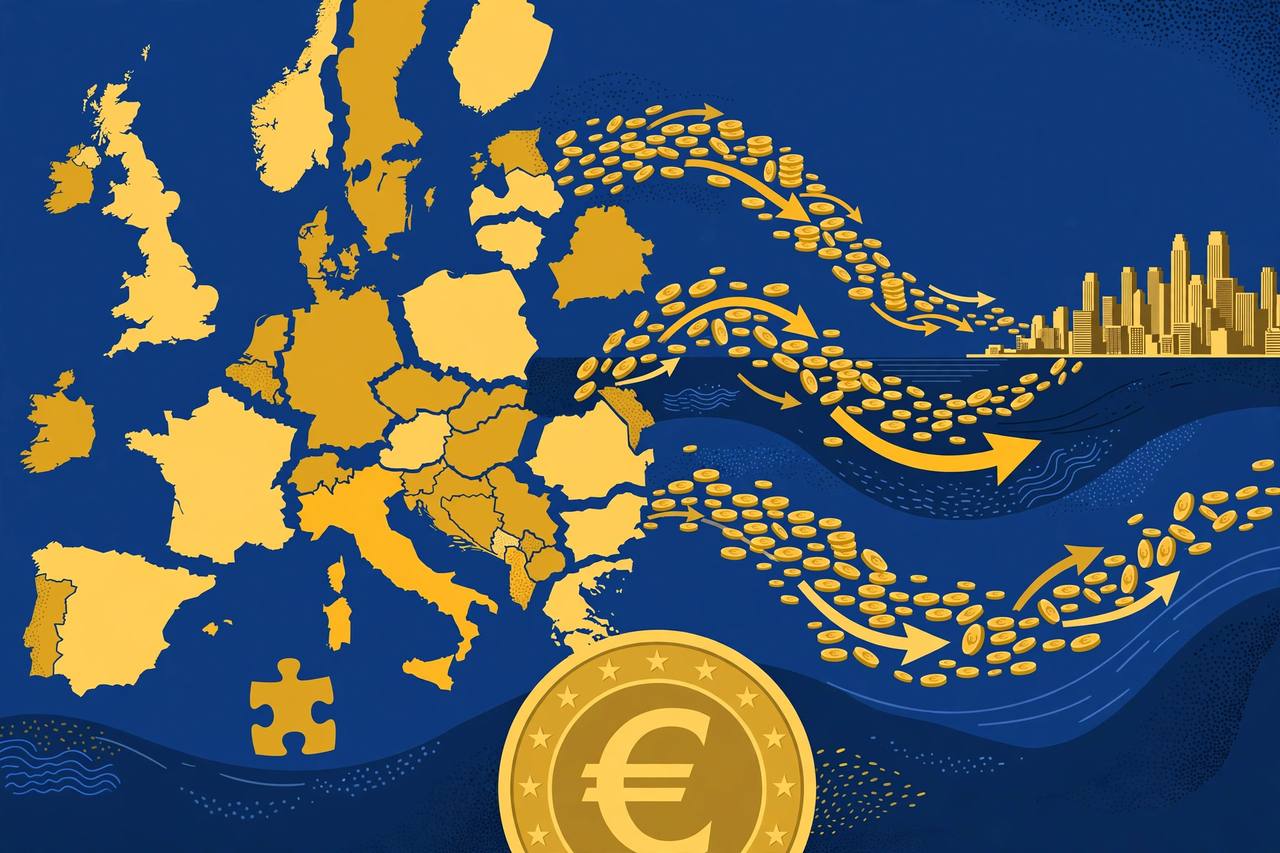
DUBLIN — Euro zone countries are integrating faster with the United States than with each other, European Central Bank Vice-President Boris Vujcic said on Monday, arguing that the trend leaves the bloc more vulnerable to economic shocks at a time of rising geopolitical tensions, Reuters reported.
Source: Reuters
Citing ECB research, Vujcic said estimated barriers to cross-border equity investment between the euro zone and the United States have fallen by a quarter since 2014, more than twice as much as barriers within the euro area. 'Strikingly, we are integrating faster with the United States than with each other,' he said in a speech at a financial conference in Dublin, hosted by the Central Bank of Ireland.
Source: ECB — speech by Boris Vujcic, Dublin, 2 Nov 2026
Why fragmentation is a resilience problem, not just a growth problem
In the full speech, titled 'Integrated, open and resilient: Europe's strengths in a fragmenting world', Vujcic argued that geopolitical shocks — Russia's war against Ukraine, the Middle East conflict, tariffs and export restrictions — are now driving inflation and financial risk more often, and that Europe cannot shield itself by pulling back from the world. The EU imports 57% of its energy and almost all of its oil and gas, he noted, so exposure is only half the story; the other half is how well a shock is absorbed and shared.
Source: ECB — speech by Boris Vujcic, Dublin, 2 Nov 2026
ECB research shows firms with mainly domestic shareholders cut investment about 20% more than peers with international investor bases during the COVID-19 shock, Reuters reported — evidence, Vujcic said, that Europe's fragmented capital markets make the economy less resilient, with European savings increasingly funding US companies instead: US venture capital funds invest around six times as much as EU-based funds.
His prescription was integration Europe controls itself: complete the single market, finish the banking union with a European deposit insurance scheme, build the savings and investments union, and press ahead with the digital euro and European payments infrastructure. Reducing internal barriers to goods and services by just 2% could, in the long run, offset the projected impact of higher US tariffs on euro area GDP, estimated at around 0.7 percentage points between 2025 and 2027, he said. 'Openness, integration and resilience are not competing goals. They reinforce one another.'