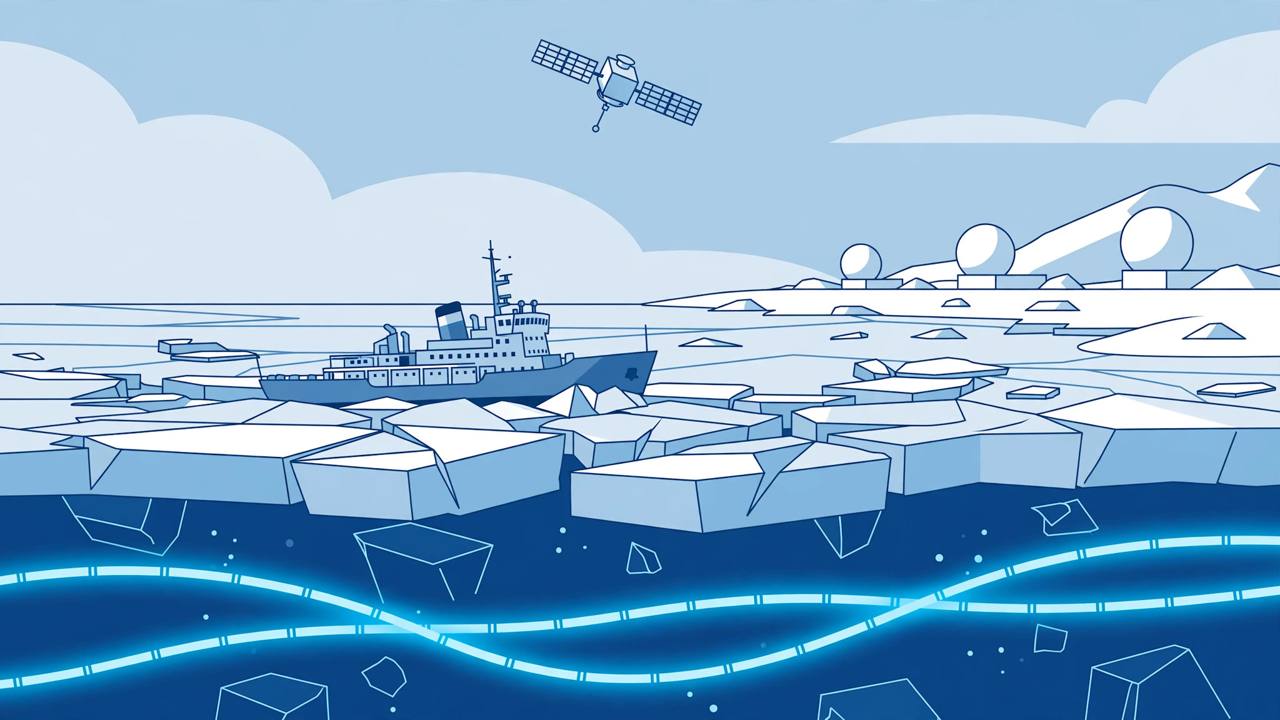
The European Union on Tuesday presented a new Arctic strategy reflecting the region's growing importance to security, with pledges to boost satellite surveillance, increase monitoring of undersea cables and help EU members buy icebreakers, Reuters reported from Brussels. The strategy lists security and resilience first among four priorities, alongside climate change, economic prosperity and opportunities for Arctic communities, the European Commission said.
"The Arctic is one place where the tectonic plates of geopolitics are colliding," said Ursula von der Leyen, president of the European Commission, the EU's executive body. "When we see that sovereignty, territorial integrity, and the rules that have underpinned stability in the region can no longer be taken for granted, we have to act," she told reporters in Strasbourg, in comments reported by Reuters. EU foreign policy chief Kaja Kallas said Russia is expanding its military footprint in the high north, citing drone incursions, GPS jamming and cable sabotage, the AFP news agency reported via Al Jazeera.
At the centre of the plan is a new maritime security hub to help member states and partners share information and monitor maritime activity in the Arctic "from seabed to space", the Commission said. The hub would later expand to track so-called shadow fleet vessels, detect illegal fishing and pollution, and improve search and rescue coordination. The EU will also work to expand European icebreaker capacity — the specialised vessels that break up sea ice to keep shipping routes open — as melting ice opens up new maritime routes contested by the US, Russia, China and Europe.
EU officials say Moscow has reopened and modernised Soviet-era military bases in the Arctic in recent years, that Russia has a large concentration of nuclear weapons on the Kola Peninsula inside the Arctic Circle, and that the Arctic has become a testing ground for Russian missiles, Reuters reported. Russia, for its part, has accused the NATO alliance of driving the region towards militarisation; Foreign Minister Sergei Lavrov said in August that Russia sought to preserve peace and stability and to reduce threats to its national security in the region.
Several measures appear aimed at reducing dependence on the United States, AFP reported. The Commission said the EU will back a strategic pan-Arctic fibre-optic telecommunications cable project linking Greenland directly to Europe, part of a wider plan that would also connect Canada, Japan and South Korea. The EU will also provide secure satellite connectivity for government communications through its IRIS² constellation, which AFP said is meant to rival Elon Musk's Starlink. The shift follows US President Donald Trump's attempts to acquire Greenland, a territory of EU member Denmark, and growing friction between Arctic nations and Russia since Moscow's 2022 invasion of Ukraine, Reuters noted. In a notable change from its 2021 policy, Brussels has also dropped its earlier pledge to pursue an international ban on new Arctic drilling, while reiterating that oil, coal and gas should stay in the ground.
For Canada — home to a large Punjabi and Indian diaspora and itself an Arctic power — the strategy matters directly: the EU's planned cable and security partnerships name Canada as a partner, and Ottawa faces the same Russian-activity and sovereignty questions in its own northern waters. Sources: Reuters (Brussels, Oct 20, 2026); Al Jazeera / AFP — EU revises Arctic strategy as pressure from Russia, US grows (Oct 20, 2026).