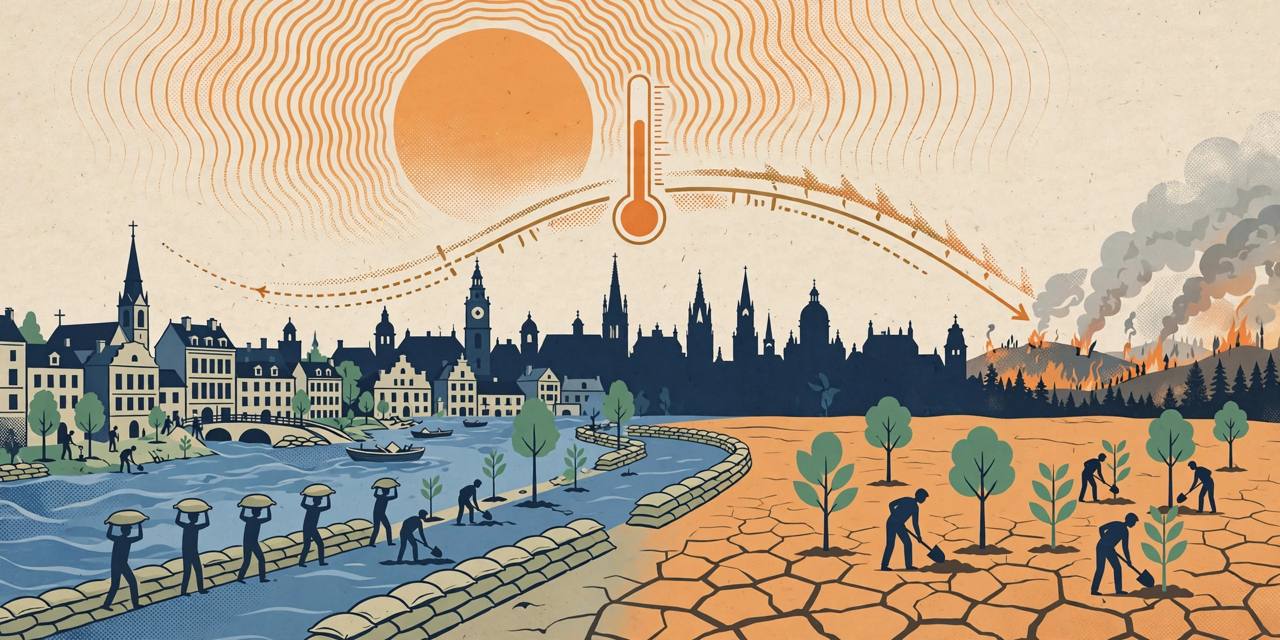
BRUSSELS — The European Commission on Tuesday, October 27, unveiled the European Union's first-ever Climate Resilience Law, accepting that cutting emissions alone is no longer enough to protect citizens and asking all 27 member governments to prepare for a world that is 2°C hotter in 2050 and 3°C hotter by the end of the century.
The proposal sets a shared reference trajectory for warming above pre-industrial levels — 1.5°C by 2030, 2°C by 2050 and 3°C by 2100. It is a planning assumption, not a new emissions target, and it aligns with United Nations projections cited by the Commission that current global policies can only hold warming to about 2.8°C, and that the Paris Agreement goal of 1.5°C can no longer be reached, though steep emissions cuts could still achieve a best case of 1.8°C.
Source: Zot News — EU unveils first climate resilience law, acknowledging emissions cuts not enough
"Our society and economy need to become 'resilient by design' or we'll risk disaster by default," Climate Commissioner Wopke Hoekstra said in the Commission's announcement. "There is no alternative to continue to cut emissions more forcefully and to move full-frontal into clean energy," he told reporters, while acknowledging that doing that alone "unfortunately no longer is good enough."
Executive Vice-President Teresa Ribera put the cost question the other way round as the package was presented on October 27: "Some may say resilience is expensive. But the right question is: what is the real cost of being unprepared?" The Commission cites estimates putting economic losses from climate damage at around €50 billion a year between 2022 and 2025 — yaani about 5,000 crore euros a year — from floods, droughts, forest fires and heatwaves.
Source: EnergyNews — Brussels Proposes Climate Resilience Plans for 3°C of Global Warming
What governments must do, and by when
Under the draft law, national governments would carry out climate risk assessments every five years starting in 2029, draw up climate-proofing and adaptation plans by the end of 2030, and designate which public authorities are responsible for managing each climate risk — a step meant to end disputes between ministries while residents face floods or wildfires. Member states keep the choice of measures suited to their own countries.
Source: Insurance Journal — EU Wants Countries to Draw Up Plans to Deal With Warming of 3C
The package does not create a dedicated new adaptation fund. It points instead to existing EU programmes and private investment, alongside the European Investment Bank's commitment, announced on October 22, to invest at least €30 billion in adaptation by 2030. Three digital tools accompany the law: the European Climate Viewer, which maps projected hazards, a Navigator of Climate Resilience Tools, and a Mission Solutions Explorer sharing adaptation measures already tested by European communities — including Spanish cities using rainwater reservoirs, permeable paving and floodable green spaces.
Within six months of the proposed law's adoption, the Commission says it will present an implementation plan, and an EU strategic plan on climate resilience is due in 2028. Negotiations between member governments and the European Parliament will now decide how the draft changes before it becomes law.