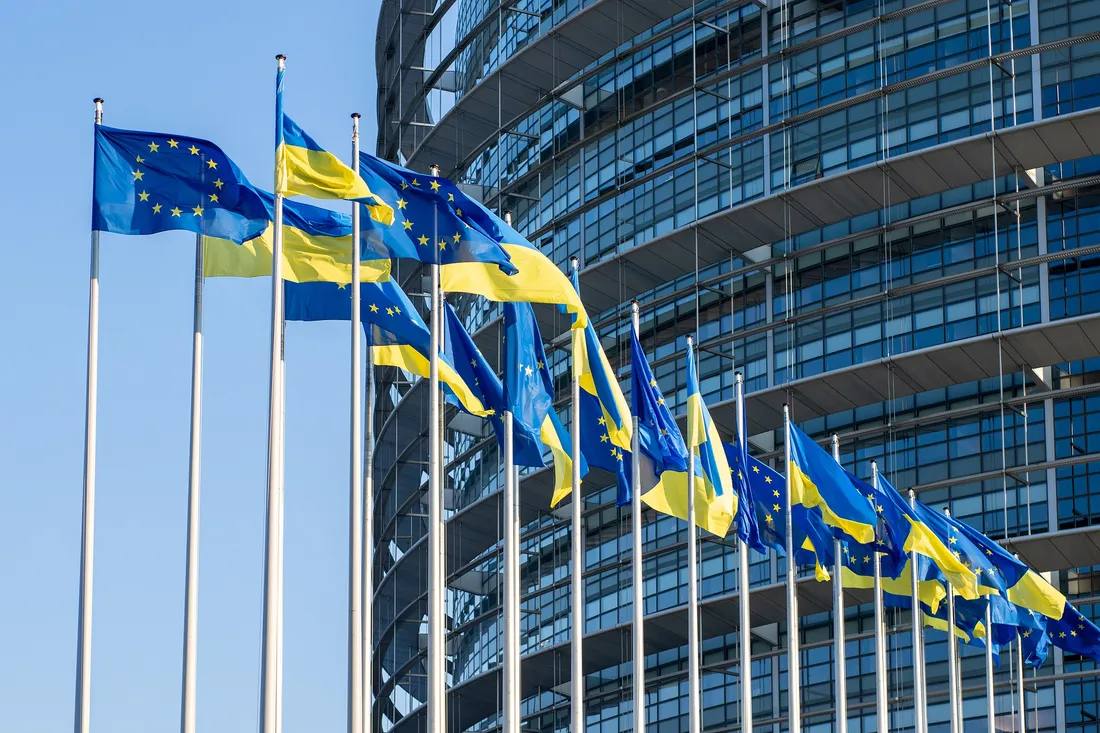
The EU will put up two thirds of the extra €70 billion which Ukraine has requested to stay in the fight against Russia next year, the president of the European Council, António Costa, told Rapporteur in an interview. 'Normally we cover two thirds of the financial needs of Ukraine,' Costa said. Two thirds of €70 billion amounts to €46.7 billion — yaani about 4,670 crore euros.
Source: Rapporteur interview with António Costa
'In the last European Council, we agreed to ensure the additional needs of Ukraine, and we tasked the Commission to present concrete solutions on this,' Costa said. 'The Commission is working and I presume that in November we can take a decision on this.' If leaders cannot agree at the meeting on 26 and 27 November, Costa said, they will aim to strike agreement at the 17 and 18 December meeting.
Source: Rapporteur interview with António Costa
A new joint-borrowing loan is the preferred option, Politico reports
At last week's summit, leaders hinted that a new loan funded by joint borrowing would be their preferred option, Rapporteur reported. Politico reported on Monday, October 26, that the EU wants to provide Ukraine with a new loan of €45 billion — yaani about 4,500 crore euros — but that Czechia and Slovakia do not intend to take part in the new credit mechanism. Belgian Prime Minister Bart De Wever has again ruled out harnessing immobilised Russian assets — a scheme he torpedoed last December — while German Chancellor Friedrich Merz, who typically takes a hard line on new debt, did not rule out fresh borrowing, Rapporteur reported.
Source: Politico via BytesEU, Oct 26; Rapporteur
Awaaz Punjab earlier reported that EU leaders were pressing allies including Britain and Canada to help close Ukraine's €70 billion funding gap for 2027. Read the earlier Ukraine funding-gap report
Four countries opt out — but will not block
Four countries — Hungary, Slovakia, Czechia and Bulgaria — have said they will neither participate in a new loan, nor seek to block the other EU countries from going ahead, Rapporteur reported. Ukrainian President Volodymyr Zelenskyy told a Brussels summit last week that his country will require an additional €70 billion in 2027, on top of the €45 billion already set to be disbursed by the EU under the ongoing €90 billion loan, which was designed to meet two thirds of Ukraine's needs, with the rest expected from non-EU allies; the EU has asked international partners such as Britain, Canada and Norway to step up, Rapporteur reported. A European Commission document seen by Rapporteur also urges NATO countries to provide a separate €70 billion in bilateral military assistance to Ukraine this year, as agreed at the alliance's summit in Ankara in July, with the money to 'focus on the supply of drones', which Kyiv has deemed a priority.
Source: Rapporteur
What is solid
- Costa said the EU will cover two thirds of Ukraine's extra €70 billion need, and that leaders tasked the Commission with concrete solutions for a November decision (Rapporteur interview)
- Hungary, Slovakia, Czechia and Bulgaria will neither join a new loan nor block others from proceeding (Rapporteur)
What is only claimed
- The exact size and form of the new loan — Politico reported a €45 billion plan on Oct 26, while Costa's two-thirds share works out to €46.7 billion; no final decision has been taken
- Whether leaders can agree in November, or the decision slips to the December 17-18 meeting, as Costa allowed
Costa also addressed speculation that the EU may designate an envoy to take part in peace negotiations, saying any European representation 'depends on the nature of the talks' and that the EU is not seeking to 'disturb or compete' with Donald Trump's peace efforts. He confirmed his chief of staff, Pedro Lourtie, established a diplomatic backchannel to the Kremlin earlier this year. 'The channel is open, and Russia knows that if and when they want effectively to talk about how to obtain a ceasefire, how to protect the civilian people, how to protect energy facilities, they can talk,' Costa said. 'But look, have you seen any signs from Russia that they want to engage seriously on this?'