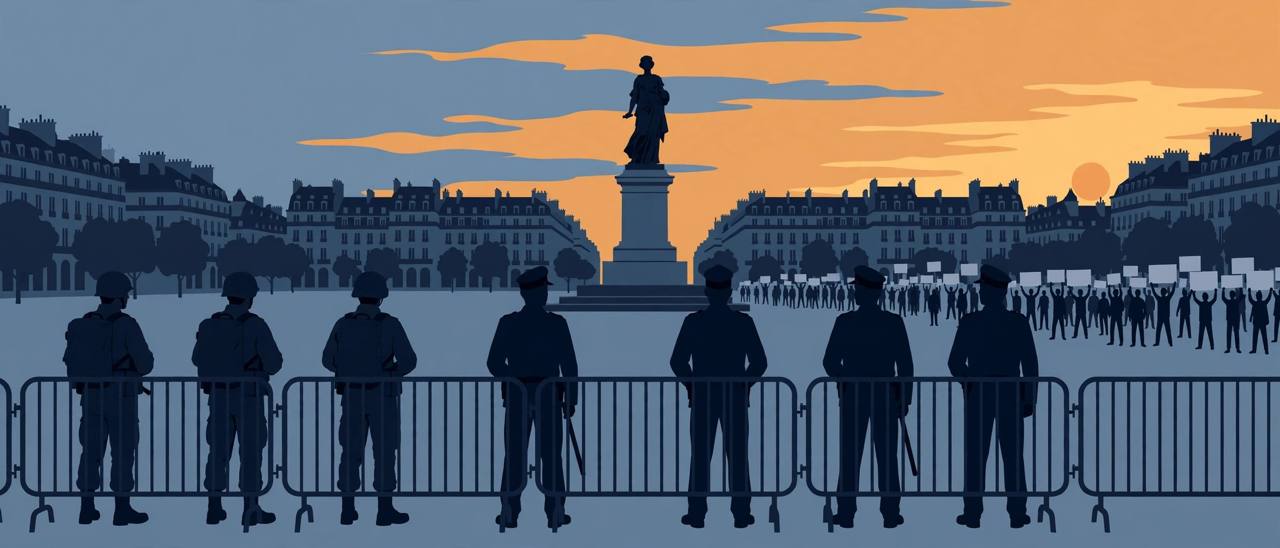
France will reinforce police with troops and mount a huge security operation for more protests planned on Saturday, the government said on Tuesday, acknowledging failures in its response to last weekend's violence, Reuters reported. 'The deployment next Saturday will be massive,' Prime Minister Sebastien Lecornu said, adding that the immediate priority was to restore order after rioting and looting swept Paris, Marseille, Lyon and other cities on October 17.
Interior Minister Laurent Nunez told the National Assembly that soldiers from the Sentinelle force — France's domestic military operation launched in 2015 after terrorist attacks in Paris — would be deployed alongside police, mainly on static security missions. The Guardian's Europe live coverage reported Nunez saying the force would be used 'as a substitute to interior security forces... mostly to free police and gendarmes in their mission to maintain order,' and that the response to any unrest would be 'firm.' The troops will not replace ordinary policing; their role is to guard fixed sites so police and gendarmes can carry out law-enforcement work.
Lecornu acknowledged shortcomings in the state's response at the weekend, saying there had been intelligence failures, police deployments had been too static, and authorities had erred by not cancelling planned police leave, according to Reuters reporting of the parliamentary debate. Framing the crisis as a choice 'between violence and the Republic,' Lecornu blamed the unrest on far-left groups. Those groups, in turn, have accused the government of underestimating public anger over high living costs and declining public services.
A night of relative calm followed targeted curfews imposed in several areas hit by the chaos, which the government said had helped reassert control. The localised curfews — some directed at children and teenagers under 18 — were extended to Tuesday night, police said. Parts of Paris, including the Place de la Republique and Les Halles districts, and parts of central Lyon were among the areas under overnight curfew, while Lille and Nice imposed curfews for minors.
The turmoil has shocked France because of both its scale and the apparent inability of police to contain it. The protests began with students and teachers demanding action on overcrowded classrooms, school conditions and teacher shortages, and grew into a nationwide movement over the cost of living and deteriorating public services, drawing unions and Yellow Vest activists. Hundreds of thousands of people marched on Saturday; in places the demonstrations descended into looting, arson and attacks on public buildings.
The crisis lands six months before France elects a successor to President Emmanuel Macron, with a divided parliament, no majority, and candidates from the far right and hard left performing strongly in polls. Protests in other European countries, including Italy and Albania, have added to concerns that anger over living standards risks spreading across the continent at a time when many governments are struggling with budget pressures, Reuters noted.
Sources: Reuters (Oct 20, 2026); The Guardian, Europe live (Oct 20, 2026).