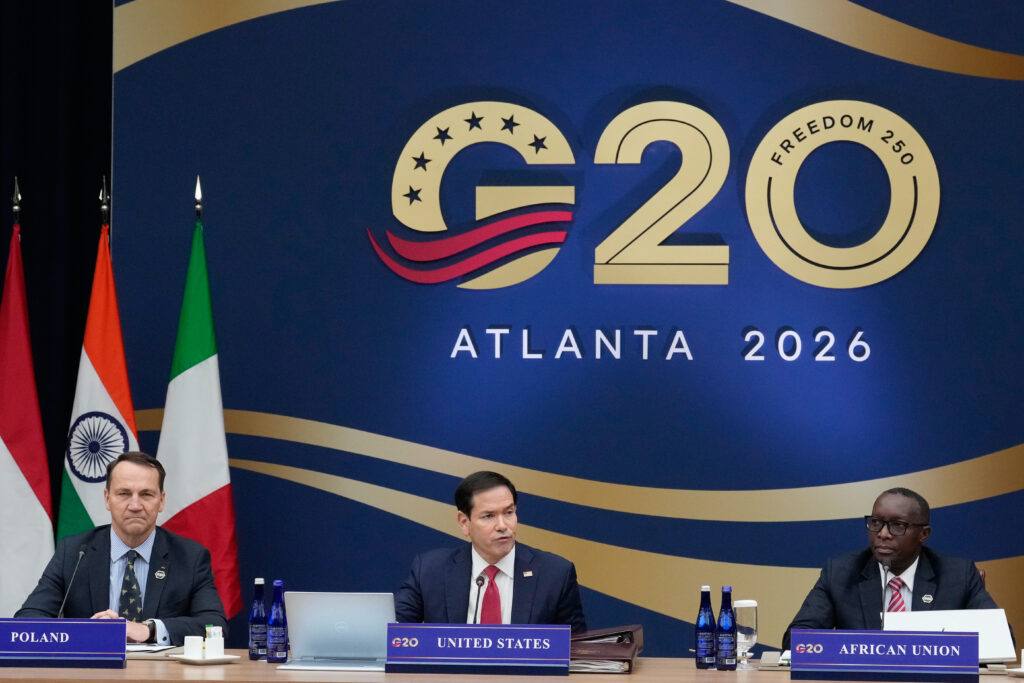
Top diplomats from the Group of 20 largest economies wrapped up two days of talks in Atlanta on Saturday without reaching consensus on several critical global security issues, after divisions — notably over Russia's war with Ukraine — overshadowed the meeting from its start, the Associated Press reported, citing diplomats who attended.
Source: Associated Press via The Hindu BusinessLine
As a result, the group will not release a joint communique. Secretary of State Marco Rubio, who chaired the October 30-31 meeting under the United States' G20 presidency, will instead release a chairman's statement summarising the talks at the conclusion. Diplomats said that format had long been the plan, given the deep differences among the attendees, including over the Russia-Ukraine conflict, the US-Israeli war against Iran, US tariffs and Chinese actions in the South China Sea — disputes they said have contributed to spikes in global fuel costs and uncertainty about trade.
The outcome closes a meeting Awaaz Punjab has followed since it opened split over Ukraine and the Middle East, and since Washington scrapped the traditional group photo on Friday after European diplomats objected to the inclusion of Russian Foreign Minister Sergey Lavrov and threatened to boycott the picture. US officials said Rubio cancelled the photo so the dispute would not distract from the discussions. Lavrov later dismissed the row, telling reporters: "If what matters most to them is how they look in the family photo and who is standing next to them, well, that says it all."
What the ministers said
Rubio opened the talks with an appeal for unity, warning of a "critical moment" and a series of interconnected economic and geopolitical crises threatening the foundations of the global economic order, including disruptions to energy, food, trade and freedom of navigation. He described Friday's first day as "very productive" and told a reception that the ministers were "mapping a vibrant, dynamic, and bold economic future." On Saturday he hosted his Quad counterparts from India, Japan and Australia — External Affairs Minister S. Jaishankar among them — before a final session on supply chains and navigation through the Strait of Hormuz and the Red, Black and South China seas, a stated top US priority for the meeting.
British Foreign Secretary Ed Miliband confronted Lavrov directly during the meeting, telling him, according to reports of the session: "Only yesterday your drones attacked and killed 15 people. And there are countless examples like this of you killing innocent civilians throughout this war. We all know you are the aggressor." He described Russia's invasion as "an assault not only on Ukraine but on us all." Lavrov replied that Moscow's position was unchanged and that Russia could not accept Ukraine as a military threat to its legitimate security interests. Polish Foreign Minister Radoslaw Sikorski, attending a G20 meeting as a guest for the first time, said he was not surprised by the failure to reach consensus: "We have wars going on, and we have participants in those wars around the table, so it's very difficult to agree on a common line." Russia also objected to Poland's participation and to its bid for formal G20 membership.
Other disputes ran through the room. The Trump administration's decision not to invite G20 member South Africa drew objections from other participants; a spokesperson for South African Foreign Minister Ronald Lamola said the country's non-participation was "not voluntary" and that it was ready to return on an equal footing when Britain assumes the presidency next year. China was represented by a deputy, Ma Zhaoxu, after Foreign Minister Wang Yi stayed away, and Ukraine — invited to previous G20 meetings — was not included this year. On the sidelines, Rubio met Saudi Foreign Minister Prince Faisal bin Farhan and Turkish Foreign Minister Hakan Fidan, whose country has been a key mediator. Washington also announced on Friday that it had approved a proposed $2.1 billion sale of Patriot air-defence interceptors for Ukraine.
The Iran war hung over the closing day. The Associated Press has reported that US officials told several Middle East countries and regional allies to be prepared for potential renewed military strikes against Iran after Tuesday's US midterm elections, and for the possibility that Iran would retaliate against them. That report is the AP's account of what officials told allies; no new strike has been announced.
What happens next
Participants who spoke on condition of anonymity said all sides had agreed to try to overcome their differences and to work to make the G20 leaders' summit hosted by President Donald Trump in Florida a success. The summit is scheduled for December 14-15 at Trump National Doral in Miami, according to the US State Department. It remains unclear whether Russian President Vladimir Putin will accept Trump's invitation to attend. Rubio's chairman's statement, expected at the meeting's conclusion, will summarise the Atlanta discussions but — unlike a joint communique — will not represent a negotiated consensus of all the ministers.
Source: Asia Today