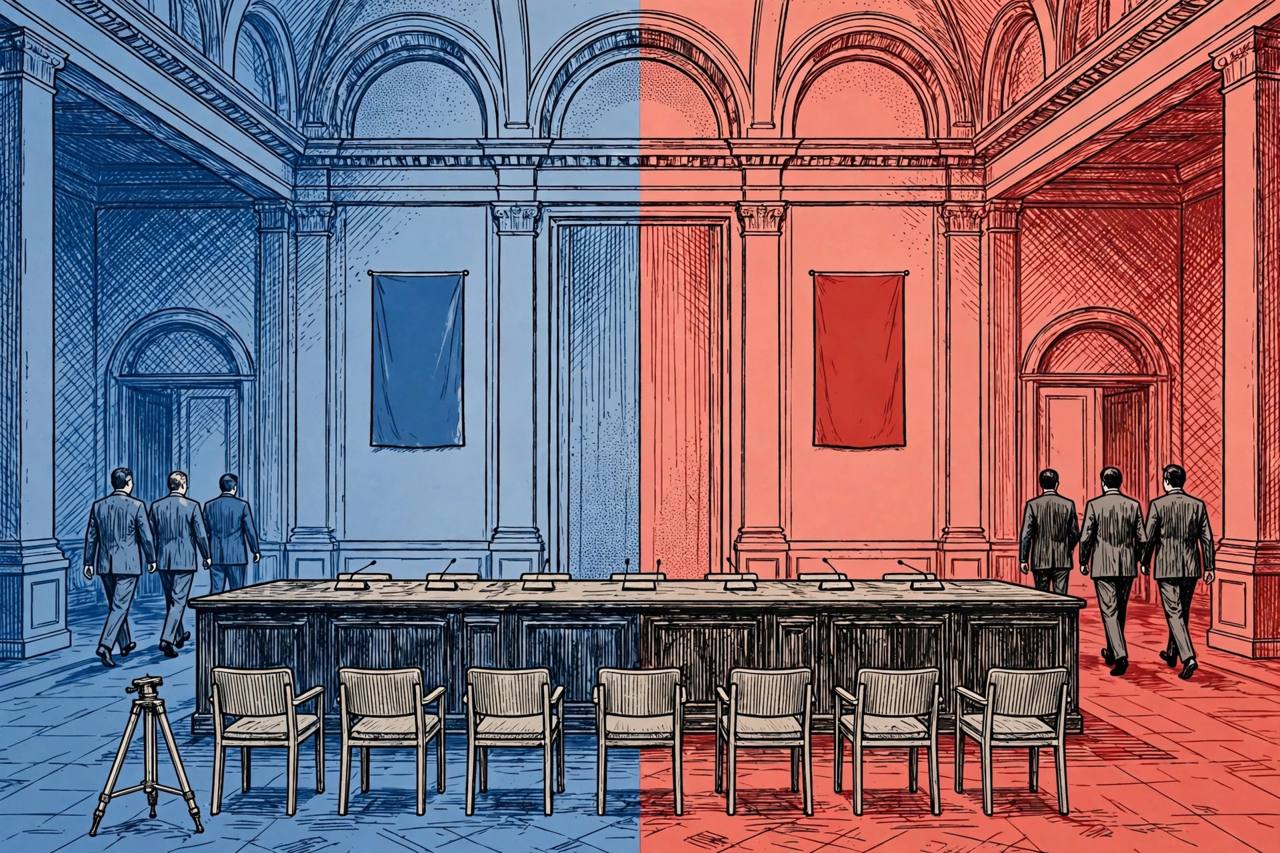
This is the outcome of the family-photo dispute in our earlier report on the Atlanta meeting opening, where European officials had suggested two separate pictures — one with Lavrov and one without. The US has now cancelled the photo entirely. Read the earlier story
The United States scrapped plans for a group photo of the G20 foreign ministers on the opening day of their talks in Atlanta on Friday, after several European ministers objected to being photographed with Russian Foreign Minister Sergey Lavrov and threatened to walk out of the photo session, the Associated Press reported.
Source: Associated Press via EuropeSays
The ministers began their first session without posing for photographers at all. Reuters reported that the US State Department's agenda for the meeting did not include the so-called family shot, and a US official said Washington had taken the photo off the agenda because it did not want it to become a spectacle or a distraction. A third of the participants, including Australia and Canada, had made clear they opposed being photographed alongside Lavrov, a Western diplomat told Reuters.
Source: Reuters via Devdiscourse
Rubio decided the row would be a distraction
Secretary of State Marco Rubio decided to cancel the photo after determining that the controversy would be a distraction, according to two US officials who spoke to AP on condition of anonymity. Opening the talks, Rubio said he hoped for “a productive meeting” and called this “a critical moment — I would call it a moment of choosing” for the United States and for the world, facing “a series of interconnected economic and geopolitical crises.”
Poland's Deputy Prime Minister and Foreign Minister Radosław Sikorski said the cancellation was “the right decision,” telling media in Atlanta: “I am not the only one who does not want to be photographed with Lavrov.” Germany's Foreign Minister Johann Wadephul told reporters there would “in no case” be a family photo with European partners and Mr Lavrov together because “there is no normalcy with Russia,” Reuters reported; he also said controversies must be exchanged at the table, but “we also must not send falsely optimistic signals,” the German news agency dpa reported via AP.
Visas, absentees and the December summit
Russia's foreign ministry complained of problems securing visas for its delegation that were resolved only at the last minute, creating the impression that “not everyone in Washington is happy” about Lavrov attending, ministry spokeswoman Maria Zakharova said, according to AP. She said Lavrov would use the meeting to advocate for the “swift reform of global economic institutions.” Lavrov has travelled very infrequently to NATO member states since Russia's full-scale invasion of Ukraine in February 2022.
The two-day Atlanta meeting, on October 30–31, otherwise goes ahead as planned and is meant to set the stage for the G20 leaders' summit hosted by President Donald Trump in Miami in December. Ukraine, which is not a G20 member but was invited to previous such meetings, was not invited this year, and South Africa — a G20 founding member — was also missing from the invite list, AP reported. Its foreign minister's spokesperson, Phindile Kunene, said South Africa was ready to participate “on an equal footing with other members” when Britain takes over the presidency next year.
The ministers meet through Saturday in Atlanta, with freedom of navigation — in the Strait of Hormuz, the Red Sea, the Black Sea and the South China Sea — energy and supply chains on the agenda. Diplomats say the real test, in Atlanta and at the December leaders' summit, is whether the US can build cooperation with smaller groups of partners when agreement among all members appears out of reach.