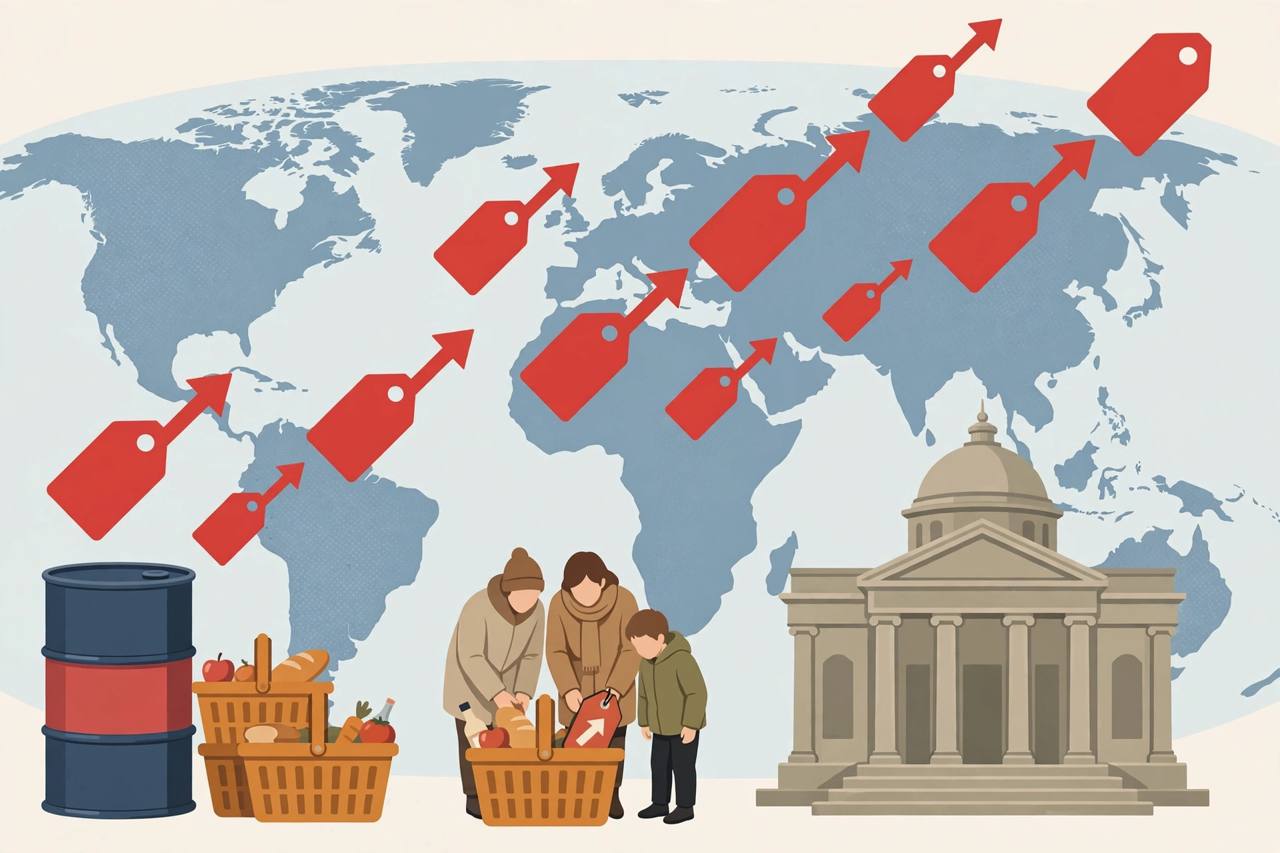
BENGALURU — High inflation will persist in the global economy well into next year, according to hundreds of economists polled by Reuters, who said they are increasingly concerned that price pressures will become entrenched beyond the rising energy costs caused by the conflict in the Middle East, Reuters reported on Tuesday.
Source: Reuters poll, Oct 27, 2026
More than 500 economists surveyed by Reuters this month raised their 2027 inflation forecasts for 31 of the 50 economies covered, and their growth forecasts for 23 of them. Economists raised the 2027 inflation forecasts for 15 of the 21 developed economies in the poll — a sign, Reuters said, that inflation worries are spreading to economies that usually experience low price pressures.
Crude oil prices have stayed above $100 a barrel since October 7, hit a six-month high of over $117 last week, and are up more than 60% since the US-Israeli war with Iran began almost eight months ago, Reuters said. For Punjabi and Indian families in the Gulf, Canada and at home, that means fuel, flights and remittances are all exposed to the same oil shock.
“I am getting much more concerned about inflation again,” Janet Henry, global chief economist at HSBC, told Reuters. “The longer the situation evolves and escalates in the Middle East and the higher the broad basket of price pressures builds, the greater the likelihood that we get not just higher but more persistent inflation.”
Most central banks have raised interest rates only a few times or not at all, Reuters said, but more could come if inflation pressures broaden. A global rout in bond markets in recent months has also tightened financial conditions through higher yields. Separately on Tuesday, Reuters reported via Kitco that gold fell as a stronger dollar weighed on bullion while investors waited for the US Federal Reserve's policy meeting, with Brent crude hovering around $116 a barrel on renewed Houthi attacks on Saudi Arabia.
Source: Reuters via Kitco, Oct 27, 2026 — gold, oil and Fed meeting
More than $1 trillion of investment in artificial intelligence technology globally since last year — yaani 1 lakh crore US dollars — has made some economies more resilient, Reuters said, even as cost-of-living pressures squeeze households and shape national politics.
The poll does not forecast a single country's rate decision. It records a direction: forecasters who did not expect a quick end to the war are now sounding more concerned about an inflation resurgence, particularly given the resilience of global growth, Reuters reported.