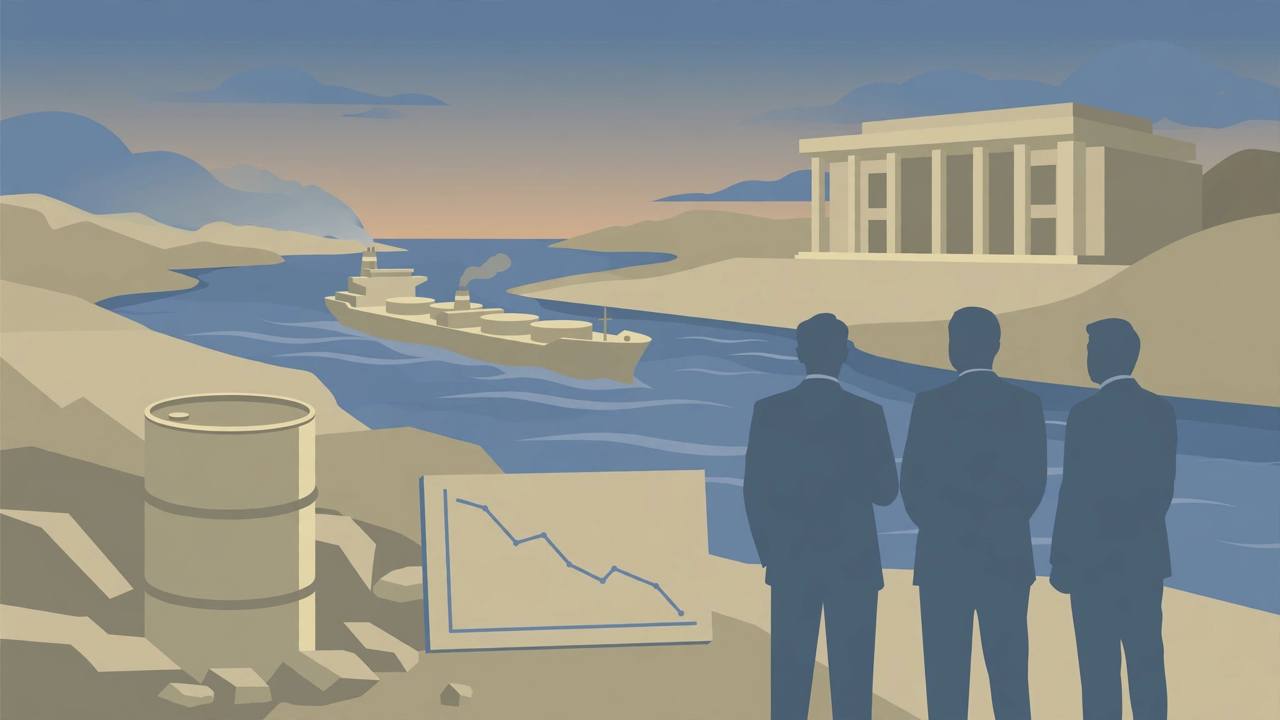
The International Monetary Fund said on Thursday it is engaging with the Iraqi authorities as it prepares a new bailout programme for the country, whose economy has been battered by the war on Iran, Reuters and AFP reported.
"Our plan now is to engage with the authorities to understand better their priorities, how they want to address their vulnerabilities, and then to move ahead on how we can best support them with a program," IMF spokesperson Julie Kozack said at a regular press briefing in Washington.
Source: Reuters/AFP via Vancouver Courier
In the IMF's own briefing transcript, Kozack said Iraq's authorities had requested an IMF-supported programme 'to help them manage the impact of the Middle East war and also, importantly, to help the country tackle some of its underlying vulnerabilities and structural challenges.' She said the Fund expects Iraq's GDP to 'shrink significantly this year before rebounding next year.'
Source: IMF press briefing transcript, Oct 29, 2026
The US-Israel war on Iran, launched in late February, plunged the region into conflict and saw Tehran's retaliatory action virtually block the Strait of Hormuz, a key energy supply route. Iraq's economy is heavily dependent on its energy exports, which almost entirely rely on transport through the strait — so the disruption cut straight into Baghdad's income.
Kozack cited the country's severe financing constraints from before the outbreak of the war, and said its very narrow non-oil revenue base was also putting pressure on the fiscal balance. Before the war, Iraq was already facing acute fiscal constraints after years of fiscal expansion, the IMF said.
IMF Managing Director Kristalina Georgieva first disclosed that Iraq had approached the Fund for a new programme at the Fund's annual meetings in Bangkok earlier this month. At those meetings, Georgieva praised the resilience of global economic growth in the face of the wars in Iran and Ukraine, but warned that outcomes were highly uneven, with more vulnerable economies battered hard by the conflicts.
The last of Iraq's three most recent programmes with the IMF ended in 2019. Iraq has a total of around $428 million in interest payments due to the Fund by 2030, according to IMF data — yaani roughly $42.8 crore in interest alone. No size or timetable for the new programme has been announced; the Fund said the next step is to understand Baghdad's priorities and how it wants to address its vulnerabilities.
Why it matters beyond Iraq: Iraq is one of the Gulf's big oil exporters, and lakhs of Indian and Punjabi workers live and work across the Gulf states. A bailout process in Baghdad is another sign of how deeply the Hormuz disruption is cutting into the region's economies — the same disruption that has pushed up oil and fuel prices worldwide.