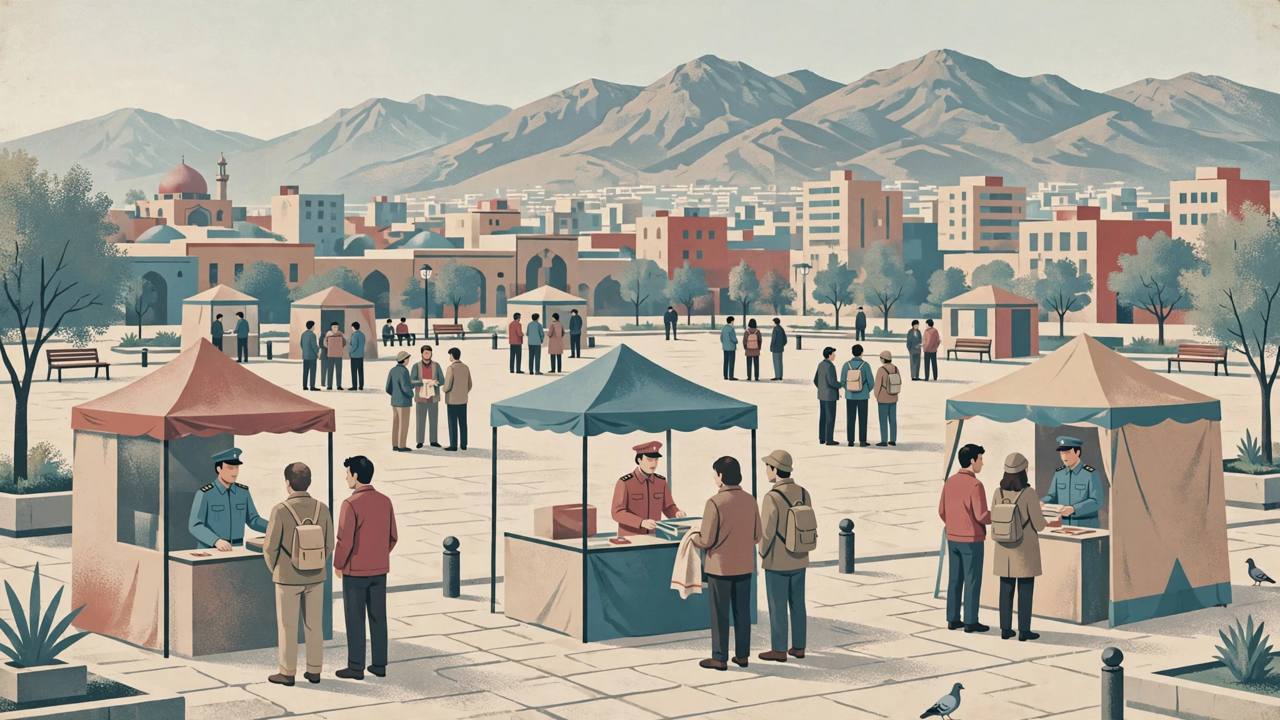
Iran's authorities are increasing investment in a campaign to arm and train civilians who would serve in the state security apparatus against domestic and foreign threats, amid growing fears that fighting with the United States and Israel could resume imminently, Al Jazeera reported on Sunday.
Source: Al Jazeera, Oct 25
The public mobilisation drive — called Janfada, or 'those who sacrifice their life' — was launched in late March at the peak of the war with the US and Israel. It has now spread to large parts of the country and is aiming to attract volunteer men and women, with a stated focus on youth but open to all ages, Al Jazeera reported.
Training booths in the squares of all 31 provinces
At street booths and stations, representatives of the Basij militia of the Islamic Revolutionary Guard Corps (IRGC) and other state bodies offer training on using weapons and other equipment. State-organised events and armed exercises linked to the campaign have been held in Tehran, Isfahan, Zanjan, Shiraz, Kerman, Mashhad, Bojnord, Ahvaz and other cities across many of Iran's 31 provinces.
Source: Al Jazeera, Oct 25
Ali Kowsari, the Basij's deputy for training, announced at a news conference this month that the IRGC wants to use at least 14 main squares across Tehran as training and equipment stations for Janfada volunteers, and aims to use one to three squares in the capital city of every province, Al Jazeera reported. He did not say how many cities are currently being used.
Reuters reported earlier this month that the campaign — whose name it rendered as Jan-Fada, 'Sacrifice for Iran' — has moved beyond registration in provinces such as Alborz, where organisers said around 100 units had been established and thousands of people were receiving training for specific roles in national defence, emergency response and social services.
Source: Reuters via Reporter World News, Oct 4
The sign-up figure is contested
The government said 33 million Iranians have signed up on the campaign's website but has provided no evidence to support the number, Al Jazeera reported. Earlier this year, foreign-based activists who accessed the website's source code said it showed fewer than four million registrations, and that only a phone number was required to register, with no national identification number needed.
What is solid
- The Janfada campaign was launched in late March and is run through the IRGC's Basij militia (Al Jazeera; Reuters)
- Training and exercises have been held in cities across many of Iran's 31 provinces, and the IRGC wants training squares in every provincial capital (Al Jazeera)
- Volunteers are being organised into units and trained for specific roles, including in Alborz province (Reuters)
What is only claimed
- How many people have actually signed up: the government claims 33 million without providing evidence; activists who examined the campaign website's source code earlier put registrations below four million (Al Jazeera)
- What the campaign is for: organisers present it as national defence and public service; foreign-based Iranian human rights groups characterise the armed mobilisation as an intimidation campaign after January's protests (Al Jazeera)
Al Jazeera reported that children have also become a focus of the campaign: Education Minister Alireza Kazemi said last week that the Basij was registering 'student Janfadas' and planned more mobilisation events involving children in the coming weeks. A resident of Gilan province told Al Jazeera that state-run stations are now a regular sight on streets in big and smaller cities across the province.
Mehran Kamrava, a professor of government at Georgetown University in Qatar, told Al Jazeera the mobilisation 'does not necessarily broaden the scope of the state's legitimacy among the larger society' but 'serves to deepen the legitimacy that the state already has among its existing supporters' and reinforces a 'siege mentality'.
Source: Al Jazeera, Oct 25
The expansion comes as Washington weighs renewed strikes on Iran and Gulf states stay on alert. Any return to open US-Iran fighting would again put Gulf airports, oil sites and shipping at risk — routes on which lakhs of Punjabi and Indian workers in Saudi Arabia, the UAE and Qatar depend for jobs, flights home and remittances.