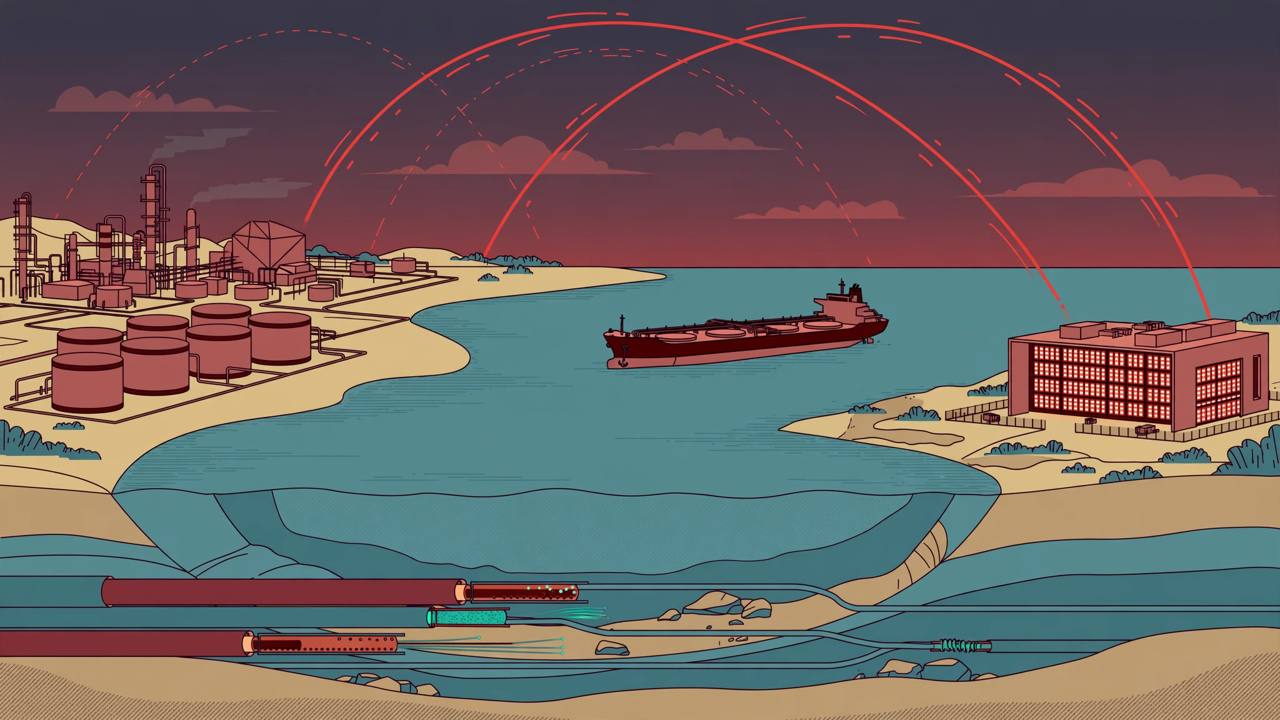
Iran will strike oil facilities, undersea cables, data centres and artificial-intelligence facilities across as many as seven countries in the Gulf if the United States and Israel launch a fresh attack, Mohsen Rezaei, the secretary of Iran's Supreme National Security Council, has said, in remarks reported by The Guardian. "In the event of a war, cables, datacentres and artificial intelligence facilities could also be targeted. If the conflict breaks out again, we will have a broader plan," Iranian media reported Rezaei as declaring.
Source: The Guardian (syndicated report)
Rezaei added, according to the same reporting: "There can be no arrangement in which Iran's economic lifelines come under attack while the economic architecture enabling those attacks is considered untouched and immune." These are threats stated by Iranian officials, reported as such — no such strikes have taken place.
Mehdi Mohammadi, an adviser to Mohammad Ghalibaf, the speaker who led Iran's negotiations with the US to end the conflict between the two countries, claimed that Donald Trump and Benjamin Netanyahu had agreed in principle on an attack but could not guarantee a successful outcome — his claim, not an established fact. "We see the next conflict as an existential threat. The third war in two years means a threat to existence. Our strategy is 'zero red lines'," Mohammadi said. "We break the temporal and spatial dimensions of the conflict. The war will continue longer and in a wider geographical area than the enemy anticipates."
Source: The Guardian (syndicated report)
Why the Gulf angle matters for Punjabi and Indian readers
The threatened target list is not abstract for this audience: the Gulf states host lakhs of Indian and Punjabi workers, and their oil facilities, ports and data infrastructure are the region's economic lifelines. Any wider war would hit oil prices — Brent crude has already topped $112 a barrel this week, yaani more than one hundred and twelve dollars for each barrel — as well as flights and remittances home. The Guardian reported that foreign ministers from three European countries, as well as Turkey, Saudi Arabia, Pakistan and Egypt, will meet in Istanbul on Friday to establish agreed policies on the linked Iranian, Yemeni and Palestinian crises.
According to recent reports in US media cited in the same coverage, US military advisers have drawn up a detailed list of targets for a fresh joint US-Israel assault on Iran to be implemented after the US midterm elections on November 3. Iran's ability to mount the operations it is threatening, including any unofficial help it receives from China or Russia, will be a key factor in any American decision to restart the war, the report noted.
What is solid
- Rezaei publicly named oil facilities, undersea cables, data centres and AI facilities across up to seven Gulf countries as potential targets if the US and Israel attack again.
- Mohammadi, an adviser to Ghalibaf, publicly described Iran's strategy as 'zero red lines'.
- European, Turkish, Saudi, Pakistani and Egyptian foreign ministers are due to meet in Istanbul on Friday on the linked crises.
What is only claimed
- Mohammadi's claim that Trump and Netanyahu have agreed in principle on a fresh attack — an Iranian official's claim, not confirmed by Washington or Jerusalem.
- Whether Iran could actually carry out strikes on that scale across seven countries — a capability question the reporting itself flags as unproven.