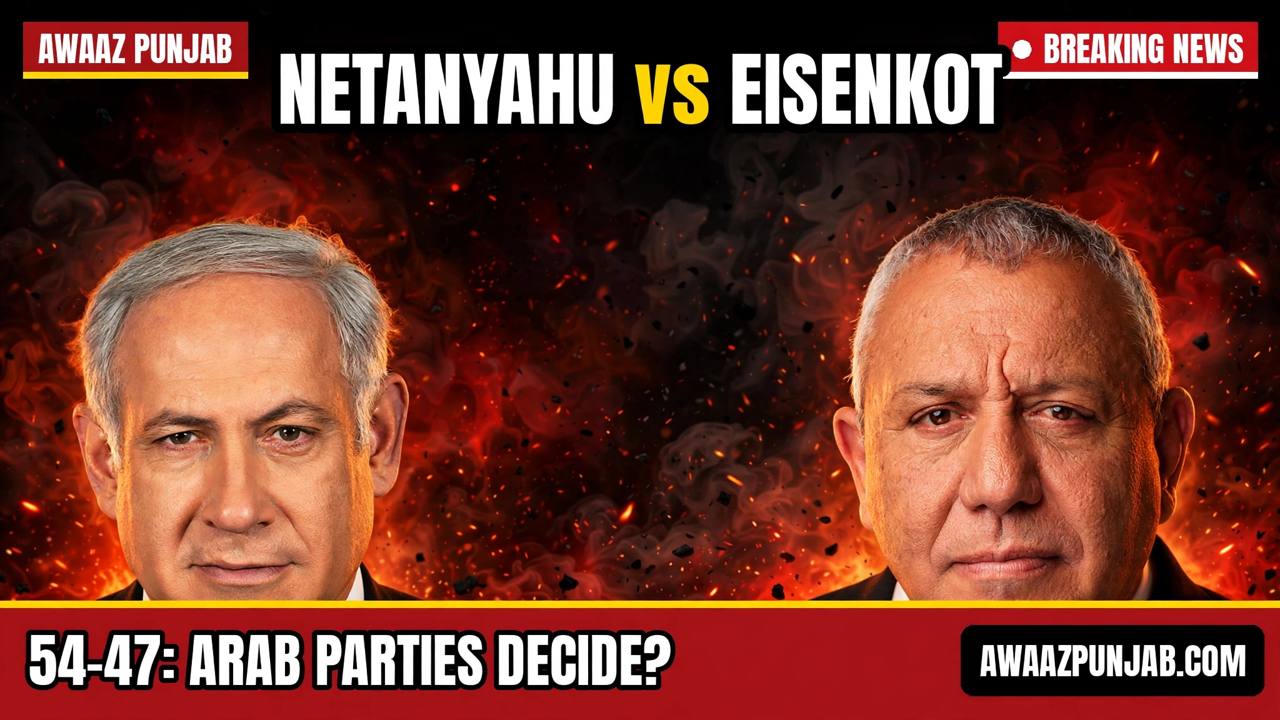
JERUSALEM — The actual vote count in Israel's general election had put Prime Minister Benjamin Netanyahu's bloc ahead by Wednesday morning but still short of a majority, as the Arab parties kept gaining seats as counting advanced and emerged holding the balance of power. With 76.89 percent of ballots counted, the Netanyahu bloc was projected at 54 seats in the 120-seat Knesset, the opposition bloc led by former military chief Gadi Eisenkot at 47, and the Arab parties at 19, according to Central Elections Committee figures tracked by The Petek results service, which put valid votes counted at 4,006,695 from 9,224 polling stations. Neither main bloc is anywhere near the 61 seats needed to form a government on its own.
The party-by-party picture at an earlier stage of the same count showed how the blocs are built. With 66.3 percent of votes counted (3,758,580 votes), All Israel News reported Likud as the largest single party with 27 seats, followed by Eisenkot's Yashar with 21 and Beyachad with 11; the Democrats and Yisrael Beytenu had 8 seats each, United Torah Judaism, Otzma Yehudit and Shas 7 each, and Religious Zionism-Zehut 6. At that stage the Arab parties held a combined 18 seats — the Joint List with 12 and Ra'am with 6 — before rising to 19 as the count advanced.
Source: All Israel News — 66.3% of votes counted, Netanyahu bloc at 54 seats, Oct 28, 2026
The count has told a different story from Tuesday night's exit polls, which had the two blocs tied at about 51 seats each. At 50.1 percent counted, Netanyahu's bloc stood at 56 seats to the opposition's 49, with the Arab parties at 15 — and as more ballots were counted, the Netanyahu bloc eased back to 54 while the Arab parties climbed from 15 to 18 and then 19, according to the successive Central Elections Committee updates. The seat projections apply the Bader-Ofer method to counted votes and will keep moving until the count is complete.
Netanyahu, speaking overnight at Likud headquarters, stopped short of declaring victory. “This is only the beginning; we will wait for the official results,” he said, while calling for a strong national right-wing government. He claimed that Likud being the largest party was “unequivocal” and that the right-wing bloc had what he called a clear majority among the Zionist and Jewish public — a claim his opponents dispute, since his bloc remains short of 61 seats overall.
Source: All Israel News — Netanyahu and Eisenkot overnight speeches, Oct 28, 2026
Eisenkot, addressing supporters at his party headquarters, said it would be “a mistake to go to another election” and argued that Netanyahu was facing a vote of no confidence, saying a worthy leader would accept that verdict and retire from political life. He also told the heads of Israel's security establishment that Netanyahu now heads a transitional government without a mandate, and warned him against using Israel's security for his political needs, All Israel News reported.
Source: All Israel News — Netanyahu and Eisenkot overnight speeches, Oct 28, 2026
The arithmetic now runs through the Arab parties. Eisenkot's bloc plus the Arab parties would pass 61 seats, but both Netanyahu and Eisenkot have rejected forming a government that depends on Arab lawmakers, and Eisenkot said during the campaign that he would not govern with them. The Joint List has indicated it could support a government seeking to remove Netanyahu without formally joining a coalition, while Ra'am, led by Mansour Abbas, previously sat in an Israeli governing coalition in 2021–22 — leaving open a range of minority or outside-support arrangements that neither camp has yet accepted.
What happens next follows a fixed timetable. Double-envelope ballots — including soldiers and diplomats — are due to be counted on October 29, and official results are scheduled for November 4, after which President Isaac Herzog will consult party leaders and hand one candidate a mandate to form a government, a process that allows 28 days with a possible 14-day extension. Until a new coalition is formed, Netanyahu remains in office in a caretaker capacity. Turnout in the election reached 77.7 percent, the highest at that stage since 1999, according to Central Elections Committee figures reported by Israeli media.
Source: The Petek — where the count stands: timetable to official results, Oct 28, 2026