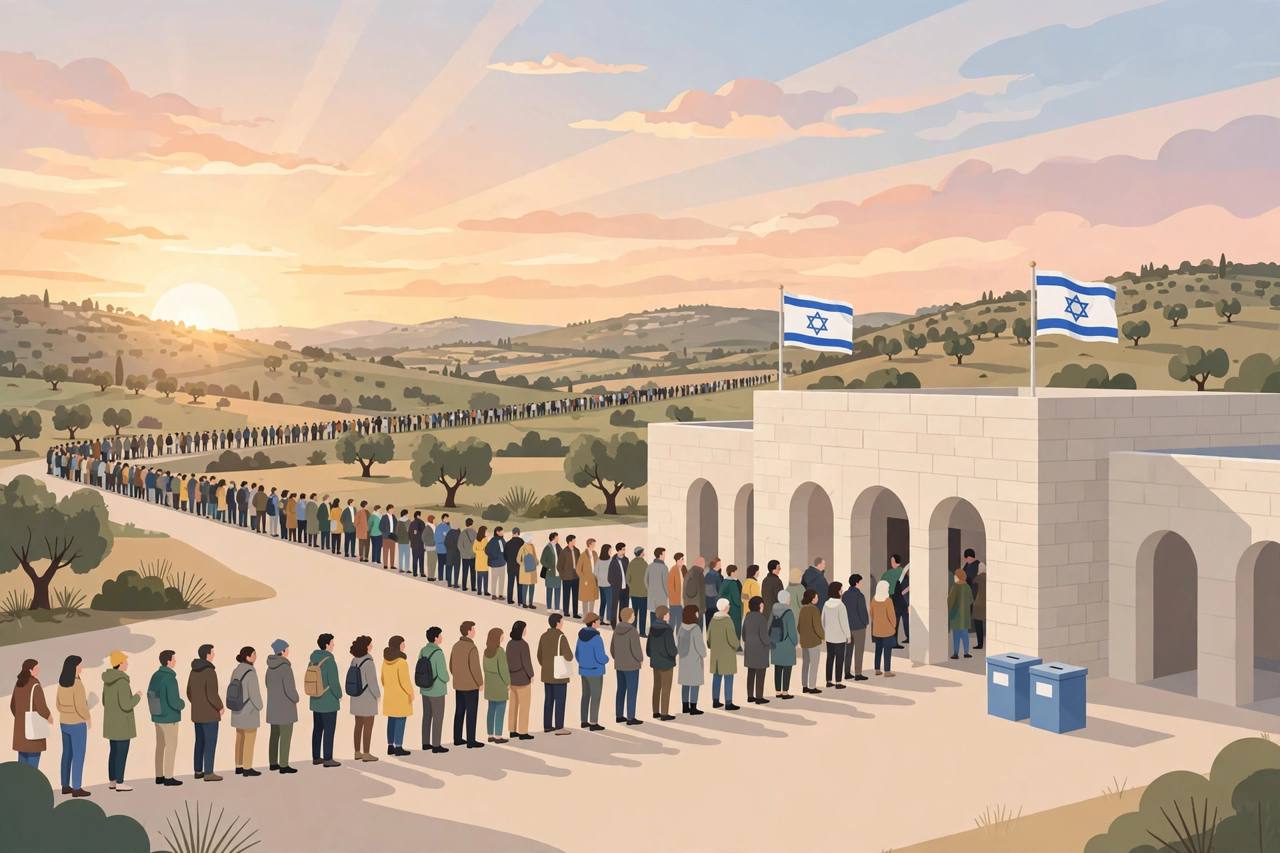
Israelis voted in large numbers on Tuesday in elections for the country's 26th Knesset, with turnout running at its highest level in decades, according to the Central Elections Committee.
Source: United with Israel - Central Elections Committee figures
By 10 a.m. local time, 16.68% of eligible voters - more than 1.2 million people - had cast ballots, the highest turnout at that hour since 1981, compared with 15.9% at the same point in the 2022 election, the committee said.
The pace kept rising through the day. By noon, turnout had reached 31.5%, with nearly 2.4 million ballots cast, and by 2 p.m. it stood at 44.9% - roughly 3.3 million voters - a full six percentage points above the 38.9% recorded at the same time in 2022.
A referendum on Netanyahu, say observers
The vote for all 120 Knesset seats pits Prime Minister Benjamin Netanyahu of Likud, who is seeking a record seventh term, against former military chief Gadi Eisenkot, leader of the Yashar party. The Washington Post, cited by the Seoul Economic Daily, described the election as a referendum on Netanyahu and his response to the Hamas attack of October 7, 2023, while the Financial Times called it one of the most important votes in Israel's history.
Source: Seoul Economic Daily / AP-Yonhap
President Isaac Herzog, who voted in Jerusalem, called the day a true festival of democracy and said the country's fate lies in the hands of voters. Netanyahu, in a post on X, urged his supporters to turn out, describing election day as an emergency call, ANI reported.
About 7.33 million Israelis are eligible to vote. Polling stations opened at 7 a.m. and close at 10 p.m. local time. Final pre-election surveys pointed to a tight race in which neither bloc was projected to win a majority on its own, making coalition negotiations after the count likely.