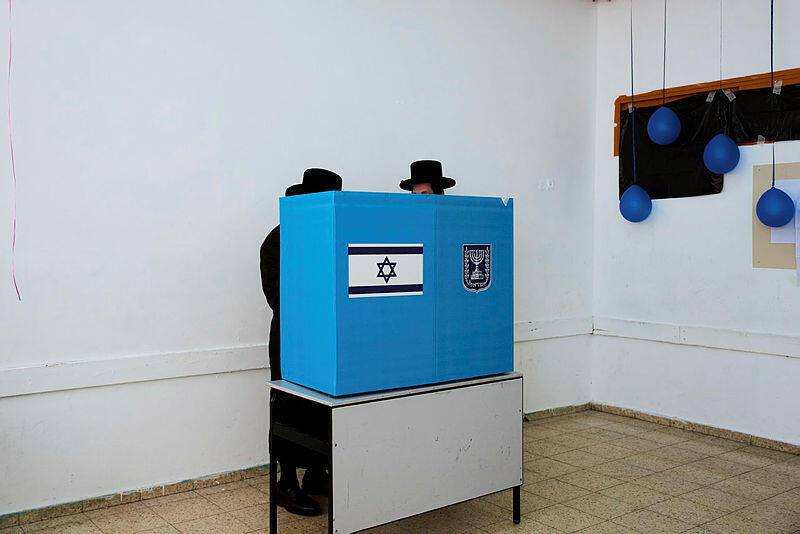
Israel's Central Elections Committee figures released on Thursday, with 100% of votes counted, confirm the deadlock that exit polls and partial counts had pointed to since Tuesday's election: Prime Minister Benjamin Netanyahu's bloc is set to win 53 seats in the 120-seat Knesset, the opposition bloc led by Gadi Eisenkot 48, and the two Arab parties a combined 19 — leaving no bloc with the 61 seats needed to form a government.
Source: CTech (Calcalist)
The committee said earlier on Thursday that it had completed counting the special double-envelope ballots, cast by soldiers and others voting away from their designated polling stations. The final tally did not change the balance between the main blocs from the partial counts reported earlier this week.
How the 120 seats divide
Netanyahu's Likud remains the largest single party with 27 seats, followed by Eisenkot's Yashar with 21 and Beyachad (B'Yachad) with 12, according to the committee figures reported by CTech and JFeed. The Joint List is projected to win 11 seats, while the Arab-led Ra'am party and the Democrats take eight each. United Torah Judaism, Yisrael Beiteinu and Otzma Yehudit are each on seven seats, and Shas and the joint Religious Zionism-Zehut list six each.
Source: JFeed
The Arab parties' combined 19 seats, up from 10 in the outgoing Knesset, came amid exceptionally high participation in Arab communities, with Arab turnout reported at approximately 80%. Overall turnout reached 77.7%, the highest in an Israeli election since 1999 and 7.1 percentage points higher than in 2022, United With Israel reported.
Source: United With Israel
What is solid
- With 100% of votes counted, the Central Elections Committee figures give Netanyahu's bloc 53 seats, the Eisenkot-led opposition 48 and the Arab parties 19, CTech and JFeed reported.
- The double-envelope ballot count is complete, and the bloc balance did not change from the partial counts.
- The figures remain provisional; official results are scheduled for publication on November 4 after an additional integrity review.
What is only claimed
- Who can actually form a government remains unsettled — neither bloc has 61 seats, and no coalition agreement has been announced.
- Likud's earlier claims that the election was stolen are not supported by the completed count; Israeli police said earlier there was no evidence behind the claim, as Awaaz Punjab reported.
What happens next
The committee stressed that the figures remain provisional. Official results are scheduled to be published on Wednesday, November 4, following an additional review of election integrity, and the 26th Knesset is scheduled to be sworn in on Tuesday, November 10. President Isaac Herzog is expected to begin consultations with party representatives on November 4; under Israeli law he has seven days from publication of the official results to assign one lawmaker the task of forming a government.
The lawmaker given the mandate first will have 28 days, extendable by up to 14 more, to build a coalition of at least 61 seats. If that attempt fails, a second candidate may be given 28 days, and after that a 21-day window opens in which 61 lawmakers can nominate a candidate in writing. If every route fails, the Knesset is dissolved and Israel votes again. Netanyahu remains caretaker prime minister while the process runs.