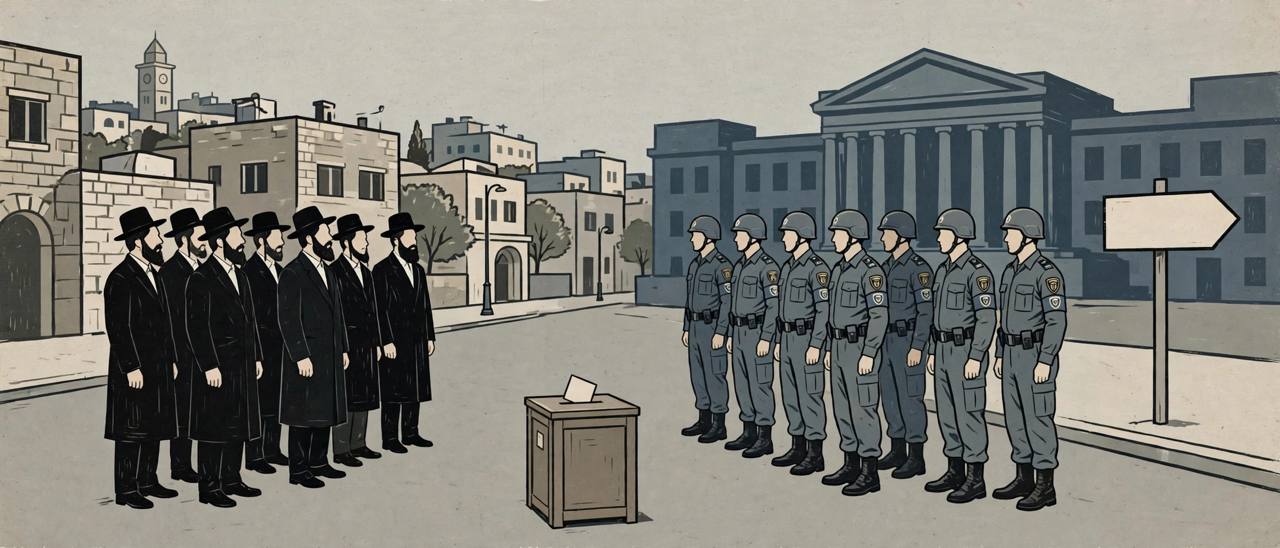
JERUSALEM — A bitter national row over whether Israel's ultra-Orthodox, or Haredi, men should serve in the military has become a central fault line of Tuesday's election, the BBC reported. In the city of Modi'in, hundreds of ultra-Orthodox men in black frock coats and fedoras have faced off against Israeli military police in a confrontation over a young man who failed to report for military service — one flashpoint in a dispute that could shape Israel's future, the BBC said. Al Jazeera reported that in early October a group of Haredim clashed with Israeli forces seeking to arrest a draft evader in Modi'in, drawing condemnation from Prime Minister Benjamin Netanyahu's opponents.
Source: BBC News, InDepth, Oct 25, 2026
The scale of the exemption is what makes the row explosive. An estimated 80,000 ultra-Orthodox men aged between 18 and 24 are currently avoiding military service, Al Jazeera reported, a figure whose significance grows with every report of staff shortages in the Israeli army. A September poll by the Israel Democracy Institute found 72 percent of Israelis wanted to see the Haredim drafted alongside other Israelis eligible for service, Al Jazeera said. Yeshiva students were long exempt from service, an arrangement dating to the state's earliest days, but two years ago the Supreme Court ruled the exemption effectively null and void, the BBC reported. State subsidies supporting full-time religious study are estimated to cost the government 35 billion shekels a year — yaani 3,500 crore shekels, about £8.4 billion (840 crore pounds), the BBC said.
Source: Al Jazeera, Oct 23, 2026
Netanyahu is caught in the middle. He needs the ultra-Orthodox parties — United Torah Judaism (UTJ) and Shas — to have any chance of staying in power, the BBC reported, yet their refusal to compromise on the draft is dragging his coalition, which polls put at about 50 to 52 seats against the 64 it won in 2022. Shas and UTJ have ruled out joining any coalition that does not pass laws exempting their community, Al Jazeera reported, and in May, after Netanyahu told the parties he lacked the votes to pass an exemption bill, they pushed to dissolve the Knesset. On Tuesday, October 20, dozens of Haredi men were detained on suspicion of evading the draft — arrests Netanyahu called “unacceptable”, The Conversation reported. Netanyahu also said he opposed the arrest of 40 Haredim taken in after returning from the United States, and told the Haredi Kol Barama radio station: “We must preserve the world of Torah because it preserved us”, Al Jazeera reported. In a pre-election interview, Netanyahu vowed a law to draft 23,000 Haredi men over three and a half years, adding that whoever does not learn must enlist, JFeed reported.
Source: BBC News, InDepth, Oct 25, 2026
His rivals are making the draft the election's defining contrast. Netanyahu's main rival, former military chief Gadi Eisenkot, says a country that sends its sons and daughters to fight “cannot tolerate a reality in which a state within a state exists”, the BBC reported; Eisenkot described the Modi'in incident as reflecting a world view that seeks “to make draft evasion the norm”, and framed the vote as “Netanyahu's draft-dodging government, or a government of conscription led by me”, Al Jazeera reported. On the left, Yair Golan has called for the immediate mobilisation of all who are eligible, the BBC said, while a UTJ candidate who compared the plight of draft evaders to the persecution of Jews in the Holocaust drew furious rebukes across the political spectrum. Israeli pollster Mitchell Barak told Al Jazeera the opposition is pitching the election as “the draft dodgers versus those who protect and serve — and that is the decisive point of the election”. A new Haredi Public Party is offering a compromise under which men genuinely devoted to full-time Torah study could continue while others serve in Haredi-friendly frameworks, the BBC reported, and pollster Dahlia Scheindlin noted almost any small party could end up as kingmaker — while far-right leader Itamar Ben-Gvir's Jewish Power party is gaining ground among young Haredim.
Source: Al Jazeera, Oct 23, 2026
Tuesday's vote is the first since Israel's war in Gaza began in October 2023, in which nearly 74,400 people have been killed, Al Jazeera reported, and the military campaigns have placed a heavy burden on state finances: an August survey found 42 percent of Israelis said their finances had worsened since the war began. The Haredi share of the population keeps growing — the BBC put it at about 14 percent of Israel's population, possibly a third of Jewish Israelis by 2050, while Al Jazeera cited 1.26 million people, or 12.5 percent of Israelis, identified as Haredi. “The great burden of having to serve became much more pronounced — and at the same time the Haredi sector keeps growing,” Shmuel Rosner, a senior fellow at the Jewish People Policy Institute, told Al Jazeera, “which means that a large cohort of potential soldiers does not ease the burden on others.”
Source: Al Jazeera, Oct 23, 2026
What is solid
- An estimated 80,000 Haredi men aged 18-24 are avoiding military service (Al Jazeera), and a September Israel Democracy Institute poll found 72% of Israelis want Haredim drafted (Al Jazeera).
- Israel's Supreme Court ruled the yeshiva exemption effectively null and void two years ago (BBC); in May the Haredi parties pushed to dissolve the Knesset after Netanyahu said he lacked the votes for an exemption bill (Al Jazeera).
- Shas and UTJ have ruled out joining a coalition that does not pass exemption laws (Al Jazeera); polls put Netanyahu's coalition at about 50-52 seats against 64 won in 2022 (BBC).
- Netanyahu opposed the arrest of 40 Haredim returning from the US and called the Oct 20 detentions “unacceptable” (Al Jazeera; The Conversation), while vowing a law to draft 23,000 Haredi men over 3.5 years (JFeed).
What is only claimed
- Population share figures differ by source and definition: about 14% of Israel's population (BBC) versus 1.26 million, or 12.5% of Israelis, identified as Haredi (Al Jazeera).
- Whether the Haredi parties will again crown the next prime minister — or instead help bring Netanyahu down, as some commentators suggest (BBC) — will only be known after Tuesday's vote and coalition talks.