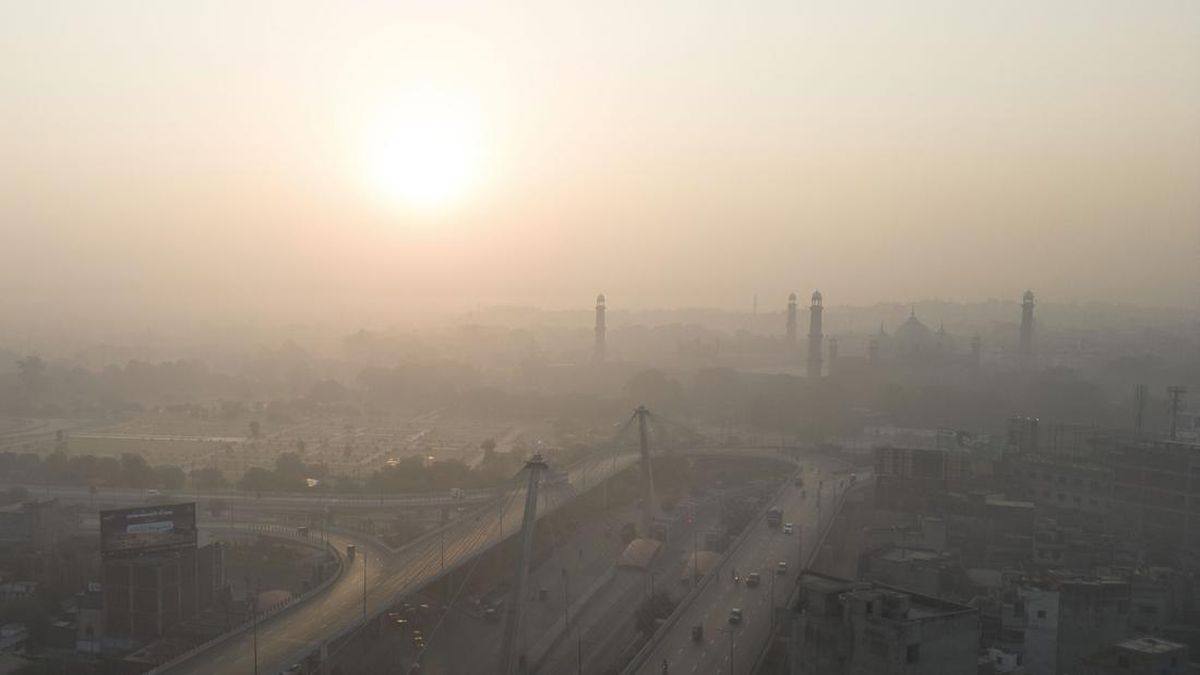
LAHORE — Lahore, the capital of Pakistan's Punjab province, recorded the worst air of any major city in the world on Thursday morning, with an air quality index (AQI) of 419 between 10 am and 11 am, according to IQAir data reported by Dawn. Any reading above 300 is classed as hazardous. Cairo was second at 274, while Karachi, Pakistan's largest city, ranked eighth at 165.
Source: Dawn via IANS
The Punjab government's own air quality dashboard also showed hazardous readings across the province, with Kasur at the top of the provincial list, followed by cities including Nankana Sahib at 261, Hafizabad at 250, Sahiwal at 210, Sheikhupura at 205 and Jhang at 203, the reports said. Lahore has topped the global list on most days this month as still, damp autumn weather traps pollution close to the ground.
A national report puts a price on the smog
The ranking came a day after the Pakistan Air Quality Initiative (PAQI) released a national report, 'Unveiling Pakistan's Air Pollution: A National Landscape Report on Health Risks, Sources, and Solutions', described as the country's first harmonised, multi-sector emissions inventory, covering Lahore, Karachi, Islamabad-Rawalpindi and Peshawar, The Express Tribune reported. It estimates pollution costs Pakistan the equivalent of 6.5 per cent of GDP, and that long-term exposure in Lahore could cut life expectancy by as much as seven years.
Source: The Express Tribune via PAQI report coverage
Lahore's annual average concentration of PM2.5 — the fine particles that penetrate deep into the lungs — exceeds 110 micrograms per cubic metre, more than 22 times the World Health Organization's annual guideline of five micrograms, the report said. It identified vehicular transport as the primary source of PM2.5 emissions in Lahore, followed by industry at 28 per cent and brick kilns at 17 per cent.
At the Pakistan National Clean Air Conference in Islamabad on October 28, Climate Change Minister Musadik Malik announced a $10 million allocation — yaani about one crore US dollars — to establish a dedicated Clean Air Fund, according to coverage of the PAQI report launch. Air quality experts, meanwhile, told reporters the Punjab government had let overcast October days pass without using artificial rain to wash the smog out, while relying on water-misting anti-smog guns whose city-scale effect critics question, Dawn reported via local coverage.
For readers across the border in Indian Punjab, the figures will feel familiar: the same smog season, driven by traffic, industry, brick kilns and crop-residue burning under still winter-bound air, settles over both halves of Punjab each autumn. What happens next depends on enforcement and weather — a spell of wind or rain is usually what clears Lahore's air first, while the PAQI report argues measures exist that could cut emissions by up to half if they are carried through.