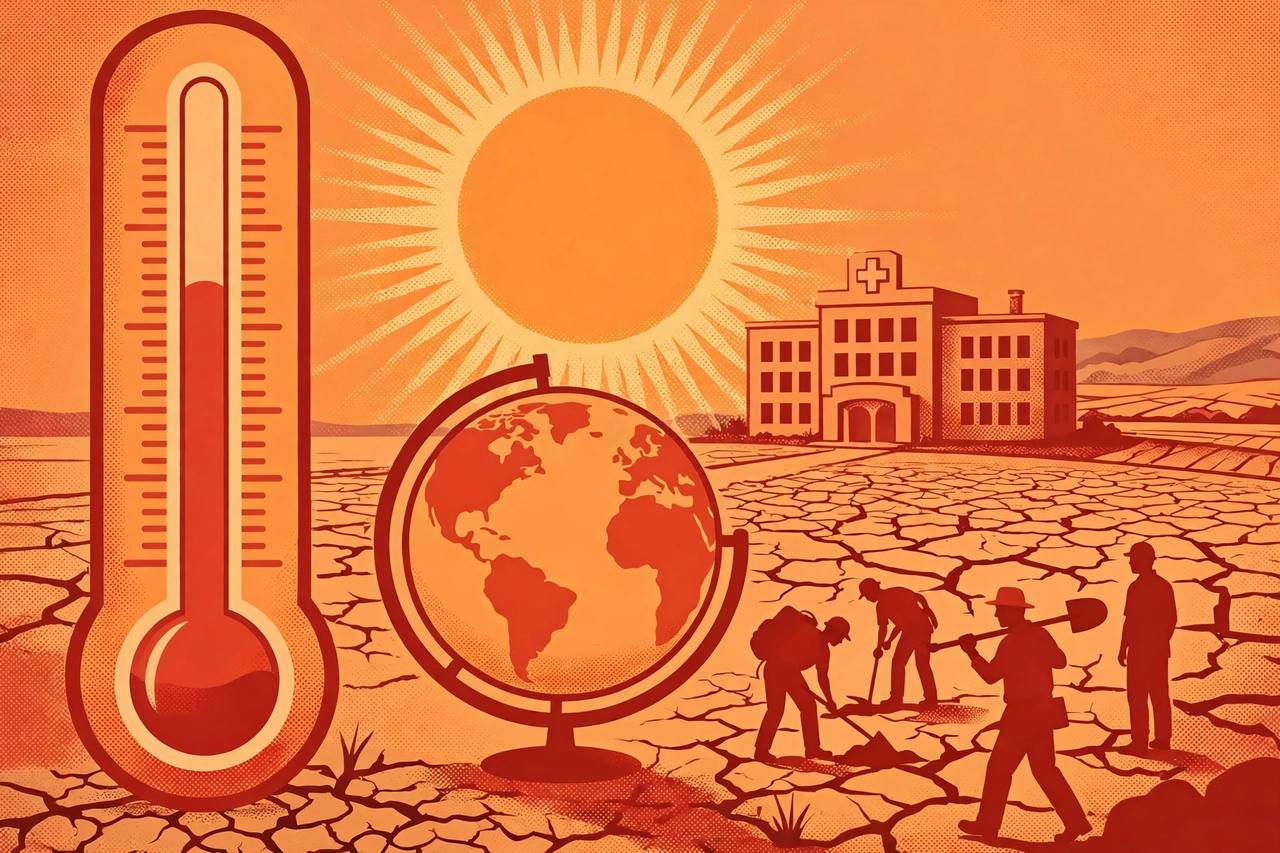
The latest Lancet Countdown report on health and climate change, released on Wednesday, calls on the World Health Organization (WHO) to formally declare climate change a global health emergency, Reuters reported. The report finds that heat-related deaths and other climate-driven health harms are accelerating faster than the global response, a decade after the Paris Agreement.
Source: Reuters via News Central TV
The assessment — the 10th edition of the Lancet Countdown — is led by University College London in collaboration with the WHO and draws on 146 experts from more than 100 institutions in over 30 countries, tracking 54 indicators, according to reporting by ABC News and Phys.org. It concludes that many health risks expanded more rapidly in the ten years since the Paris Agreement took effect in 2016 than in the preceding decade.
"A decade after the Paris Agreement, our findings are unambiguous," said Marina Romanello, executive director of the Lancet Countdown at UCL, adding that climate-related health harms are outpacing the world's response and, in many cases, accelerating. The 710,000 heat deaths in 2023 alone exceeded annual deaths from malaria or HIV, the report noted.
The drought picture is stark: the pace at which land is hit by extreme drought has risen about 700% between 2016 and 2025 compared with the prior decade, and satellite observations show 43% of land drying out since 2003 while 37% gets wetter — together pushing more than 80% of land into hydrological extremes that threaten crops, water supplies and sanitation, The Independent and DW reported. Heat's economic toll fell hardest on Southeast Asia and Africa, which lost the equivalent of 3.9% and 3.2% of GDP respectively, with agriculture (38%) and construction (29%) — both outdoor, physically demanding sectors — absorbing most of the losses.
Source: The Independent and DW via Globe TV
The report also records progress. Clean-energy investment reached a record $2.1 trillion in 2025 (yaani about $2,100 billion) — 82% more than fossil-fuel investment — and renewables grew from 5.5% to 13.5% of global electricity between 2016 and 2023, while cleaner air prevented an estimated 323,000 deaths a year in 77 countries. Yet fossil fuels still supply more than 80% of global energy, emissions hit a record high in 2024, and fossil-fuel air pollution still kills an estimated 2.73 million people each year. Fifty-six WHO member states now have national health adaptation plans, up from 14 in 2015.
The authors recommend a new WHO instrument, broader than the existing Public Health Emergency of International Concern mechanism, to coordinate sustained global action, pooled climate-health data and more grant and low-interest finance for vulnerable countries. The report lands weeks before the UN COP31 climate conference in Antalya, Turkey, next month, where it is intended to shape negotiations.