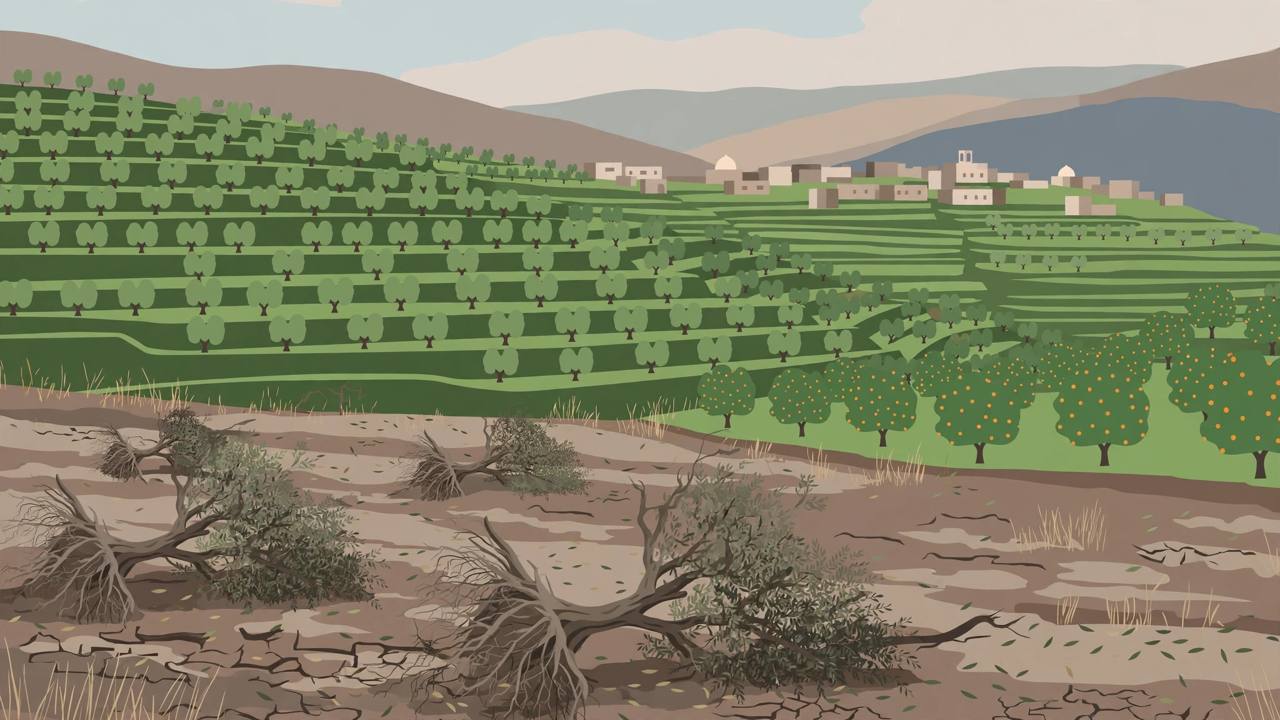
Israeli attacks have directly affected about 56,000 hectares of agricultural land in Lebanon — the equivalent of 22.5 percent of the country's farmland — Agriculture Minister Nizar Hani said in an interview with the Anadolu news agency published on Monday.
Source: Anadolu via Eastora News
Around 52,000 of the affected hectares are in the South and Nabatieh governorates, with another 4,000 hectares in Baalbek-Hermel, Hani said. The ministry's latest assessment puts the impacted area at almost 56,264 hectares spread across approximately 285 towns in the south, the Bekaa and Baalbek-Hermel, of which about 18,559 hectares sustained direct damage.
Source: Qatar News Agency via Business Arabia
Olive country has been hit hardest in the south: around 24,000 hectares of olive-growing land were directly affected, and another 750 hectares were removed from production after Israeli forces bulldozed farmland and uprooted olive trees, the minister said. Large areas planted with olives and tobacco were also damaged.
The damage goes well beyond crops. Lebanon has lost more than 30,000 beehives and around 70 percent of livestock in southern Lebanon during the conflict, Hani said — in a region that accounts for about 70 percent of the country's citrus production and 90 percent of its banana output.
A ministry survey covering 15,025 farmers in the affected areas found that 76.6 percent of them had been displaced, an indicator Hani described as deeply worrying, because it means the loss of agricultural labour and expertise from the production cycle, not just the relocation of residents.
Allegations on chemicals, and tests that cannot yet be done
Hani said Israel used white phosphorus during the war and sprayed areas near the border, particularly forested land, with the herbicide glyphosate. Those are the Lebanese minister's allegations; the reports of his interview carried no Israeli response. He said tests conducted by Lebanese authorities through the end of 2025 on soil, crops, forests and water remained within levels he described as “under control”, but renewed fighting and continued Israeli control of some areas had prevented teams from conducting fresh tests at several locations.
Earlier environmental findings showed hotspots where phosphorus concentrations reached about 1,858 parts per million in some samples, Hani said — a figure he stressed applies to specific sites and samples, not to all land in southern Lebanon.
The recovery bill
In the ministry's latest interim assessment, production losses reached US$530.5 million — yaani takreeban 53 crore US dollars, about half a billion — compared with US$41.2 million in direct damage, which Hani said shows rehabilitation cannot stop at restoring fields but must rebuild the agricultural economy as a whole. A separate ministry assessment with the UN Food and Agriculture Organization (FAO) for the 2023–2024 war put material damage at US$118 million and production losses at US$586 million, with recovery needs estimated at US$263 million — yaani lagbhag 26 crore US dollars.
On food security, Hani cited Integrated Food Security Phase Classification figures showing about 1.24 million people in Lebanon faced acute food insecurity at Phase 3 or higher between April and August 2026.
What happens next: the ministry says returning farmers to damaged land will follow phases — surveying and documenting damage, ensuring safe access, testing soil and water, classifying land and rebuilding productive capacity — and that compensation on this scale requires a government decision, funding and a unified database, with international partners including the FAO, the World Food Programme, UNDP and the World Bank contributing under a national plan.