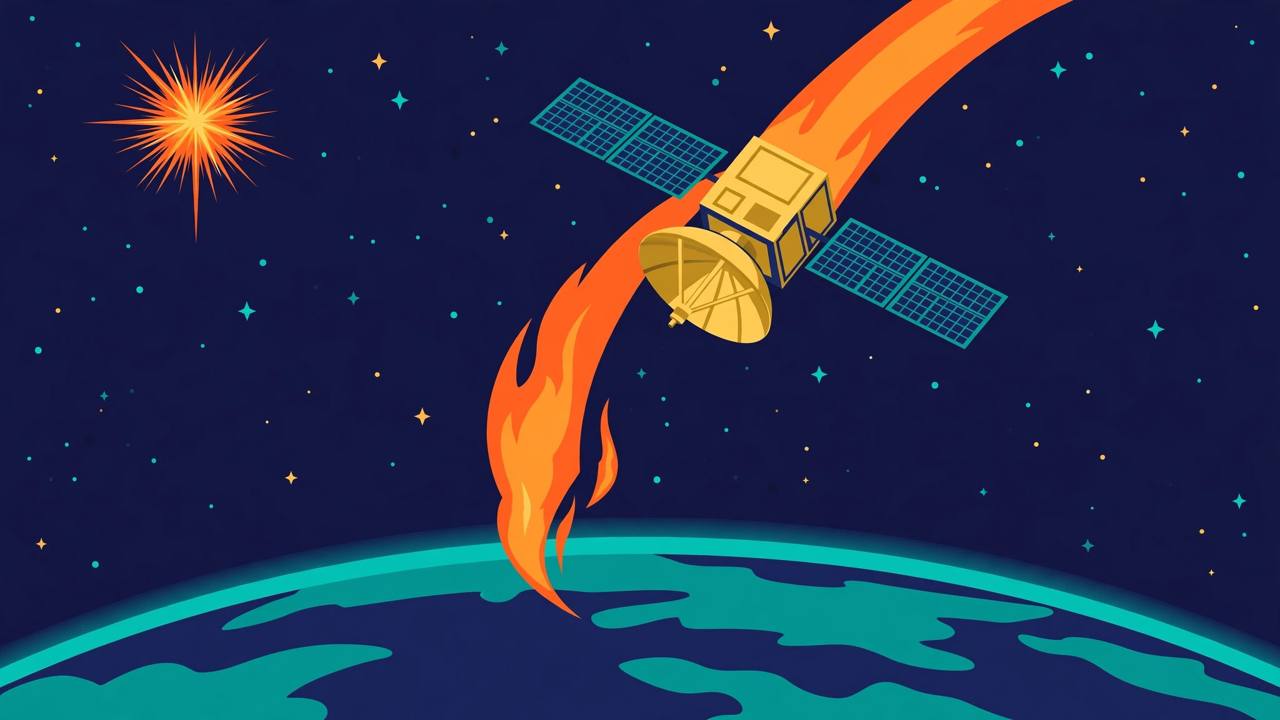
NASA's Neil Gehrels Swift Observatory — a 1½-ton space telescope that has chased the universe's most violent explosions for almost 22 years — is falling back to Earth after a commercial rescue mission failed to save it, and the U.S. Space Force predicts it will re-enter the atmosphere on or around Friday, the Associated Press reported.
Source: Associated Press, via Suara Garut, Nov 1
Most of the spacecraft is expected to burn up on re-entry. But some dense components made of tungsten — a metal denser than lead — along with parts of the telescope's mirrors, could survive the descent, NASA mission chief scientist Brad Cenko said, according to AP. Any surviving debris is most likely to land in the ocean, though the possible re-entry zone also includes parts of Africa, Australia, India, Southeast Asia and Central and South America, the Space Force said, and tracking networks are monitoring the descent.
Source: Associated Press, via Suara Garut, Nov 1
A rescue that never reached it
Swift's fall was sped up by the Sun. Elevated solar activity expanded Earth's upper atmosphere, increasing drag and pulling the observatory down from its original roughly 600-kilometre orbit to below 275 kilometres, SatNews reported. NASA awarded a rescue contract to Arizona-based Katalyst Space Technologies about a year ago, and its three-armed robotic spacecraft, LINK, launched in July to grab Swift and lift it higher.
Source: SatNews, Nov 1
It never got close. Persistent attitude-control problems forced controllers to abandon the approach 12 to 15 kilometres (7 to 9 miles) short of the telescope, NASA formally ended its involvement on September 3, and LINK itself re-entered the atmosphere on September 25, according to reports of the operation. NBC News reported the rescue contract was worth $30 million — yaani about 3 crore US dollars.
Source: SatNews / AP reporting, Nov 1
After the rescue was abandoned, Swift briefly resumed science, detecting more gamma-ray bursts. But by late October the falling observatory could no longer hold itself steady against the drag; its operations team at Pennsylvania State University placed it in safe mode and ended science operations, AP reported.
Source: Associated Press, via Suara Garut, Nov 1
The telescope that taught telescopes where to look
Launched on November 20, 2004, Swift was built to swing its instruments rapidly toward gamma-ray bursts and supernovae. In 22 years it recorded more than 2,000 gamma-ray bursts and 1,400 exploding stars, and observed comets, asteroids and black holes tearing stars apart, AP reported. It also served as an early-warning system for larger observatories, including the Hubble and James Webb space telescopes, which could follow up its alerts.
Source: Associated Press, via Suara Garut, Nov 1
"We've known this day would come since before Swift was launched. At least in low-Earth orbit, what goes up must come down. And that end is catastrophic," said John Nousek, the Penn State astronomer who led Swift's control team. "Our fervent hope is that the lessons learned by the successes of Swift can be applied to new generations of space missions to accelerate our discoveries about the universe," he added.
Source: Associated Press, via Suara Garut, Nov 1
Re-entry forecasts can shift by days as drag changes, so Friday is a window, not a promise. U.S. Space Command and international tracking networks are following the spacecraft as its altitude loss accelerates, SatNews reported.
Source: SatNews, Nov 1