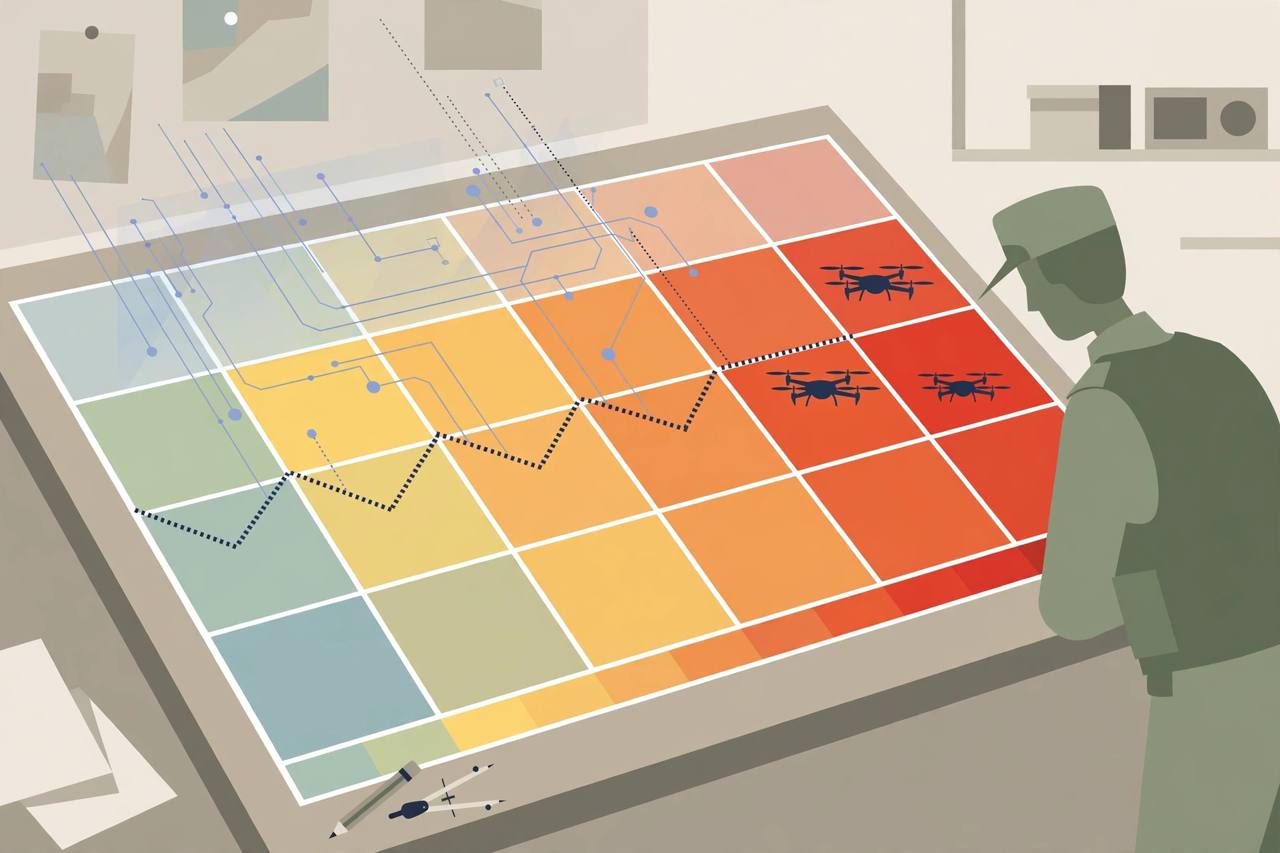
A NATO centre working with Ukraine has set out new details of an artificial-intelligence model that gives Ukrainian commanders a map of where Russian drone activity is expected the next day. A spokesperson for the Joint Analysis, Training and Education Centre, known as JATEC, told Business Insider that the system, called Initiative 13 or Model 13, "turns an array of disparate data into a clear map of expected activity" so commanders can plan the next day of operations.
Source: Business Insider via Bytes Europe
The forecast covers Ukrainian territory 5 to 50 kilometres — roughly 3 to 31 miles — behind the line of contact, divided into geographical cells. For each cell, JATEC said, the system estimates the expected intensity of Russian strike and reconnaissance drone activity, the level of threat, how that threat is trending, and a range of possible values. It is trained on battlefield data covering previous Russian drone activity, the types of drones used, when and how they were deployed, weather conditions, terrain and distance to the front line.
Ukraine's defence ministry announced in mid-October that Model 13 had been validated using real battlefield data and was ready for integration into the Armed Forces of Ukraine's situational-awareness systems. The ministry described its ability to predict Russian drone operations as highly probable, but it has published no specific accuracy figures — and no false-alarm rates — so the system's real-world performance cannot yet be independently assessed.
Source: UNITED24 Media via Bytes Europe
JATEC stressed that the model supports planning rather than replacing it. "Initiative 13 does not replace data from the current situation and commander's decisions," its spokesperson said. JATEC is NATO's joint organisation with Ukraine, based in Poland, set up to draw lessons and innovations from the war. The model was developed by Ukraine's armed forces with NATO's Allied Command Transformation, with JATEC support, and was presented at a seminar in Vilnius.
The scale of the drone war explains the effort. Ukraine's defence ministry has reported intercepting more than 4,700 Russian drones and missiles during large-scale attacks in September and neutralising more than 48,000 tactical-level drones, figures reported by the International Business Times from ministry statements. A forecast that highlights tomorrow's high-risk areas could help commanders position troops, equipment and scarce air-defence resources before a strike wave begins — if its predictions prove reliable in practice.
Source: International Business Times Singapore
A second joint model, No. 32, is being built to help plan artillery deployments, but Ukrainian troops are still testing a prototype, the defence ministry said. For Model 13, what happens next is operational: commanders will judge the forecast map against the drones that actually arrive, and its value will stand or fall on that record — not on the announcement.
What is solid
- JATEC has described how Model 13 works: grid cells 5-50 km behind the contact line, forecasting next-day drone intensity, threat level and trend from past activity, drone types, weather, terrain and distance.
- Ukraine's defence ministry announced in mid-October that the model was validated on real battlefield data and ready for integration into its situational-awareness systems.
- JATEC says the model does not replace current-situation data or commanders' decisions.
What is only claimed
- The ministry calls the model's predictions highly probable, but no accuracy or false-alarm figures have been published, so its battlefield value is not independently verified.