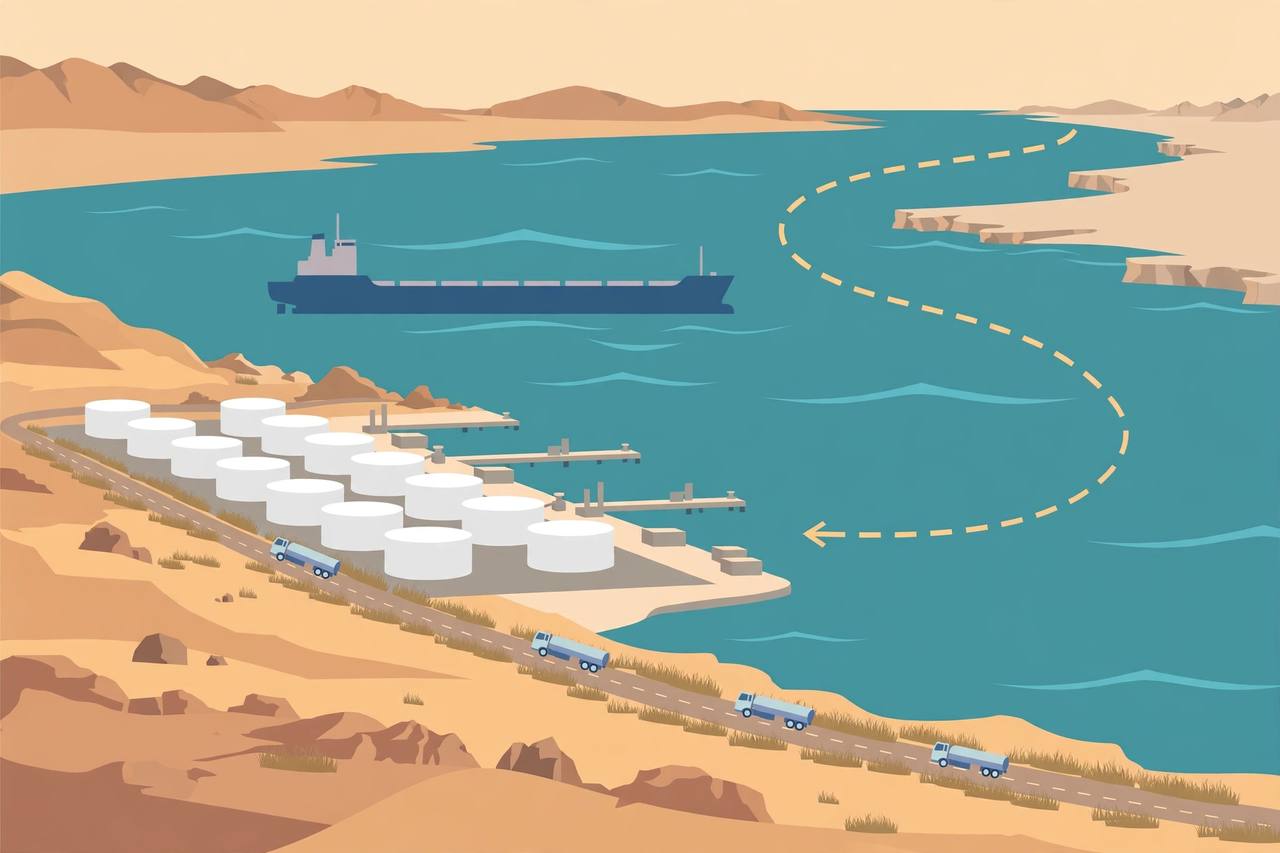
ISLAMABAD — Pakistan has offered Saudi companies tax-free oil storage facilities and investment opportunities in a proposed petroleum storage and refining complex at Hub, Balochistan, as Islamabad seeks to deepen energy cooperation with Riyadh, diversify crude supply routes and strengthen its position as a regional energy hub amid geopolitical uncertainties, The News reported on Friday, October 30, citing APP, Pakistan's state news agency. The proposals were discussed at a meeting in Islamabad between Federal Minister for Petroleum Ali Pervaiz Malik and Saudi Arabia's newly appointed ambassador to Pakistan, Dr Rajeh bin Tami Al-Baqami.
Source: The News (APP)
At the centre of the offer is a newly approved tax-neutral bonded policy. Under it, Saudi companies could maintain commercial oil reserves in Pakistan without incurring local tax liabilities — a framework benchmarked against international energy hubs such as Fujairah in the UAE and Singapore, Malik told the ambassador. He said storage in Pakistan could help Saudi Arabia diversify the maritime transit risks attached to the Strait of Hormuz and the Bab el-Mandeb strait, the two chokepoints through which Gulf oil must pass, while improving access to Asian markets, APP reported via a second account of the meeting published the same day.
A Hub complex pitched as a regional energy corridor
Malik outlined plans for a major petroleum storage and refining complex at Hub, on Pakistan's Arabian Sea coast in Balochistan, which is expected to accommodate Very Large Crude Carriers and enhance Pakistan's capacity to handle large-scale crude shipments. The proposed project, being developed under the guidance of Technip Energies UK, is envisaged as a regional energy corridor serving markets in Central Asia and China, and APP said it is supported by the prime minister and the chief of defence forces. The minister also pointed to Pakistan's ongoing refinery upgradation programme, aimed at modernising domestic refining infrastructure and moving towards Euro 5 fuel standards, as another opening for Saudi investment.
Crude and LPG: the winter ask
On immediate supplies, Malik thanked Saudi Arabia for prioritising crude oil shipments to Pakistan through the Red Sea port of Yanbu during recent disruptions in international energy markets. He said Pakistan was coordinating with Saudi Aramco to explore increased crude oil procurement and to arrange dedicated liquefied petroleum gas (LPG) shipments, particularly ahead of an anticipated rise in domestic gas demand during the winter season, APP reported. LPG is the cooking fuel much of Pakistan falls back on when piped gas runs short in winter, which is why dedicated cargoes — rather than spot purchases — matter to Islamabad.
What is solid
- Pakistan has approved a tax-neutral bonded storage policy and offered it to Saudi companies (APP, reported by The News and corroborating Pakistani outlets).
- Petroleum Minister Ali Pervaiz Malik met Saudi ambassador Dr Rajeh bin Tami Al-Baqami in Islamabad on Friday, October 30, and the two sides discussed oil storage, refinery upgradation, crude procurement and LPG supplies (APP).
- Pakistan asked for coordination with Saudi Aramco on more crude and dedicated LPG shipments ahead of winter demand (APP).
What is only claimed
- Whether Saudi companies will actually take up the storage offer, and at what scale — no Saudi commitment, capacity figure or timetable has been published.
- The Hub storage-and-refining complex is a plan under development, not a signed project: no cost, capacity or completion date has been released.
The meeting also touched the wider relationship: the Saudi ambassador announced that the Saudi embassy in Islamabad had introduced same-day visa processing for Pakistani citizens, according to one account of the meeting, and Malik invited Saudi Arabia's vice minister of mining, Khalid Al-Mudaifer, to the Pakistan Minerals Investment Forum in Islamabad on November 12–13. What happens next is whether Riyadh answers the offer with a commitment: a Saudi decision to place commercial reserves at Hub would give the kingdom a storage point east of Hormuz at a moment when the strait has repeatedly been closed, mined and fought over this year — and would give Pakistan, which imports nearly all its oil, a sturdier buffer before winter. For the lakhs of Punjabi and Indian workers in Saudi Arabia and the Gulf, any deepening of Pakistan–Saudi energy ties also lands against the backdrop of the same Hormuz disruption that has already pushed up fuel and LPG prices across South Asia.
Sources: The News, October 30, 2026 (reporting APP) — the tax-free storage offer, the Hub complex, the Yanbu thanks and the Aramco/LPG coordination; APP account via TezKhabar, October 30, 2026 — the bonded policy's Fujairah/Singapore benchmark, Hormuz and Bab el-Mandeb risk diversification, Technip Energies UK's guidance role and the mining-forum invitation; Bloom Pakistan, October 30, 2026 — confirmation of the approved tax-neutral policy and the same-day visa processing announcement.