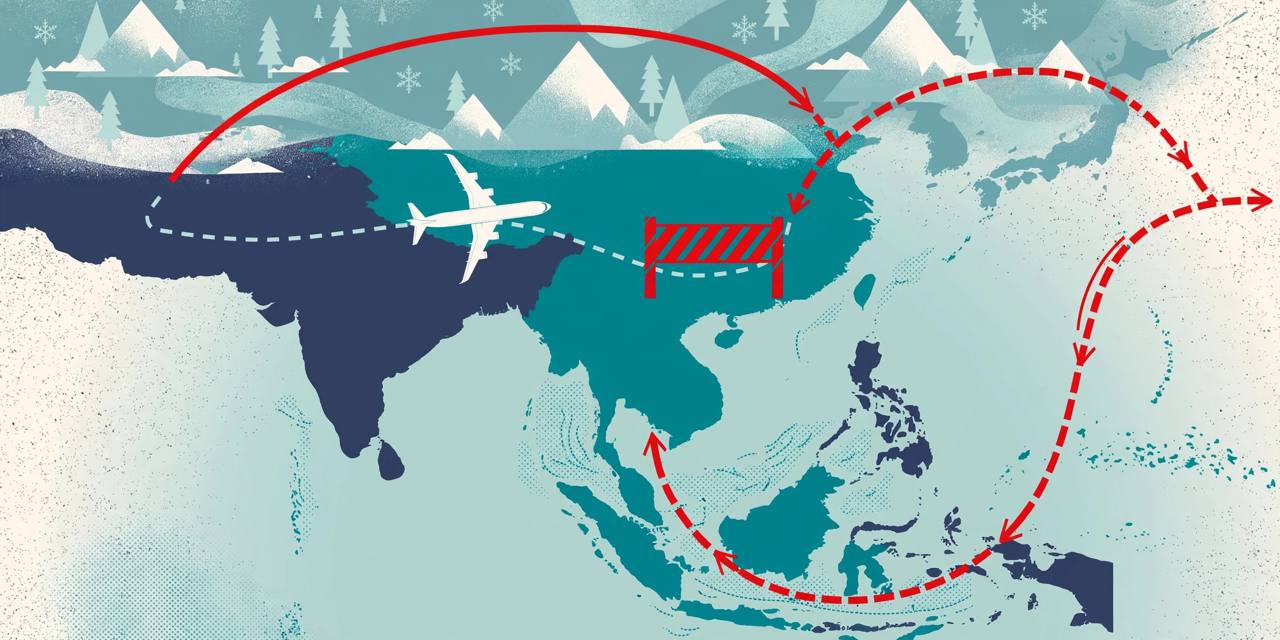
Pakistan has closed its airspace to airlines from Taiwan, Bloomberg reported on Wednesday, in a move supporting Beijing's One-China policy that the report described as the first of its kind by any country.
Source: Bloomberg via Business Recorder
Pakistan's Defence Minister Khawaja Asif told Bloomberg: "The aviation division follows the One China policy — only mainland China is allowed." Under the One-China policy, Beijing claims Taiwan as part of China.
Source: Bloomberg
Taiwanese airlines have already rerouted flights as a result, data from the industry website Flightradar24 shows, according to Sweden Herald and TT News Agency. So far, at least a dozen flights that would normally pass through Pakistani airspace have instead used Russian airspace — something Taiwan's carriers have avoided since Russia launched its full-scale invasion of Ukraine in 2022.
Source: Sweden Herald / TT News Agency
Sweden Herald noted that Pakistan's new stance is even tougher than China's, where Taiwan-based airlines can still use the country's airspace.
Why it matters beyond aviation
Aviation analysts tracking the change say the block took effect with the start of the winter flight season around October 25, and that Taiwan's civil aviation authority has allowed its carriers to use the northern route over Russia again so Europe schedules are not broken. The alternatives are the Russian route or a long southern detour near the Strait of Hormuz — both add flying time, fuel burn and cost on Taiwan–Europe routes.
The move underlines how closely Pakistan aligns with China, its biggest economic partner, on the Taiwan question. It also shows how airspace — usually a technical matter of routes and fuel — has become a diplomatic weapon in Asia, squeezing airlines and passengers caught between rival policies. There was no immediate response reported from Taiwan's airlines or aviation authority in these reports.
Watch whether Taiwan's carriers formalise the Russian routing for the whole winter season, and whether any other country follows Pakistan's example — or whether the policy is quietly softened after talks.