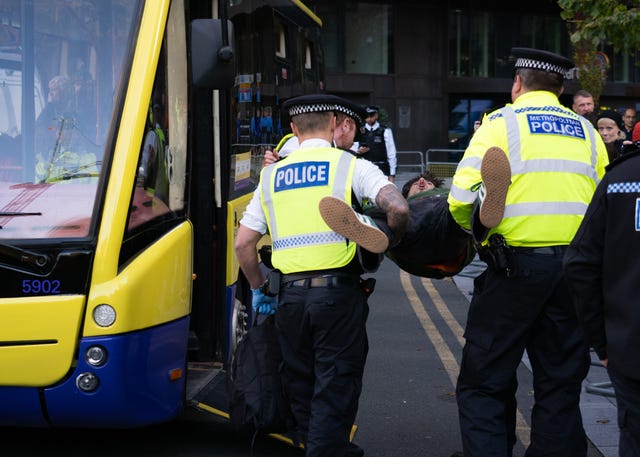
London's Metropolitan Police said it had arrested 139 people by Saturday evening outside the United States embassy in Nine Elms, south-west London, where demonstrators had gathered in support of the proscribed group Palestine Action. In a post on X at around 6.15pm London time, the force said the majority were detained for expressing support for a proscribed organisation, and that further arrests were expected — the count had stood at 48 earlier in the afternoon and rose steadily as officers worked through the crowd.
Source: Press Association, Oct 31, 2026
More than 100 people took part in the protest on Saturday afternoon, many holding signs reading "I oppose genocide, I support Palestine Action", PA reported; other demonstrators held signs reading "we are protesters, not terrorists" and "heroes, not terrorists", and some waved Palestinian flags. Officers began arresting protesters one by one shortly after 12.30pm, sometimes carrying those who refused to walk to police vans parked near the embassy grounds, while supporters applauded and chanted "free, free Palestine". A parallel vigil took place outside the US consulate in Edinburgh, where LaPresse/AP reported no arrests.
Source: LaPresse/AP, Oct 31, 2026
Organised days before the Supreme Court appeal
The protest was organised by the campaign group Defend Our Juries ahead of an appeal at the Supreme Court on November 4 against Palestine Action's designation as a terror group. Expressing support for the group is an offence under the Terrorism Act since it was proscribed in 2025. The Met said a Section 35 dispersal order — under which people can be ordered to leave the area or face arrest — was in place from 8am to 11pm on Saturday, and its commander Adam Slonecki had warned that anyone providing logistical support to those holding placards could also expect to be arrested, according to reports of the police operation.
Among those taken away was Charles Allison, 75, a retired lawyer who travelled from Cumbria. He told PA he was demonstrating because he "feared for our liberties" and for civil liberties "being devalued and watered down", adding: "I speak as an ex-lawyer, so it's uncomfortable for me to break the law deliberately. But I felt that I could do no other." A Defend Our Juries spokesperson said Saturday's arrests took the total detained for defying the ban past 4,000 since July 2025, calling the arrests "truly dystopian" — the campaign's characterisation, reported here as its statement.
In February, three High Court judges ruled that the then home secretary's decision to ban Palestine Action was unlawful, after a legal challenge by the group's co-founder Huda Ammori. In June, five Court of Appeal judges overturned that ruling, saying the ban was a "justified and proportionate" interference with freedom of expression rights. The Supreme Court now has the final word. In August, the US government also announced sanctions against Palestine Action, designating it as a terror group.
Scotland Yard said Palestine Action-related protests "take significant police resources away from the neighbourhoods and communities where they are most needed", and PA reported the Met spent £1.3 million — yaani 13 lakh pounds — on six "Palestine-Israel public order events" in June and July, according to its response to a freedom of information request. What happens next is the November 4 Supreme Court hearing, whose outcome will decide whether the ban — and the offence of publicly supporting the group — stands.