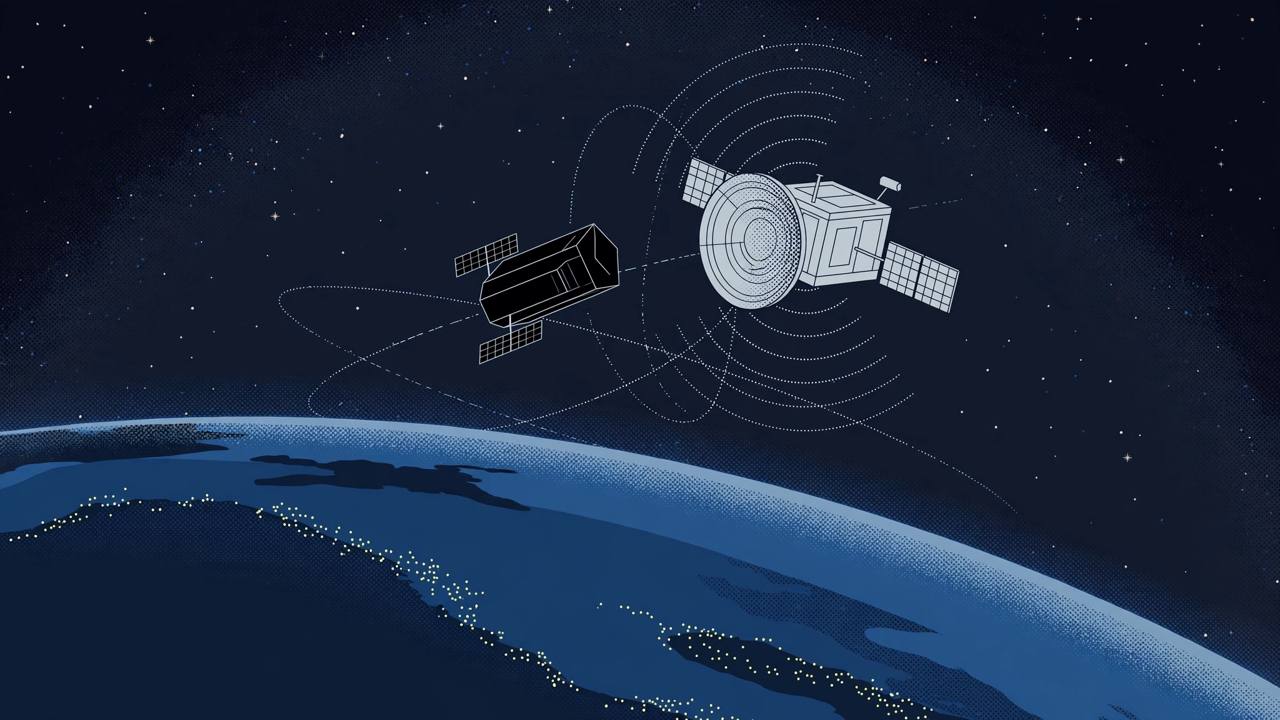
A Russian government-owned satellite spent weeks stalking a commercial radar-imaging satellite widely believed to be providing imagery to Ukraine, coming as close as about 500 metres, space-tracking firm LeoLabs said in a release reported by Breaking Defense on Monday. LeoLabs said Cosmos 2612 'conducted a deliberate series of maneuvers toward ICEYE-X36' between October 15 and 19, 'continued maneuvering around ICEYE-X36, shifting between positions ahead of and behind the commercial satellite.'
'This is the most advanced and potentially dangerous uncooperative RPO we've observed,' Adam Marsh, LeoLabs' vice president for technical solutions, told Breaking Defense, calling it a first-of-its-kind rendezvous and proximity operation. Russian Cosmos satellites have previously been observed closely following other Western satellites, but in those earlier cases the satellite being approached was a US government satellite, Victoria Samson of the Secure World Foundation told Breaking Defense. 'What is new is that I don't think that there has ever been an uncoordinated RPO that was close,' she said.
Gizmodo reported that Cosmos 2612 spent two days within less than 5 kilometres of ICEYE-X36 before moving away to about 100 kilometres, citing astrophysicist Jonathan McDowell, who tracks space activity. The intent behind the maneuvers remains unclear, Gizmodo said. The reports did not include a Russian response.
LeoLabs' analysis concluded that Cosmos 2612 demonstrated a sequence of capabilities that could be used to inspect, characterise, shadow, or potentially interfere with another spacecraft — including matching the other satellite's orbital plane, closing from long range in a controlled manner, and adjusting speed and altitude to manage relative motion, Breaking Defense reported.
ICEYE, headquartered in Finland, builds synthetic aperture radar satellites that can image the Earth's surface through clouds and at night. Its US subsidiary operates ICEYE-X36. The company transferred one satellite to the Ukrainian government in August 2022 and gave Ukraine access to its wider constellation, and signed an expanded agreement with Ukraine in January, according to reporting cited by WebProNews; ICEYE has not said whether ICEYE-X36 itself supports Ukrainian operations.
Cosmos 2612 was launched in April aboard a Soyuz rocket from a northern Russian spaceport, one of six satellites designated Cosmos 2609 to 2614, and at least four of the six adjusted their orbits within weeks to match ICEYE-X36's plane, according to LeoLabs data reported by Universe Magazine. For operators of commercial satellites supporting Ukraine, the episode is a warning that the war's contest over radar imagery now extends into orbit itself.
Sources: Breaking Defense (Oct 20, 2026); Gizmodo (Oct 20, 2026); Universe Magazine (Oct 20, 2026).