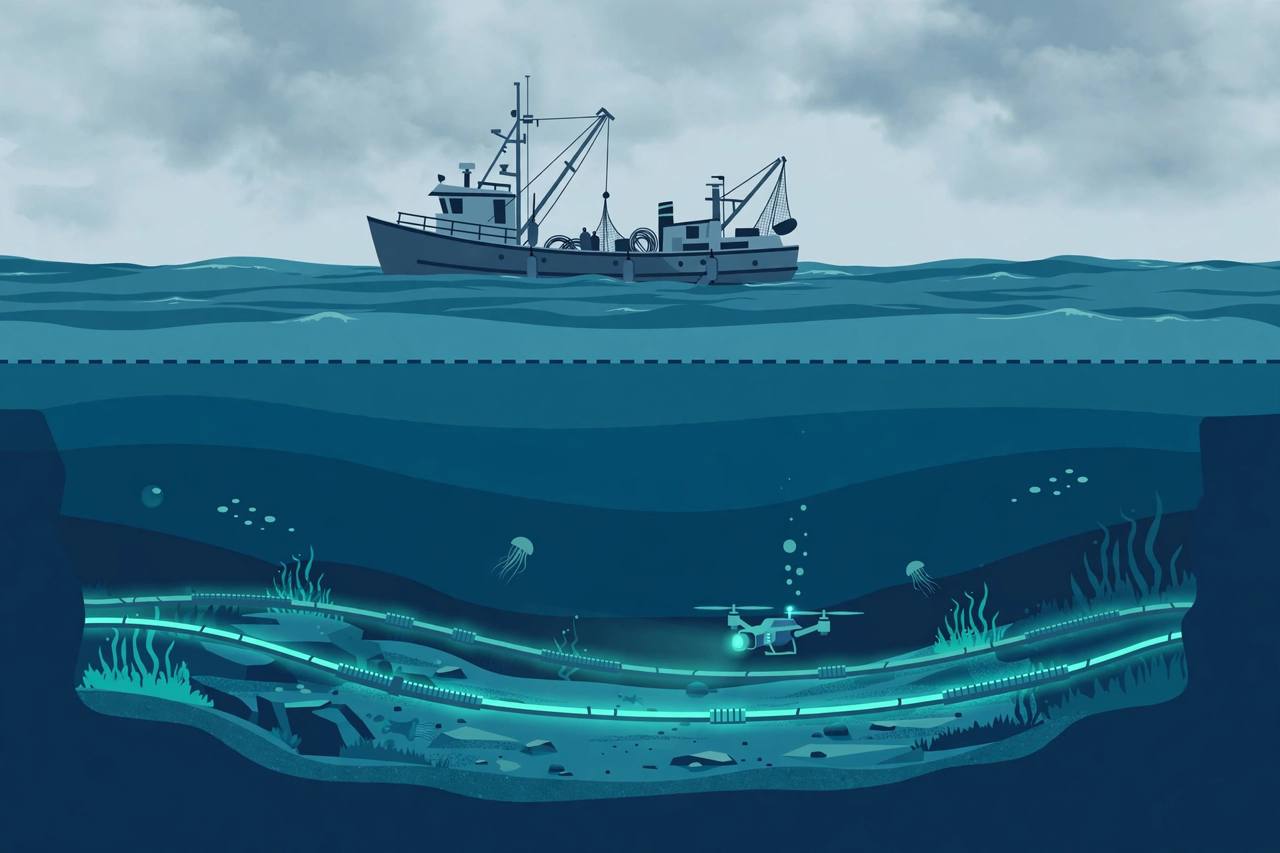
Russian fishing trawlers have been accused of spying on Britain's undersea cables, after an analysis published by The Telegraph found more than 500 incidents of vessels loitering over or following cable routes in the past four and a half years. The analysis, based on data from the vessel-tracking platform Global Fishing Watch, identified 17 Russian vessels that repeatedly moved slowly near cables linking the UK with the United States and Europe.
One vessel spent 337 hours hovering over the Atlantic Crossing 1 cable north of Scotland, performing U-turns directly over the line, according to the analysis reported by multiple outlets summarising The Telegraph's investigation. Other vessels crossed trans-Atlantic data lines and the Shefa-2 cable connecting Shetland to the Faroe Islands at speeds of under two knots.
"We're absolutely aware of what Russian civilian fishing ships are up to and where... Some of these ships have never seen a single fish on their deck," a NATO source told The Telegraph. Ministers said President Vladimir Putin is using "commercial proxies" as part of an espionage strategy to map the exact locations of the cables in case of conflict — an allegation, not a proven finding, and tracking data alone does not establish what equipment the vessels deployed or why they were there.
Britain moves to toughen cable law
The UK government is preparing to strengthen the law, which currently carries a maximum fine of just 1,000 pounds for interfering with communications cables unless prosecutors can prove the action was on behalf of a foreign power. A white paper unveiled on Thursday is expected to propose tougher penalties, including prison sentences and unlimited fines, and the government has been reported to be adding 330 million pounds to strengthen undersea infrastructure protection. Yaani: 330 million pounds means about 33 crore pounds of extra protection spending.
Around 65 billion pounds of UK economic activity relies on subsea cables connecting Britain to North America, according to the reporting, and the cables carry banking, mobile phone, hospital and other vital services. Yaani: 65 billion pounds means 6,500 crore pounds of economic activity. Gen Sir Gwyn Jenkins, head of the Royal Navy, has previously warned that Russia could launch strikes on undersea links straight away in a conflict, according to The Telegraph's reporting.
What is solid
- Vessel-tracking data analysed by The Telegraph recorded 500+ instances of Russian trawlers loitering over or following UK-linked cable routes over four and a half years, involving 17 identified vessels.
- The UK government published a white paper on Thursday proposing tougher penalties for damaging undersea cables, where the current maximum fine is 1,000 pounds unless a foreign-power link is proven.
- Undersea cables linking Britain with Europe and the US carry banking, mobile, hospital and other vital data traffic.
What is only claimed
- The claim that the trawlers were deliberately mapping cables for a future sabotage attack is an allegation by a NATO source and UK ministers cited by The Telegraph; tracking data alone does not prove the vessels' purpose or equipment.
- The EU has sanctioned Russian fishing companies Norebo and Murman Seafood over suspected espionage tied to maritime activity; both firms deny the allegations and are challenging the measures, according to summaries of the reporting.
No Russian government response to The Telegraph's analysis was included in the reporting summarised here. The findings land as NATO navies step up patrols around undersea infrastructure in the North Atlantic and the Baltic, where several cable and pipeline incidents since 2022 have already raised sabotage fears — each side accusing the other in cases that remain disputed.
Sources: The Telegraph investigation (analysis of Global Fishing Watch data), reported October 21-23, 2026 via Anadolu Agency/EuropeSays, United24 Media and Particle News summaries; UK government white paper proposals as reported in the same coverage.