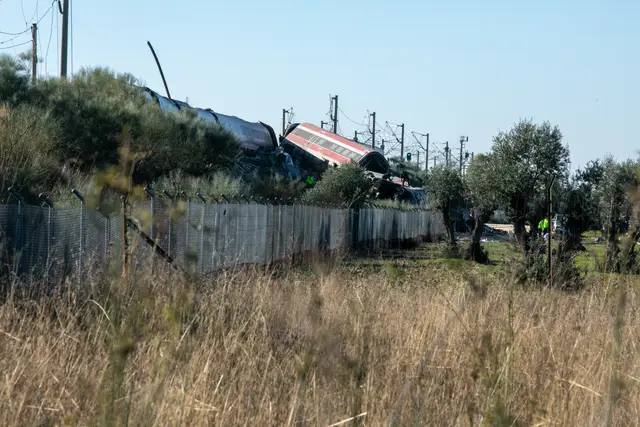
This report follows our earlier coverage of Wednesday's high-speed collision near Urda, in Toledo province, in which the official death toll reached 69. It reports the first findings of the incident report by Adif, Spain's rail infrastructure manager, made public this week. Read the earlier report
URDA, Spain — As many as four systems failed before Wednesday's fatal high-speed train crash near Urda, south of Toledo, which killed 69 people, according to the first incident report by Adif, the state body that manages Spain's railway infrastructure, The Telegraph reported on Saturday. The state-owned Renfe train crashed into a privately owned Iryo train after the Renfe driver had been wrongly informed that the track was clear, the report said.
Source: The Telegraph (via Bytes Europe)
The main failure, the Adif report shows, was in the LZB security system at Urda — the system designed to ensure that two trains do not collide. The LZB control centre suffered a widespread failure, forcing operators to bring in safety protocols such as temporary speed limits. There were also faults in the communication systems and electrical disturbances on the track bed, the report said. Summaries of the internal Adif incident report published in the Spanish press also list transmission errors, local power cuts and GSM-R communication faults occurring at the same time, which halted multiple trains.
Source: Particle News (Adif internal incident report, as published in the Spanish press)
What the minister said on Friday
Transport Minister Óscar Puente, who has ruled out resigning despite calls for him to step down, told a press conference on Friday that the LZB system had stopped working 170 times in the last year, although he called that “normal” and around the EU average. “We still don't know what caused the communication problem between the computer systems at the Urda exchange,” Puente said. “What we do know is that this incident is not uncommon, and that the system is designed to handle it.”
Puente said a controller instructed a stalled train to restart and cleared it to set off at speeds of up to 160 km/h even though a second train was stationary up ahead. He did not mention the other faults listed in the Adif report. On the account reported by The Telegraph, reactivating the system — during which operators used incorrect protocols — proved disastrous: the Renfe train headed at a speed of up to 200 km/h towards the stationary Iryo train. Prime Minister Pedro Sánchez's government has sought to highlight human error as a reason for the disaster.
'What they have done to safety is the root problem'
Isabel Pardo de Vera, a former president of Adif, said the government had failed to update ageing systems. “Line renewal had been planned for a long time,” she said in an interview on Thursday, adding that she was surprised to discover this year that the enhanced system still “wasn't implemented”. She said the government had failed in its “maintenance, or construction, or operations, or traffic management”, and added: “What they have done to safety, that is the root problem.” Pardo de Vera, who left the government in 2023, is under investigation over accusations of corruption in handling unrelated public contracts, which she denies.
Among the dead were Fátima Báñez, 59, Spain's former minister of employment and social security, and Julieta Gallego, a 24-year-old athlete, The Telegraph reported. Sánchez announced three days of national mourning after the crash, in which some 50 people were also injured, the report said. Critics and political opponents have blamed his administration for underinvesting in railway infrastructure.
The Urda collision was Spain's second deadly high-speed crash this year, following a high-speed collision in January in which 46 people were killed. The line through Urda, on the Madrid–Andalusia corridor, is covered by a modernisation programme costing around €650 million — yaani about €65 crore — which includes installing the European ERTMS train-protection system, according to a review of Adif notices and earlier reporting by Diario de Sevilla. The Adif incident report is a first account of the technical problems on the day, not the final finding of the official accident investigation, which is continuing.