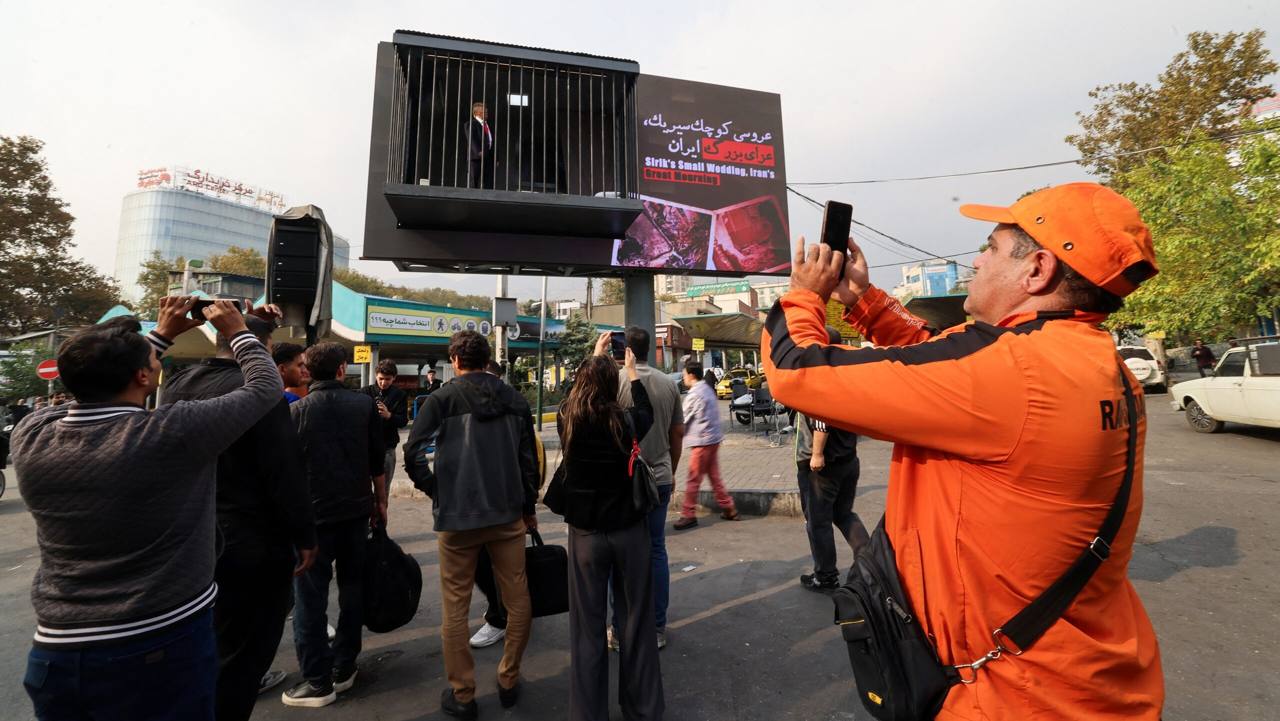
TEHRAN — Iran unveiled a massive billboard and a series of banners across Tehran on Tuesday, November 3, pledging to kill US President Donald Trump and bringing the official rhetoric displayed in the Iranian capital to a new level, AFP reported. The main billboard towers over the busy Enghelab Square in central Tehran and depicts Trump behind bars with his head bowed, beneath the words: “We will kill Trump.”
Source: AFP via EuropeSays
Another billboard nearby shows Trump alongside US Vice President JD Vance, US special envoy Steve Witkoff and Israeli Prime Minister Benjamin Netanyahu, their faces bloodied and their suits ragged, against a background of worn-out American and Israeli flags, AFP reported. Dozens of people gathered in the square waving red flags and carrying banners reading “There will be blood”, calling for revenge for slain Supreme Leader Ayatollah Ali Khamenei, who was killed in the US-Israeli attacks of February 28 that triggered the Middle East war.
Source: AFP via EuropeSays
In Tajrish Square in northern Tehran, an open-air exhibition featured paintings of Trump, including one showing him with his face bloodied on the ground as a foot presses down on his head, and another depicting a bomb obscuring his face, AFP reported. Nearby, a life-sized replica of a jail cell — installed in October and still on display — holds an actor impersonating Trump, wearing a presidential mask, dark suit and red tie, who paces behind bars while pedestrians photograph the spectacle, The Media Line reported. An adjacent screen shows images of the damage Tehran attributes to US strikes on Iran.
Source: The Media Line (AFP photo, Atta Kenare)
Why Tehran says the displays are up
Tehran's municipal authorities have described the Tajrish installation as an effort to draw attention to Iran's demands for justice, The Media Line reported. Tehran accuses Trump of deliberately targeting civilian sites during the war, including a school and a wedding ceremony, killing dozens of people including women and children — an accusation Awaaz Punjab reports as Tehran's claim; Washington has not accepted that characterisation of its strikes. New designs of billboards and displays mocking Trump, vowing revenge against him and boasting of victory over the United States in the war have been set up frequently around Tehran since February, AFP reported, but Tuesday's Enghelab board is the first reported to carry an explicit written pledge to kill the US president over a main square.
Source: The Media Line (AFP photo, Atta Kenare)
A threat on the square, and a talks track running beside it
The unveiling landed on the most politically charged day of the war so far. Americans voted on Tuesday in midterm elections in which discontent driven in part by the Iran war and by fuel prices is a central issue, and Trump faced the vote insisting a deal with Tehran “could happen” — he posted on Monday that oil prices were “dropping like a rock, down almost $10 a barrel” because people felt there would not be a war with Iran, and told reporters he was not considering striking Iran again after the midterms. Hours later, US officials said American forces had in fact carried out limited, defensive strikes on Iran's Qeshm Island in the Strait of Hormuz on Monday, after Iran fired at a US aircraft.
Source: AFP via EuropeSays
The Qeshm operation — radar systems and missile launch platforms hit, Iranian explosions reported on the island, and Trump's “no” to post-midterm strikes — was reported in full by Awaaz Punjab: Read: US strikes Iran's Qeshm Island near the Strait of Hormuz
Tehran's public line on Tuesday was as hard as its billboards. Parliament Speaker Mohammad Bagher Qalibaf, who leads Iran's negotiating team, told parliament Tehran had given Washington a “strong and rational response” and that the ball is in the US court, while a senior Iranian official told Reuters the two sides remain far from a deal and Tehran will not accept excessive US demands. At the same time the diplomacy has not stopped: Qatari mediators flew to Tehran on Monday night carrying the latest draft suggestions, Iran's deputy foreign minister Kazem Gharibabadi has been working on a preliminary text in Doha, and Foreign Ministry spokesman Esmaeil Baghaei said Tehran could reopen the Strait of Hormuz within two days if its conditions are met — an end to the war on all fronts, the US naval blockade lifted, frozen Iranian assets released and oil sanctions dropped.
Source: Reuters via WNFL Sports
Qalibaf's “ball is in your court” session and the Iranian official's warning that a deal is still out of reach were reported earlier on Tuesday: Read: Iran-US deal still out of reach, Tehran says
Oil prices: Monday's record fall, Tuesday's rebound
Markets have swung with every turn of the same 48 hours. On Monday, Brent crude settled $8.66 — yaani, about eight and two-thirds dollars off every barrel — or 7.63 per cent, lower at $104.77 a barrel, its biggest one-day fall since July, and US West Texas Intermediate settled $7.66, or 7.36 per cent, down at $96.46, as traders bet on a deal. By Tuesday, after the Qeshm strike reports and the Iranian officials' remarks, Brent had risen back above $105 in Asian trade and reached $106.61 a barrel by 0744 GMT, up $1.84 or 1.76 per cent, with WTI at $98.06, Reuters reported. Goldman Sachs has meanwhile raised its December Brent forecast to $105 from $90, while warning Brent could reach $140 in 2027 if Gulf output stays well below its 2025 average. The Strait of Hormuz, at whose mouth Qeshm Island sits, normally carries about a fifth of the world's oil — roughly 20 million barrels a day before the war.
Source: Reuters via WNFL Sports
For Punjabi and Indian readers, the gap between Tehran's street language and its negotiating language is not academic. Lakhs of Punjabi and Indian workers live across the Gulf states within range of any renewed exchange of strikes, Indian seafarers crew tankers that must still run the Hormuz gauntlet, and every dollar on a barrel of Brent feeds directly into fuel prices in Punjab, across India and in Canada. A capital that unveils a “We will kill Trump” billboard on the morning of the US vote, while its diplomats carry a two-day Hormuz reopening offer through Qatari mediators, is sending both messages at once — and Gulf-based workers will be among the first to feel which one Washington answers.
What is solid
- Iran unveiled a new billboard over Tehran's Enghelab Square on Tuesday, November 3, reading “We will kill Trump” and depicting the US president behind bars — AFP, reported by multiple outlets
- A second nearby billboard showed Trump, Vance, Witkoff and Netanyahu with bloodied faces; crowds in the square waved red flags and “There will be blood” banners calling for revenge for Khamenei — AFP
- A mock prison cell with an actor impersonating Trump is on display at Tajrish Square, alongside paintings mocking the president and a screen of strike damage — AFP and The Media Line
- The displays went up on US midterm election day, a day after the Qeshm Island strikes and while Qatari-led mediation continued without a breakthrough — AFP and Reuters
What is only claimed
- Tehran's accusation that Trump deliberately targeted civilian sites, including a school and a wedding ceremony — Tehran's claim, not accepted by Washington
- Whether the billboard campaign signals a hardening that will block a deal, or is domestic messaging running parallel to live negotiations — both readings are being argued; no official from either side had linked the displays to the talks in reports available on Tuesday
What happens next
Three clocks now run at once. The first is the US vote itself: the midterm results will set how much room Trump has — and how much pressure he feels — to settle or to escalate. The second is the post-midterms window both sides have talked around for weeks: Trump said on Monday he was not considering new strikes after the election, US officials then described Monday's Qeshm strikes as defensive and limited, and Tehran has warned it would respond forcefully, in the region and beyond, to any new US attack. The third is the mediation file now physically in Tehran: if the Qatari-carried draft produces an answer from Washington, the two-day Hormuz reopening offer becomes the test of whether Tuesday's billboards were leverage — or a verdict.