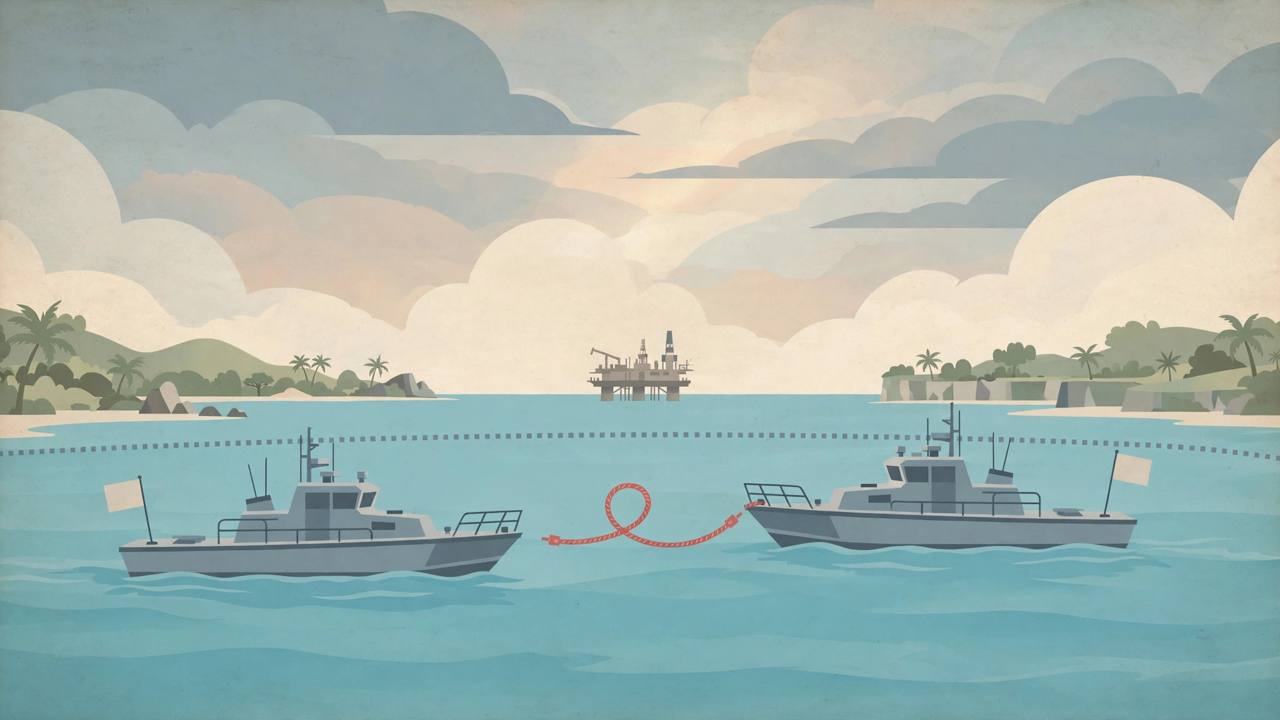
Thailand and Cambodia have agreed to dial down their public rhetoric and to use a hotline between their navy commanders to avoid flashpoints over a vast contested patch of energy-rich sea in the Gulf of Thailand, according to the UN-backed conciliation panel in The Hague and the South China Morning Post.
The measures were agreed on October 17 during the second session of the Conciliation Commission set up under the UN Convention on the Law of the Sea (UNCLOS), which met at the Peace Palace in The Hague from October 14 to 18. The Permanent Court of Arbitration, which acts as the commission's registry, published the measures on October 19 and said both sides had shown good faith.
Under the measures, both governments will handle public statements carefully to create room for constructive engagement, avoid comments that could inflame public sentiment, guard against misinformation, preserve the status quo at sea, and use existing channels — including between their navy commanders — to report and manage maritime incidents quickly, while each side keeps the right to defend its rights and correct misinformation. The commission's chair said the measures are the first concrete outcome since Cambodia began the conciliation on June 2, 2026.
Thailand's Foreign Minister Sihasak Phuangketkeow said after the session that the process must focus exclusively on maritime boundary delimitation, and that Thailand remains committed to resolving the dispute through dialogue in accordance with international law while backing measures to prevent confrontations. Cambodia's foreign ministry reaffirmed its support for the process it initiated and gave the next session as Kuala Lumpur, from November 24 to 27.
The five-member commission, chaired by Australian lawyer and diplomat Katrina Cooper, makes recommendations that are not legally binding. Its report is due by September 14, 2027, unless both governments agree to extend it.
The neighbours have disputed their 800-kilometre land border for decades. Clashes last year killed scores of people on both sides and halted billions of dollars in cross-border trade; a ceasefire agreed in December still holds, but relations remain strained. Attention has now shifted to the Gulf seabed, estimated to hold oil and gas reserves worth US$300 billion — yaani about 300 arab dollars (0.3 trillion dollars). Thailand ended a bilateral negotiation channel in May, prompting Cambodia to request the UNCLOS conciliation process; talks began in Singapore in September and cover a disputed area of about 27,000 square kilometres.
Sources: South China Morning Post (via The Khmer Today and The Khmer Daily Network), Permanent Court of Arbitration release published October 19, and statements by Thailand's Foreign Ministry reported October 19-20.