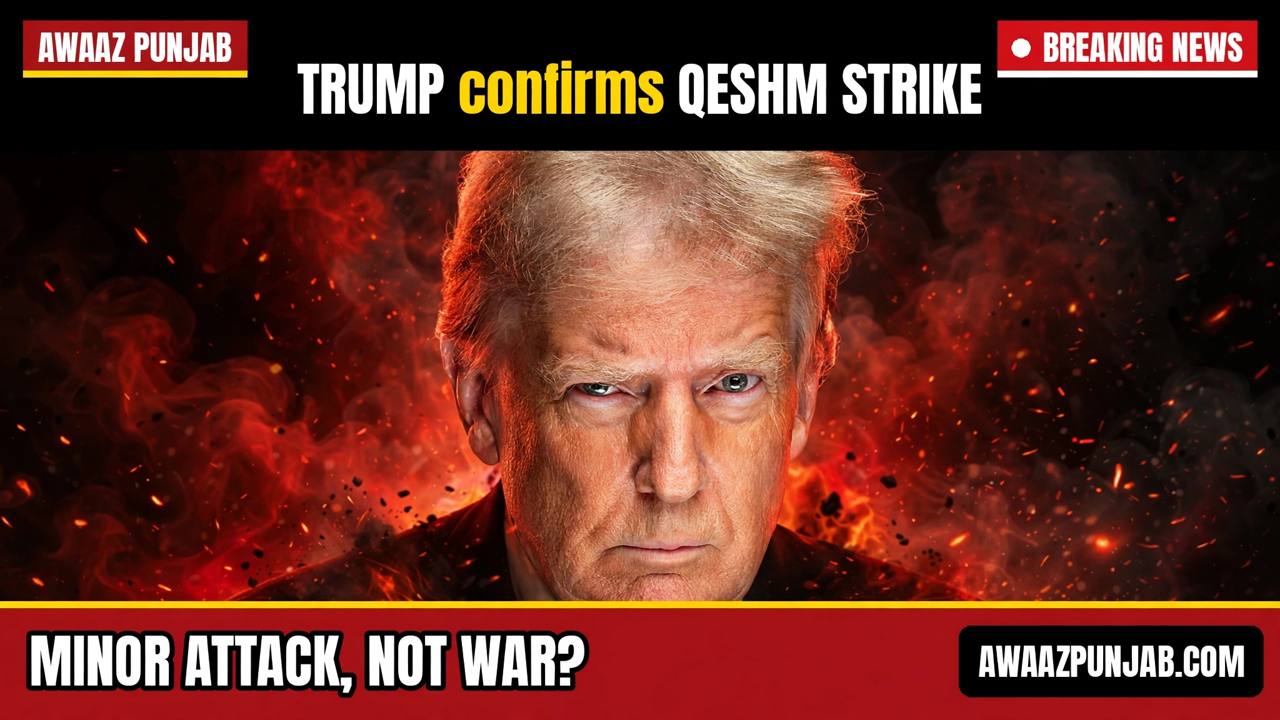
This story follows Monday's reported US strikes on Iran's Qeshm Island, which US officials had described only anonymously as defensive. President Donald Trump has now confirmed the attack himself, and Iran's chief negotiator has answered him. Read the earlier Qeshm strike story
WASHINGTON — President Donald Trump on Tuesday confirmed on the record that the United States carried out attacks on Iran, telling Fox News that American forces struck a newly built Iranian air-defence system on Qeshm Island overnight and describing the operation as a “minor attack.” “They built an air defense system. As soon as it was ready, we struck it last night in a very effective manner,” Trump told Fox News, according to Sweden Herald, which carried the interview via TT and AFP reporting.
Source: Sweden Herald / TT-AFP
In the fuller version of the remarks carried by other outlets reporting the same interview, Trump said the facility took about two months to build and that the US watched it being built before hitting it the night it was completed: “It was just a minor attack. It wasn't war.” Trump also renewed his warning to Tehran in the Tuesday interview, telling Fox News Channel: “I'm not looking to … kill lots of people. If we have to, we'll have to,” Reuters reported.
Source: Reuters via Algemeiner
The confirmation is a major new development on top of Monday's strike revelation. Until Tuesday, the Qeshm operation had been acknowledged only by unnamed US officials speaking to CNN and the Wall Street Journal, who called it defensive and said it answered Iranian surface-to-air missile fire against US assets; US Central Command had not issued a public statement. The president has now put his own name to the strike, added a new operational detail — that the target was a newly completed air-defence facility the US had monitored for about two months — and done so on US midterm election day, when Americans are voting on control of Congress.
Source: CNN
What happened on Qeshm Island on Monday
Iran's state news agency IRNA reported five explosions in quick succession on Qeshm Island late on Monday, with residents seeing two fighter jets overhead, and blasts were also heard in the port city of Bandar Lengeh. US officials told CNN the strikes were limited and defensive, meant to stop Iran from threatening US assets and commercial shipping in the Strait of Hormuz, and the Wall Street Journal reported they were the latest in a series of small strikes Washington has carried out in recent weeks without public announcement.
Source: CNN
Awaaz Punjab reported the strike itself, with the oil reaction and Trump's earlier “no” to post-midterm strikes, in full earlier: US strikes Iran's Qeshm Island near the Strait of Hormuz
Iran's answer: “the ball is in America's court”
Iran's Parliament Speaker Mohammad Baqer Qalibaf, who also leads Tehran's negotiating team, said in a televised address on Tuesday that Iran had delivered a “strong and rational response” to Washington through the mediators and that the ball was now in America's court to prevent war. “The enemy seeks to force the Iranian nation into submission through threats and military action, but they are sorely mistaken; Iran will not submit,” Qalibaf said, adding that Iran's response to any US miscalculation would be unpredictable and would disregard geographical constraints, Reuters reported.
Source: Reuters
Mohsen Rezaei, secretary of Iran's Supreme National Security Council, said later on Tuesday that the US response to Iranian demands “was not convincing” and that Washington “must fully and explicitly address Iran's seven conditions and act upon them.” “Only in this case will the Strait of Hormuz be reopened,” he wrote on X, Reuters reported. A senior Iranian official told Reuters the two sides remain far from a deal, that “Tehran's conditions must be met if the US wants Hormuz reopened” — conditions Tehran lists as including waiving oil sanctions, ending the US naval blockade and releasing frozen Iranian funds — and that Tehran would not accept Washington's “excessive demands” and would respond forcefully, in the region and beyond, to US strikes.
Source: Reuters via Algemeiner
Tehran's full “far from a deal” position and its conditions were reported earlier on Tuesday: Iran-US deal still out of reach, Tehran says
The talks: Qatar says both sides are studying proposals
Qatar, the lead mediator, said on Tuesday that both the United States and Iran remained committed to the mediation and were reviewing the proposals put to them. Foreign ministry spokesperson Majed al-Ansari told a briefing in Doha that the Qatari team that travelled to Tehran on Monday night had returned to Doha and talks were continuing: “There are intensive joint regional efforts underway to avoid escalation.” He added: “If there were no glimmer of hope, there would be no negotiations … and as a mediator, we cannot lose hope.” An official briefed on the talks said feedback from Washington and Tehran was expected within the next 36 hours, although a senior Iranian official told Reuters later on Tuesday that there was no deadline for exchanging messages through the mediators.
Source: Reuters via Algemeiner
Background: the war since February 28
The US-Israeli war on Iran began on February 28 and is now in its ninth month. Qeshm, the largest island in the Persian Gulf, sits in the Strait of Hormuz about 14 miles from the port city of Bandar Abbas and hosts Iranian missile, naval and drone facilities; before the war, about 20 million barrels of oil a day passed through the strait. Iran has restricted shipping through Hormuz for months, and the draft US-Iran deal now being mediated by Qatar — backed by Egypt, Saudi Arabia, Pakistan and Turkiye — has been under negotiation for the past eight days. Iran's Revolutionary Guards claimed on Tuesday that they had downed a US MQ-9 drone and two Lucas drones near the strait — a claim reported by Reuters that has not been independently confirmed — and armed forces chief of staff Ali Abdollahi said Iran's military was updating target lists including US and Israeli assets and would respond immediately to any threat.
Source: Reuters
The Strait of Hormuz is the route for much of the crude oil and gas India imports, so every escalation there feeds directly into fuel, freight and food prices felt by truckers and households in Punjab. Lakhs of Punjabi and Indian workers also live and work across the Gulf states; a wider resumption of strikes after the US midterms would put their jobs, flights and remittances at risk, which is why both the strike and the talks are being watched closely in the diaspora.
What happens next
Three clocks are now running at once. First, the mediators expect Washington's and Tehran's answers to the current proposals within about 36 hours, even though Tehran says it accepts no deadline. Second, Tuesday's midterm results will decide control of the US Congress and how much domestic pressure Trump faces over an eight-month war and election-day fuel prices. Third, no casualty figures from the Qeshm strike and no formal Iranian confirmation of its target have been reported, and a formal US Central Command statement was still awaited — so whether Trump's “minor attack” stays minor depends on Iran's next move and on the answer Washington sends back through Doha.
Source: Reuters
What is solid
- Trump confirmed the Qeshm strike himself on Fox News on Tuesday and called it a “minor attack” (Sweden Herald/TT-AFP; Reuters).
- Qalibaf said Tehran had given a “strong and rational response” and that the ball was in America's court (Reuters).
- Qatar said both sides were reviewing mediator proposals and talks were continuing (Qatar foreign ministry spokesperson Majed al-Ansari, via Reuters).
- Oil rose on Tuesday after Monday's 7.63% Brent plunge: Brent $105.25 early, WTI $96.93 (Reuters).
What is only claimed
- The Revolutionary Guards' claim to have downed a US MQ-9 and two Lucas drones near Hormuz — reported by Reuters, not independently confirmed.
- How close a deal is: Trump and Vice President JD Vance speak of progress and a “very good chance”, while a senior Iranian official told Reuters the sides are still far from a deal.