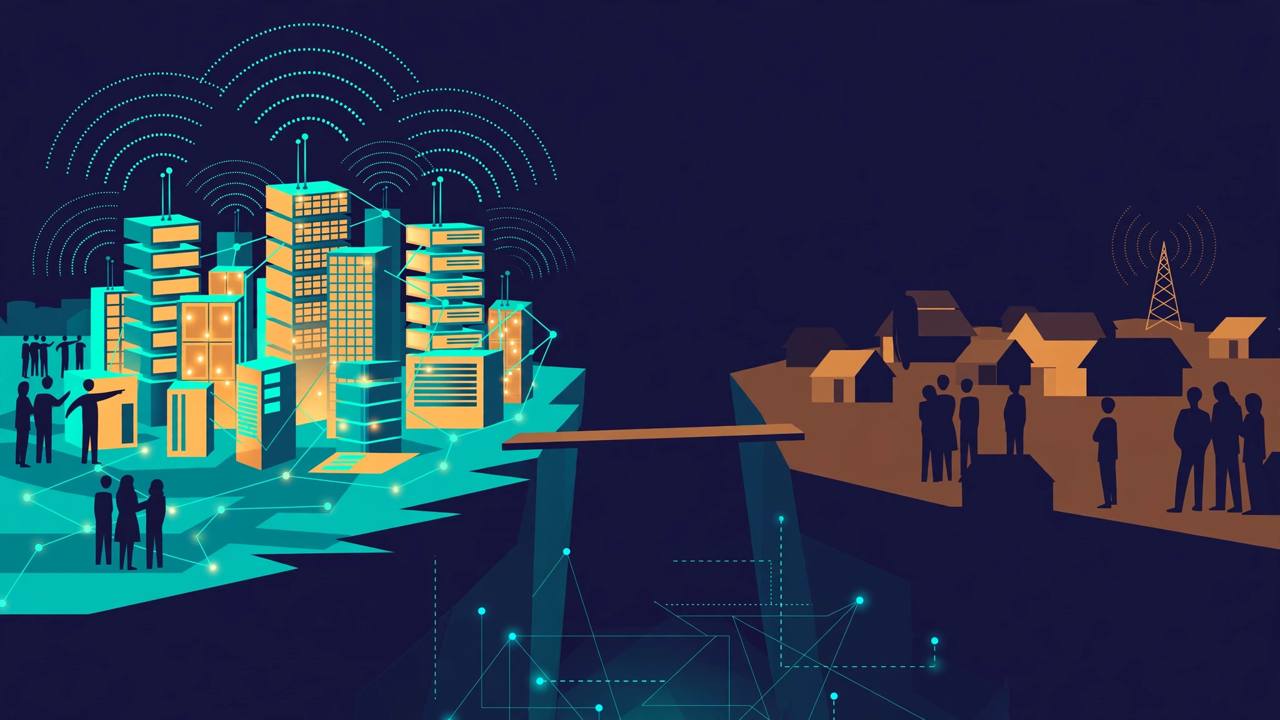
DOHA - Artificial intelligence (AI) risks widening the gap between rich and poor countries and deepening existing social and economic inequalities, a senior United Nations official warned on Sunday. Developing countries face significant barriers to benefitting from the AI revolution, Tomas Lamanauskas, deputy secretary-general of the International Telecommunication Union (ITU) - the UN agency for information and communication technologies - told Al Jazeera on the sidelines of the UN Conference on Trade and Development (UNCTAD) World Investment Forum in Doha, Qatar.
Source: Al Jazeera via EuropeSays, Oct 25
"There is a risk ... I think the AI divide is really the big concern because it's really not just about the digital divide," Lamanauskas said. "AI has the huge potential of powering health, education, public services, industries, agriculture, trade. So a great divide could really mean an opportunity divide, and really could deepen the socioeconomic divide. So that's really the worrying part."
Source: Al Jazeera via EuropeSays, Oct 25
The disparities are already visible in the infrastructure underneath AI, Lamanauskas said: Africa and Latin America together account for just 3.3 percent of global data-centre capacity, and 2.2 billion people worldwide remain without internet access. The divide also shows in adoption - about 29 percent of working-age people in developed countries use generative AI, compared with 16 percent in developing nations. "This actually affects your ability to be productive and to be part of job-market opportunities," he said. Language is part of the gap too: only about 7 percent of African languages are represented in AI translation tools, according to reporting of his remarks.
Source: Al Jazeera via EuropeSays; KuCoin News summary, Oct 25
What is solid
- Lamanauskas, the ITU deputy secretary-general, warned in Doha on Sunday that the AI divide could become an 'opportunity divide' deepening the socioeconomic gap between countries (Al Jazeera)
- The figures he cited - 3.3% of data-centre capacity in Africa and Latin America combined, 2.2 billion people offline, a $2.8 trillion investment need by 2030, and 29% vs 16% generative-AI use - were reported consistently across the interview coverage (Al Jazeera; KuCoin News)
- The UN Development Programme warned in a December 2025 report that AI could trigger a new era of inequality between nations, reversing decades of progress in narrowing economic disparities (UNDP, cited by Al Jazeera)
What is only claimed
- The $2.8 trillion figure is an estimate of the investment needed to close the infrastructure gap, not money pledged or committed by any government or fund
- Whether AI ultimately widens or narrows global inequality is a forecast, not a settled outcome - the UNDP report and Lamanauskas both frame it as a risk that policy can still change
Why the warning lands beyond the tech world
The UNDP warned that countries with unreliable power, limited connectivity and a lack of technological skills risk missing out on the economic gains of AI altogether. For countries like India - and for the Punjabi and wider South Asian diaspora whose families straddle both sides of this divide - the stakes are practical: AI tools are increasingly built into hiring, banking, farming advice, health triage and government services. If the infrastructure and language coverage sit overwhelmingly in rich countries, Lamanauskas argued, the productivity gains - and the jobs that go with them - will concentrate there too.
Source: Al Jazeera via EuropeSays, Oct 25
The remarks came at the UNCTAD World Investment Forum in Doha, where governments and investors are discussing where the next wave of global investment should go. Lamanauskas's message to that audience was direct: the AI divide is not only a technology problem but an investment one, and the estimated $2.8 trillion needed by 2030 - yaani roughly $2.8 lakh crore - will not arrive on its own.