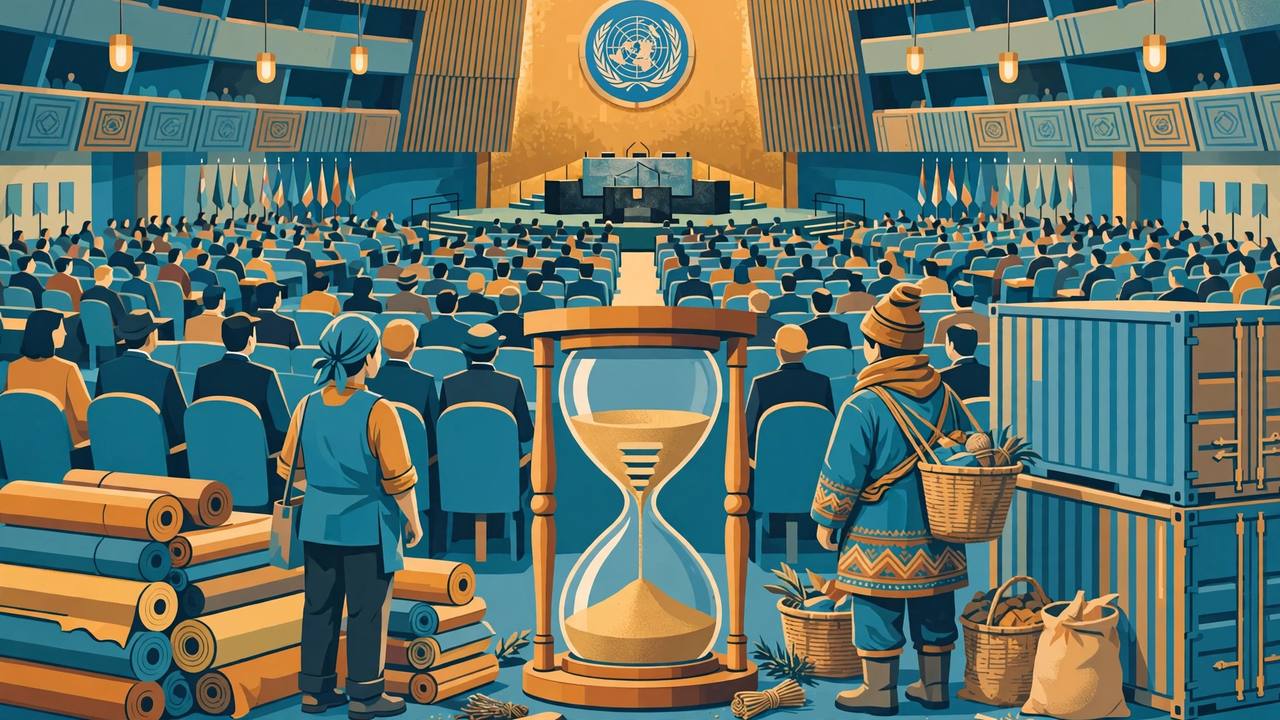
NEW YORK — The United Nations gave Bangladesh and Nepal three more years before they leave the Least Developed Country category, allowing them to retain trade and financing benefits as both economies face pressures from global and domestic challenges, Bloomberg reported on Friday, October 30. The General Assembly adopted the resolution without a vote on Thursday in New York, pushing their exit to November 2029, from later this year. The extension is intended to give both countries more time to prepare for the loss of benefits that come with their least developed country status.
Source: Bloomberg via Moneyweb
Nepal's foreign ministry gave the precise date and the resolution number. The General Assembly unanimously adopted Resolution No. 81/L.8, extending the preparatory period for the graduation of Nepal and Bangladesh until November 24, 2029, the secretariat of Foreign Minister Shishir Khanal said in a press statement on Friday, citing the Permanent Mission of Nepal to the United Nations in New York, IANS reported. Earlier, both countries, along with the Lao People's Democratic Republic, were supposed to graduate from the LDC list in November this year.
Why the UN said yes — and what it asks in return
General Assembly President Khalilur Rahman said conflicts in the Middle East, disruptions to energy supplies and supply chains, global trade uncertainty and "persistent structural vulnerabilities" had affected both countries, Bloomberg reported. Bangladesh's new government, led by Prime Minister Tarique Rahman, sought the extension within days of taking office after his party's landslide win in February's election; Nepal formally requested a three-year postponement in May, citing economic vulnerabilities and growing geopolitical challenges, its request following a similar one by Bangladesh, IANS reported. The extension comes with conditions: Bangladesh is expected to make progress on economic reforms, while Nepal must draw up a time-bound plan for its transition. Nepal's foreign ministry said Kathmandu would use the extended period to enhance productive capacity, strengthen institutions and advance economic and social transformation, aiming at a graduation that is smooth, sustainable and irreversible.
The decision is a reprieve above all for Bangladesh's garment industry, the backbone of its exports, which will continue to enjoy duty-free access to key markets such as the European Union for another three years. Business groups had warned losing the benefits next month could cost billions of dollars in exports, while the delayed exit also allows Dhaka to retain export subsidies and other benefits available to the poorest nations. Bangladeshi reporting citing state agency BSS put the risk concretely: without the deferment, exporters faced an average tariff of about 12.5 percent on Bangladeshi goods. For Nepal, officials had warned that losing duty-free and quota-free market access after graduation could affect employment in productive sectors by as much as 35 percent, according to the IANS report of the foreign ministry statement.
What is solid
- The UN General Assembly adopted the extension — Bloomberg reports adoption without a vote on Thursday; Nepal's foreign ministry calls it unanimous, Resolution 81/L.8, with the preparatory period running to November 24, 2029.
- Both countries were due to graduate in November 2026 and keep LDC trade and financing benefits, including Bangladesh's duty-free EU access for garments, under the extension (Bloomberg; Nepal foreign ministry via IANS).
- The stated grounds were Middle East conflicts, energy and supply-chain disruption, global trade uncertainty and structural vulnerabilities (General Assembly President Khalilur Rahman, via Bloomberg).
What is only claimed
- How ready the two economies really are divides opinion: Bangladesh had already passed all three UN graduation tests in successive reviews since 2018, and economists in Dhaka welcomed the reprieve while warning that revenue, banking and trade reforms cannot simply wait until 2029 approaches again.
- The exact trade cost of graduating on time was estimated, not measured: business groups warned of billions of dollars in lost exports and an average tariff near 12.5 percent (BSS reporting), figures that depend on what alternative trade deals Dhaka could have negotiated.
For South Asia, the vote is a reminder that 'graduation' from the poorest-country list is not just a badge of progress — it is the moment duty-free access, concessionary finance and export subsidies start falling away, and in a year when war in the Middle East has driven energy prices and shipping costs sharply higher, the UN decided neither Dhaka nor Kathmandu should face that cliff in November. Nepal's garment, carpet and pashmina exporters and the large Nepali and Bangladeshi worker diasporas whose remittances support both economies gain the same three-year breathing room. What happens next is the hard part the resolution itself names: time-bound transition plans, annual progress reporting, and reforms finished before November 24, 2029 — because the Assembly has now moved this deadline once, and neither country can count on it moving again.
Sources: Bloomberg, October 30, 2026 — adoption without a vote, November 2029 exit, garment duty-free access, billions in exports at risk, conditions on both countries and the General Assembly President's stated grounds; IANS, October 30, 2026, reporting Nepal's foreign ministry — Resolution 81/L.8, the November 24, 2029 date, Nepal's May request and transition plans; BSS reporting via Bangladeshi outlets, October 30, 2026 — the 12.5 percent average tariff risk and duty-free preferences covering 73 percent of exports.