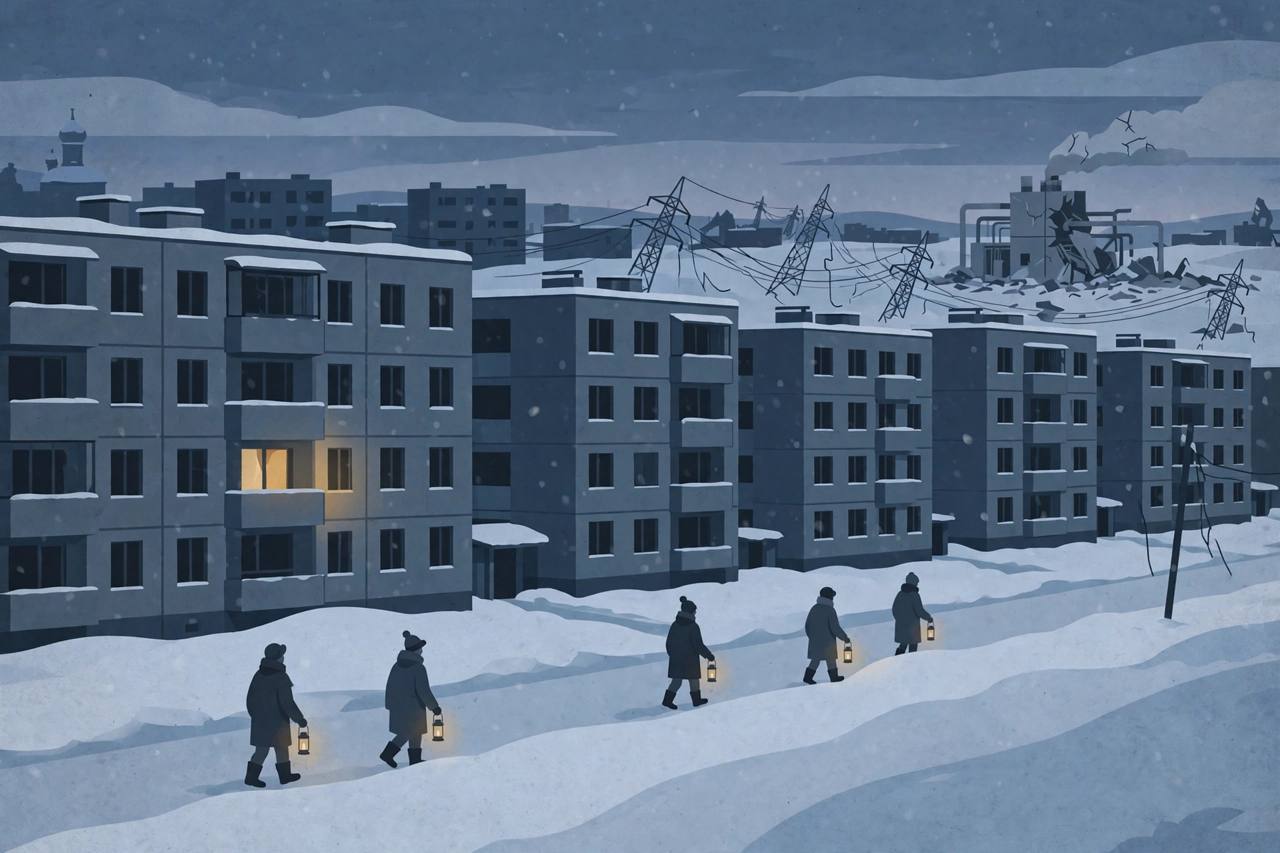
Russian authorities have committed war crimes of intentionally directing attacks against civilian objects and the crimes against humanity of other inhumane acts through continuous attacks on Ukraine's energy infrastructure, the UN Independent International Commission of Inquiry on Ukraine said in a new report submitted to the UN General Assembly, the UN human rights office (OHCHR) said on Monday, October 26.
Source: OHCHR (UN Human Rights Office)
The Commission investigated the impact on civilians of large-scale attacks on Ukraine's energy infrastructure, particularly during the severe winter of 2025-2026, as well as their cumulative effect since autumn 2022, OHCHR said. The frequency, intensity and geographic range of systematic waves of attacks, with hundreds of drones and missiles at a time, have increased over the years and inflicted significant damage to Ukraine's energy sector. Last winter, when temperatures dropped to minus 21 degrees Celsius, millions of people in Ukraine faced lengthy outages of heating, electricity, water and gas, and had to cope with intolerable living conditions. “As the cold season approaches, the attacks have intensified once again, raising serious concerns about the threats to civilians' lives and health,” said Erik Møse, Chair of the Commission.
Source: OHCHR (UN Human Rights Office)
According to the Commission's assessment, the Russian commanders ordering the attacks knew that the heating facilities they targeted in large civilian population centres were indispensable to the civilian population, particularly during winter, and Russian authorities had made official declarations concerning further attacks and referred to a plan to carry them out, OHCHR said. The Commission concluded that the attacks were carried out with intent and pursuant to a state policy to deprive the civilian population of electricity and other essential energy-dependent services and cause suffering. It relied on the accounts of 255 people who endured the winter in the Dnipro, Kyiv, Kharkiv, Kherson, Mykolaiv, Odesa, Poltava, Zaporizhzhia and Zhytomyr regions, as well as Ukrainian authorities, medical doctors and non-governmental organisations. A 53-year-old man in Kyiv told investigators: “the scariest thing was to fall asleep and not to wake up; it was like torture to be scared of dying from cold.”
Source: OHCHR (UN Human Rights Office)
CNN reported that the report names Russian President Vladimir Putin, former defence minister Sergei Shoigu, his successor Andrey Belousov and Chief of the General Staff Valery Gerasimov as the officials most responsible, and that CNN has asked the Kremlin for comment. Ukraine's Foreign Minister Andrii Sybiha said the report “confirms what Ukrainians have experienced for years,” CNN reported, and Kyiv says large-scale Russian attacks last winter reduced Ukraine's thermal power generation capacity by 70 per cent in the worst-hit areas. Russia has previously maintained that its operations target facilities supporting Ukraine's war effort.
Source: CNN, via KION
The Commission also found compelling evidence that Russian authorities trafficked people from 29 countries into the Russian armed forces, through deception and coercion, in coordination with agents or agencies operating in different countries, OHCHR and Anadolu Agency both reported. The agents presented themselves as legitimate, government-endorsed businesses and processed visas and travel documents, but soon after arrival the men were forced to sign contracts in Russian with Russia's Ministry of Defence and were deployed on front lines in Ukraine and assigned dangerous tasks. Many have been killed or have gone missing, while others surrendered or were captured by Ukrainian forces, acquiring prisoner-of-war status. The wife of one man recruited from the Caribbean said: “They took his passport and just told him to sign here, here and here on the contract. It was only in Russian. He was totally pressured and had no choice.”
Source: OHCHR; Anadolu Agency, via Bytes Europe
The Commission said it also examined attacks by Ukrainian armed forces on energy infrastructure in Russia and in the occupied areas of Ukraine, but was unable to investigate their impact further because Russia did not allow access or respond to its requests for information, OHCHR said. It reiterated that international law prohibits attacks against civilians and civilian objects and called for such attacks to stop, and for all trafficked persons to be discharged from the Russian armed forces.
Source: OHCHR (UN Human Rights Office)