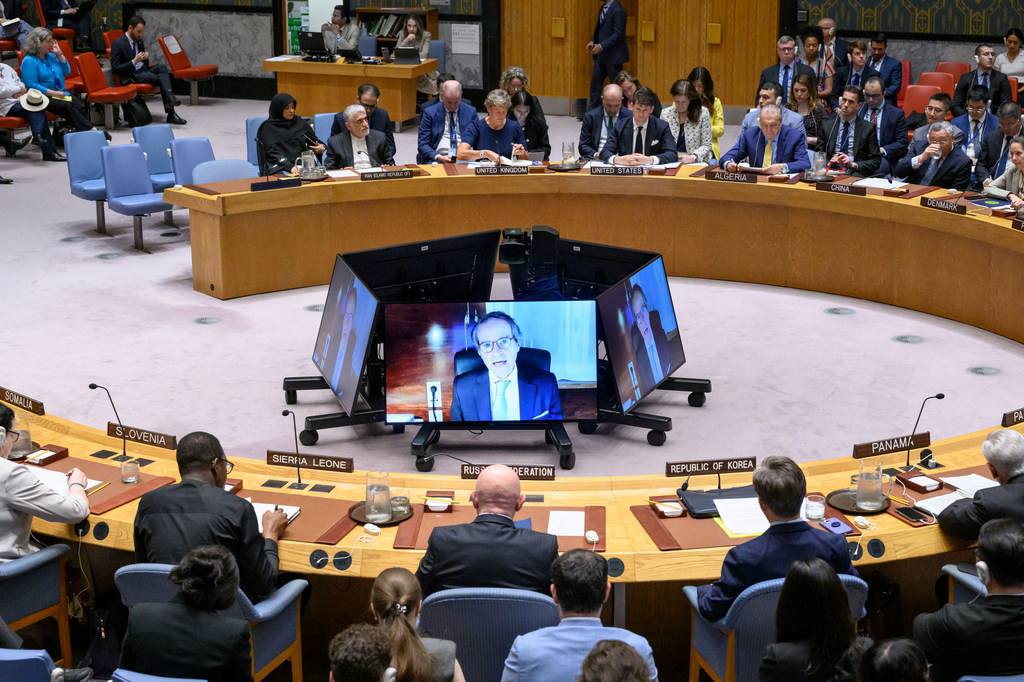
The UN Security Council met in New York on Tuesday to take up Iran's nuclear programme after the International Atomic Energy Agency's Board of Governors voted to report Tehran to the council, and the agency's chief, Rafael Grossi, told the meeting that Iran must let inspectors back into its nuclear facilities without further delay, describing that access as a legal obligation.
Source: The Diplomatic Insight
Grossi said the agency still cannot confirm what happened to Iran's stockpile of near-weapons-grade uranium. Before the June 2025 strikes, the IAEA calculated that Iran held roughly 440 kilograms of uranium enriched to 60 percent. He said inspectors have identified no activity to repair or reconstruct facilities damaged in the 2025 and 2026 attacks since June 2025, but that without access the agency cannot confirm the status of the material itself.
How the referral reached the council
The board's September 9 resolution, proposed by the United States, France, Britain and Germany, passed by 23 votes to 3, with Russia, China and Niger opposed and eight states abstaining. It directed Grossi to report Iran's noncompliance with its safeguards agreement and called on Iran to urgently remedy that noncompliance, according to the Arms Control Association. Iran's ambassador to the IAEA, Reza Najafi, condemned the resolution as “dangerous and entirely counterproductive” and said granting safe access to the bombed facilities was materially impossible because of the US and Israeli strikes.
Source: Arms Control Association
China and Russia challenge the meeting itself
China's permanent representative, Fu Cong, told the council that US and Israeli military attacks on nuclear facilities under IAEA safeguards were “the direct reason the agency has been unable to conduct inspections”, and blamed Washington's unilateral withdrawal from the 2015 nuclear deal and its subsequent “maximum-pressure” policy as “the root causes of the current crisis”. He also said the mechanism for re-imposing UN sanctions on Iran, known as snapback, had fundamental legal and procedural flaws, Press TV reported.
Source: Press TV
Russia's representative, Vassily Nebenzia, challenged the legality of holding the meeting under the council's “non-proliferation” agenda item, saying that under Resolution 2231 the council had concluded its consideration of Iran's nuclear programme on October 18, 2025, and had removed that item from its agenda. He said claims that earlier UN sanctions resolutions had been reinstated “have no legal basis whatsoever”. Russia and China had proposed holding the briefing instead under the agenda item “Threats to international peace and security”.
Iran's deputy UN ambassador, Gholamhossein Darzi, accused the council of silence after the US-Israeli attacks and denounced what he called “wars of aggression against Iran”, saying the meeting showed a double standard in which the aggressor is shielded and the victim is criticised. He pointed to Israel's reported nuclear arsenal, which Israel has never confirmed, and, according to The Diplomatic Insight, did not address the IAEA's unanswered questions.
What is solid
- The IAEA board voted 23–3 on September 9 to report Iran's safeguards noncompliance to the Security Council.
- The council voted 11–2, with 2 abstentions, to hold Tuesday's meeting despite Russian and Chinese objections.
- Grossi told the council the IAEA cannot confirm the status of Iran's enriched uranium stockpile without renewed access.
What is only claimed
- Russia says the council legally closed the Iran nuclear file in October 2025 under Resolution 2231; Western states and Bahrain requested the meeting anyway.
- China and Iran say US and Israeli strikes are the reason inspections stopped; Western states say safeguards obligations are not optional.
What happens next is unclear. The Arms Control Association noted that action by the Security Council is unlikely, because Russia and China are veto-wielding members and both opposed the board's decision. Iranian officials have said Tehran is willing to resume inspections only as part of a broader diplomatic agreement, and President Masoud Pezeshkian said in September that Iran was willing to submit to verification as part of such a deal. With the council divided and Tehran refusing to move on access alone, the standoff over the unconfirmed uranium stockpile looks unlikely to ease soon.