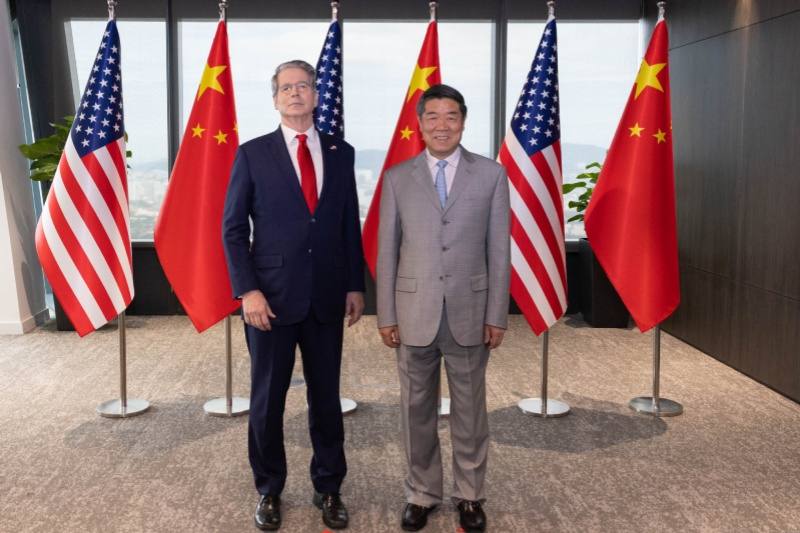
KUALA LUMPUR - The United States and China have outlined a framework for a trade deal that would pause steeper American tariffs and Chinese rare-earth export controls, officials from both countries said on Sunday after two days of talks in Kuala Lumpur on the sidelines of the ASEAN summit. US Treasury Secretary Scott Bessent called it a 'very substantial framework' and told NBC's Meet the Press he no longer anticipated the 100% tariffs on Chinese goods that President Donald Trump had threatened from November 1, Reuters reported. 'I'm also anticipating that we will get some kind of a deferral on the rare earth export controls that the Chinese had discussed,' Bessent said.
Source: Reuters via Times of India, Oct 26
China's top trade negotiator Li Chenggang said the two sides had reached a preliminary consensus on issues including extending the trade truce, fentanyl and export controls, the Associated Press reported. Bessent said on CBS's Face the Nation that the threat of additional higher tariffs was 'effectively off the table', that Beijing would make 'substantial' purchases of US soybeans and other agricultural products, and that the talks yielded initial agreements to stop fentanyl precursor chemicals reaching the United States.
Source: Associated Press, Oct 26
What is solid
- Bessent and China's Li Chenggang both confirmed a framework / preliminary consensus after Kuala Lumpur talks between Bessent and US Trade Representative Jamieson Greer and Chinese Vice Premier He Lifeng and Li (Reuters; AP)
- The framework covers deferring China's rare-earth controls, resuming substantial US soybean purchases, fentanyl precursor chemicals and extending the May truce (Bessent via Reuters and AP)
- Final terms are for Trump and Xi to decide; the two leaders are set to meet on Thursday in South Korea (Reuters; AP)
What is only claimed
- Beijing had yet to officially confirm the Trump-Xi face-to-face meeting, Reuters noted; no final signed deal exists yet - what was agreed in Kuala Lumpur is a framework for the leaders, not the deal itself
How the standoff built up
The talks came after weeks of escalation. Beijing recently expanded its controls on rare-earth magnets and minerals - materials needed for advanced technology, cars, planes and weapons - and Trump responded by threatening triple-digit tariffs from November 1. Washington had also considered restrictions on software-powered exports to China, including laptops and jet engines, Reuters reported. The two countries had rolled back most of their tariffs under a trade truce signed in May, but that truce is due to expire on November 10; Bessent said it could be extended pending the president's decision.
Source: Reuters via Times of India, Oct 26
Trump, who arrived in Malaysia on Sunday for the ASEAN summit, expressed confidence about the outcome. 'I think we're going to have a deal with China,' he said, according to Reuters, and Bessent told reporters: 'I think we have a very successful framework for the leaders to discuss on Thursday.' Trump also indicated he could meet Xi again in China and the United States. On the summit's sidelines, Thailand and Cambodia signed an expanded ceasefire agreement at a ceremony Trump attended - part of the same Kuala Lumpur weekend that produced the China framework.
Source: Associated Press, Oct 26
Why it matters beyond Washington and Beijing: rare earths sit inside phones, electric vehicles, wind turbines and defence systems worldwide, and a 100% tariff wall between the world's two largest economies would have pushed up prices far beyond their own borders - including for Indian and Punjabi diaspora businesses that trade across both. For now, the escalation is paused; Thursday's Trump-Xi meeting in South Korea will decide whether the framework becomes a deal.