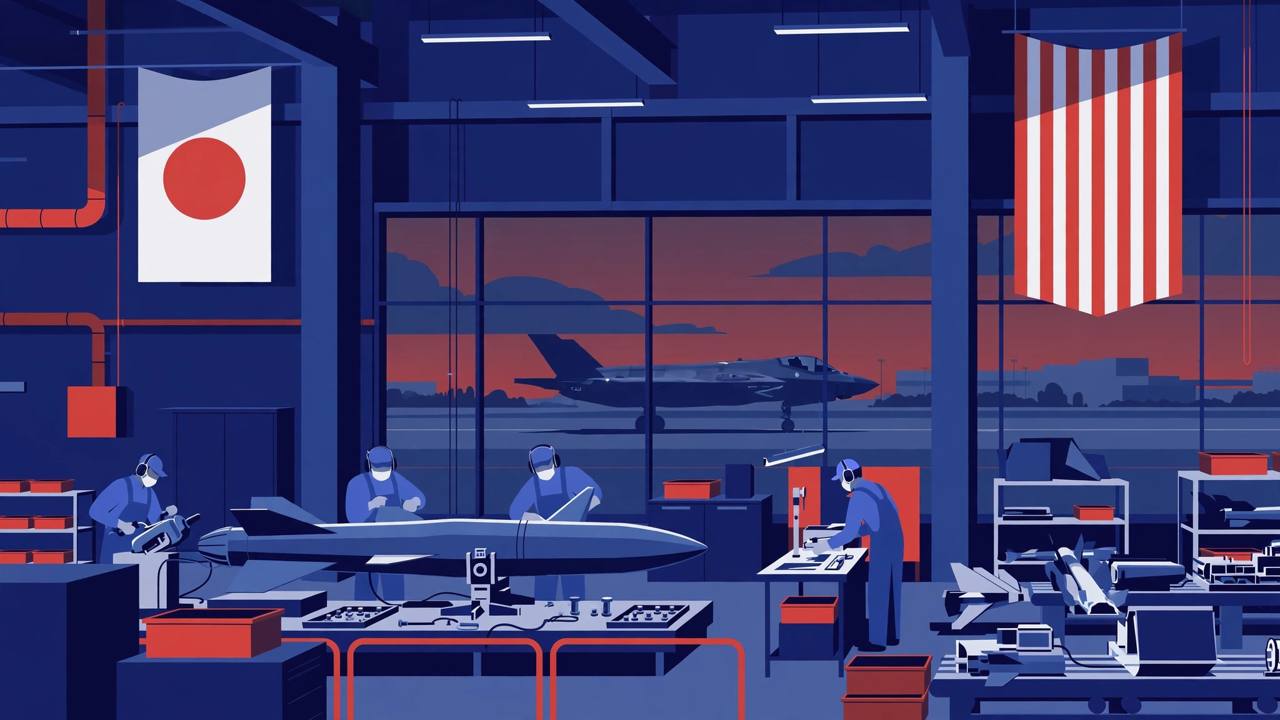
The United States and Japan agreed on Wednesday, October 28, to establish a facility in Japan for the joint production of advanced medium-range air-to-air missiles, Japanese Defence Minister Shinjiro Koizumi announced late on Wednesday in Cebu, Philippines, after meeting US Defense Secretary Pete Hegseth on the sidelines of the annual ASEAN defence ministers' meetings.
Source: Associated Press, Oct 28, 2026 — US and Japan agree to establish missile-production facility (Cebu)
The missiles are the AIM-120 AMRAAM, which Koizumi called “essential for the F-35” — the US-made fighter jet flown by both countries — and the joint effort is called “Operation Supercharge”. In remarks reported in translation, Koizumi called it “a groundbreaking agreement that will not only ensure the acquisition of equipment needed by both Japan and the United States, but will also strengthen Japan's defense industry base.” The location of the facility has not yet been announced.
A ‘sense of crisis’, answered with deterrence
“We shared a sense of crisis … regarding the increasingly severe regional situation and we agreed to strengthen the deterrence and response capabilities of the Japan–US alliance with greater speed and intensity than ever before,” Koizumi said after the meeting. “We reaffirmed the importance of a free and open international order based on the rule of law, which rejects any attempts to unilaterally alter the status quo through the use of force, coercion or other means.” He added, cautiously, that the discussions were not directed at any specific country — even as the Associated Press noted the two allies have repeatedly expressed alarm over China's growing aggression in Asia.
Source: Associated Press, Oct 28, 2026 — Koizumi and Hegseth remarks in Cebu
The two defence chiefs met for about 30 minutes, according to reports citing Nikkei. Alongside the AMRAAM plant, they agreed to share technical information to expand production of the SM-3 Block IIA, a ship-launched interceptor designed to destroy ballistic missiles in space, and to expand joint exercises, including live-fire drills. Hegseth welcomed Japan's work to strengthen its defence production base, and the Japanese side said Hegseth did not press for a specific increase in Japan's defence budget.
In its own readout of the meeting, the Pentagon did not mention the AMRAAM facility, but said both leaders committed to continue close coordination on critical munitions production. The Cebu agreement follows a massive $20.7 billion Pentagon contract to expand production of the missile over the next seven years — yaani, 20.7 billion dollars means 2,070 crore dollars of missile-production work.
Source: Bytes Europe, Oct 28, 2026 — US and Japan finalize agreement for AMRAAM facility
Two years in the making
The decision caps more than two years of industrial talks under the two countries' Defense Industrial Cooperation, Acquisition, and Sustainment framework, known as DICAS. Japan changed its defence export rules in December 2023 to allow domestically produced PAC-3 missiles to be exported to the United States; ministers meeting in Tokyo on July 28, 2024 announced efforts to pursue joint production of AMRAAM and Patriot PAC-3 missiles; an April 14, 2026 DICAS plenary in Washington agreed to include AMRAAM circuit-card assembly in production discussions and to keep examining final assembly and check-out in Japan; and on May 30, 2026, in Singapore, Koizumi gave the acceleration effort its name — Operation Supercharge. The Cebu agreement establishes the AMRAAM final assembly and inspection facility in Japan.
Source: Asia Daily, Oct 28, 2026 — Japan and US agree to establish AMRAAM missile facility (DICAS timeline)
A final assembly and check-out plant — FACO — is where completed components are put together into finished missiles and tested before delivery, according to reports citing the Asahi Shimbun and NHK. The announcement came at meetings whose stated aim is to avert a major regional conflict and strengthen defence cooperation. The wider backdrop, as the Associated Press reported from Cebu, includes China's claims to the South China Sea virtually in its entirety — disputed by the Philippines, Vietnam, Malaysia, Brunei and Taiwan — and a separate Beijing–Tokyo dispute over tiny Japanese-controlled islands in the East China Sea.
The facility's location has not been announced. Watch for the site decision, the production timetable, and any reaction from Beijing, which was not named by either minister in Cebu but whose growing military activity in Asia both allies cited as the reason for moving ‘with greater speed and intensity than ever before’.