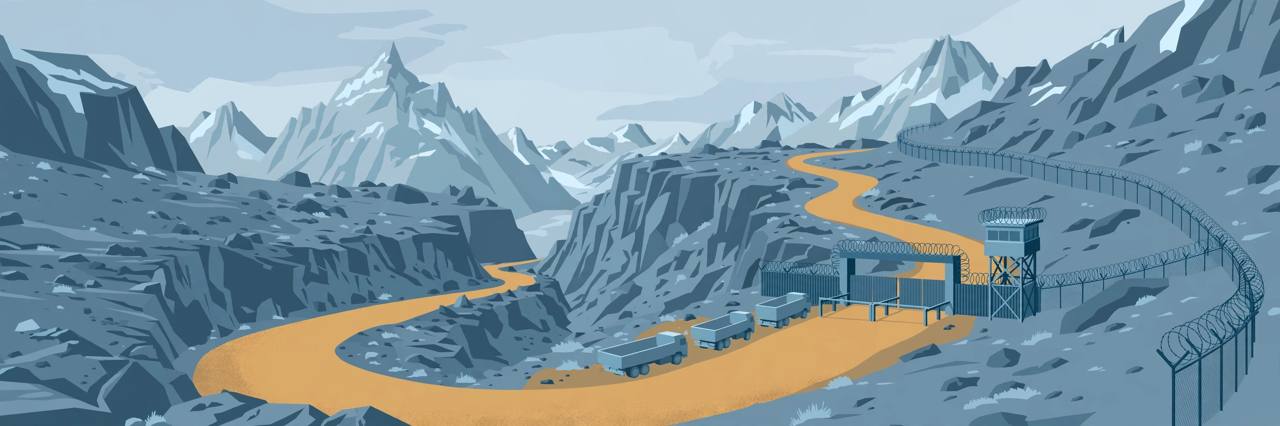
Afghanistan's Taliban authorities have finished a road to the Chinese border — and found the border still shut. The 121-kilometre gravel road through the remote Wakhan Corridor was inaugurated on October 4, running from Broghil in Wakhan district to the frontier with China, the Times of Central Asia and the Lowy Institute reported. On the Chinese side, however, there is no open crossing: the border remains heavily fenced and under surveillance, and Beijing sent no representatives to the inauguration and gave it no official acknowledgement, according to reporting by Radio Free Europe/Radio Liberty (RFE/RL).
The road cost 365 million Afghanis — yaani roughly 5.5 million US dollars — and includes four bridges, 66 culverts and more than 3,000 metres of retaining walls, according to the Lowy Institute, citing Afghanistan's Ministry of Rural Rehabilitation and Development, which inaugurated the route. The corridor sits at more than 4,000 metres above sea level in one of the most isolated mountain regions on earth, the Times of Central Asia reported.
A road that ends at a fence
One report cited by the Times of Central Asia said that when Taliban personnel reached the border area, Chinese border guards ordered them to leave. That account has not been independently confirmed, and China has not commented publicly on it. What is not in dispute is the physical picture: satellite imagery examined by RFE/RL showed the new road reaching within a few dozen metres of the frontier, where the Chinese side is secured with fencing, razor wire and surveillance cameras, and there is no indication Beijing intends to open the crossing in the near future.
The Wakhan's eastern end is Afghanistan's only direct border with China — a frontier of about 74 kilometres that Beijing ordered closed decades ago and has kept shut ever since, the Times of Central Asia reported.
Why Kabul wants the route — and why Beijing hesitates
For Kabul, the attraction is leverage and an alternative to Pakistan. Afghanistan has long depended on Pakistani ports for access to world markets, and that dependence was exposed when the two countries shut major border crossings after deadly fighting in October 2025, disrupting trade and stranding trucks. Before that closure, more than 70 per cent of medicines used in Afghanistan were imported from Pakistan, according to the European Union Agency for Asylum, cited by the Lowy Institute.
Beijing's hesitation is about security, analysts cited by RFE/RL and Afghan reporting say: China remains concerned about militant groups in northeastern Afghanistan, including the East Turkistan Islamic Movement, and about the risk of infiltration across the rugged Pamir terrain. Until those concerns change, the new road gives Afghanistan a bargaining chip and a symbol — but not yet a trade route.
121 km gravel road inaugurated Oct 4, 2026 • Cost 365 million Afghanis (yaani ~US$5.5 million) • 4 bridges, 66 culverts • China border — Afghanistan's only direct frontier with China, about 74 km — remains closed and fenced • No commercial crossing exists
What is solid
- The Taliban inaugurated a 121-km road through the Wakhan Corridor to the Chinese border on October 4, 2026
- China's border at the Wakhan remains closed and heavily fortified, with no commercial crossing
- Beijing sent no representatives to the inauguration and has not officially acknowledged the road
What is only claimed
- A report cited by the Times of Central Asia says Chinese guards ordered Taliban personnel to leave the border area — not independently confirmed
- Whether the road will eventually persuade China to open a crossing — analysts disagree