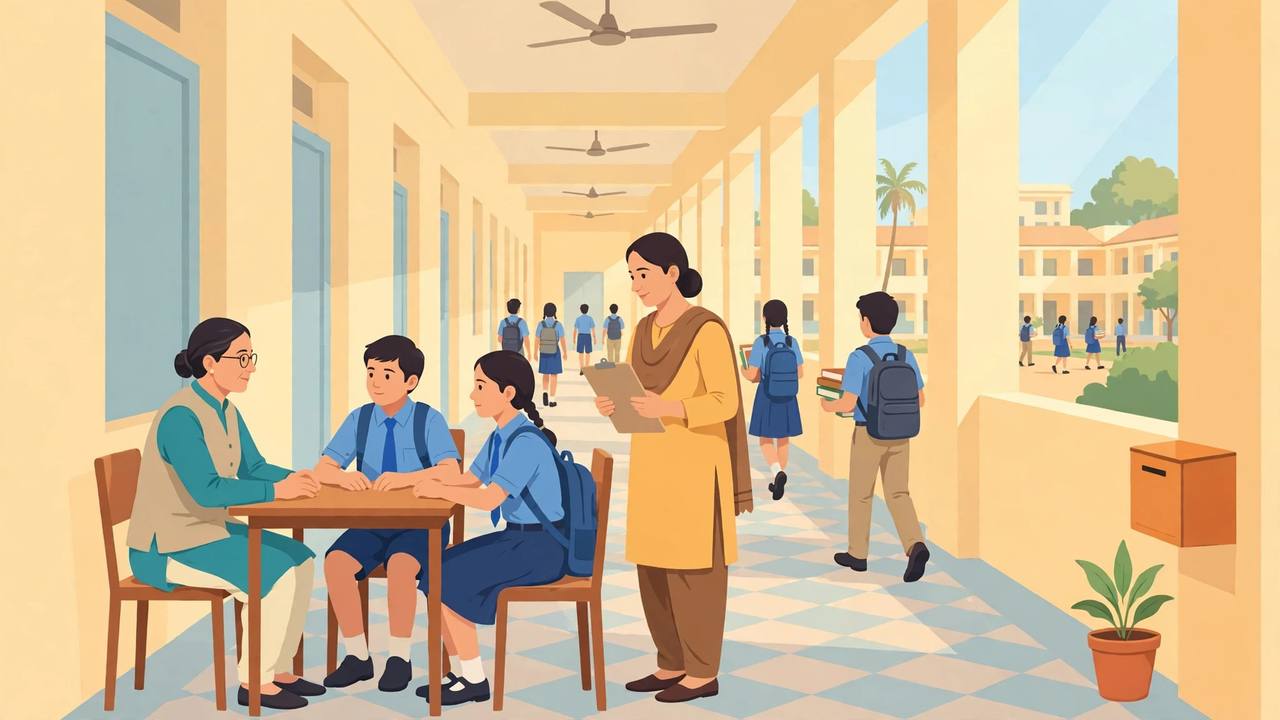
The Gujarat government has introduced new regulations mandating mental health support mechanisms in secondary and higher secondary schools across the state, including dedicated wellness teams, peer-support systems and qualified counsellors, a state government release said on Sunday, November 1. The provisions, introduced under the Gujarat Secondary and Higher Secondary Education Regulations, 1974, will apply to Classes 9 to 12 in schools affiliated with the Gujarat Secondary and Higher Secondary Education Board (GSHSEB). The Education Department has added Regulation 16(A) to the 1974 regulations, with detailed provisions on mental health, student welfare and suicide prevention set out in a new Appendix 8.
Source: Careers360 (state government release)
A wellness team in every school
Under the new rules, every school offering Classes 9 to 12 must constitute a School Wellness Team (SWT) at the beginning of each academic year, and the team's functioning will be reviewed annually. The school principal will head the team, while a counsellor or a designated teacher will serve as its coordinator. The team will also include one teacher each from the secondary and higher secondary sections, a School Management Committee representative, a non-teaching staff member and two student peer leaders, called 'Mano-Mitra', representing the two sections. The teams will be trained to safeguard students' emotional well-being, identify signs of mental distress and respond promptly to suicide risks and other emergencies.
Source: ReportWire
Schools with 100 or more students must appoint at least one qualified counsellor, psychologist or social worker trained in child and adolescent mental health. Schools with fewer than 100 students must establish formal referral arrangements with external mental health professionals, nearby community and primary health centres, the District Mental Health Programme and Tele-MANAS services. Under the Mano-Mitra initiative, selected students will provide initial emotional support to their peers and guide those requiring assistance towards appropriate support services. In the event of a suicide, schools must arrange psychological, emotional and social support for other students, teachers, staff and affected family members through a postvention process, officials said.
Source: IANS via hi INDiA
The regulations also require schools to provide additional mentoring or counselling during critical periods, including board examinations, result announcements and transitions from Class 8 to 9 and Class 10 to 11. Schools will be prohibited from segregating students on the basis of examination results or marks, publicly humiliating them or comparing them with other students in ways that could cause emotional distress. Schools must provide confidential and accessible channels for students to share their concerns, maintain suggestion boxes, and prominently display child helpline numbers and School Wellness Team contact details. All teaching and non-teaching staff must undergo training by certified mental health professionals at least twice a year, covering psychological first aid, identification of warning signs, response to self-harm and referral to appropriate services.
Source: Careers360 (state government release)
Schools must also maintain strict confidentiality of students' mental health information and counselling records, and establish confidential grievance redressal mechanisms for bullying, cyberbullying, ragging, sexual harassment and discrimination. Failure by a school to take timely action despite being aware of a risk situation may be treated as institutional culpability if it contributed to serious harm or a student's suicide, the release said. A district-level monitoring committee headed by the District Collector will oversee implementation and review complaints and serious incidents. Officials said the decision was taken under the guidance of Chief Minister Bhupendra Patel, Education Minister Pradyuman Vaja and Minister of State for Education Rivaba Jadeja, and that the state has adopted the NCERT's UMMEED guidelines as a reference framework. The government said the rules aim to ensure students' mental well-being receives as much attention as their academic performance, amid concerns over examination pressure, competition for marks, excessive social media use, family expectations and anxiety about the future.