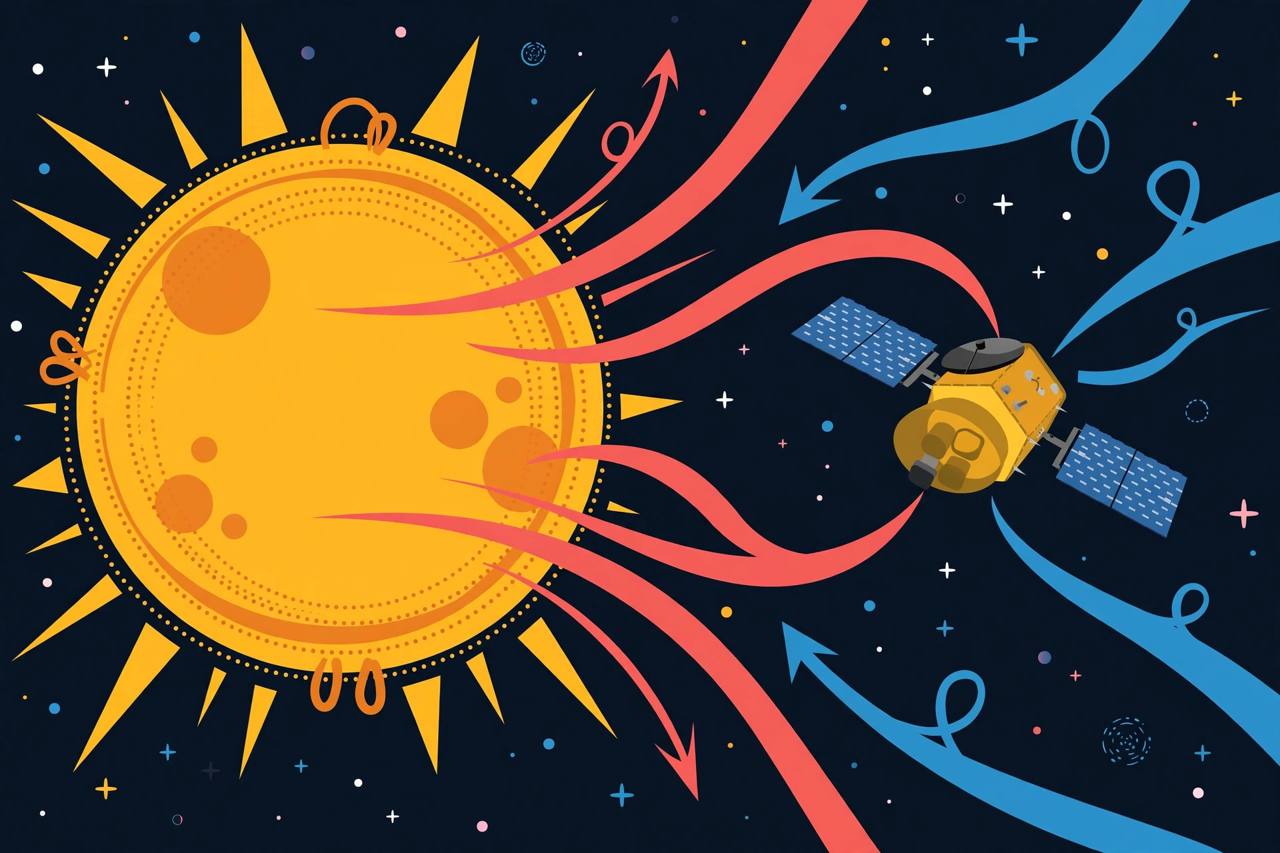
Scientists from the Indian Institute of Astrophysics (IIA), Bengaluru, have created Doppler velocity images of activity in the solar corona using data from the Visible Emission Line Coronagraph (VELC) aboard Aditya-L1, India's first dedicated solar mission, The Hindu reported. The images are expected to provide previously unavailable information on how coronal mass ejections (CMEs) — huge eruptions of magnetised plasma from the Sun — travel along the Sun-Earth line.
Source: The Hindu via Tech Word News
The key advance is direction. Ordinary coronagraph images show an eruption projected across the sky but struggle to show whether the plasma cloud is coming toward Earth or moving away. The Doppler images fill that gap: positive and negative Doppler velocities indicate that solar plasma is moving away from and toward the observer, the scientists said.
"Positive and negative Doppler velocities indicate that the solar plasma is moving away from and toward the observer," the IIA researchers said, explaining the method with the familiar school-level example of a train's whistle rising in pitch as it approaches a platform and falling as it moves away — applied here to light waves instead of sound.
Detailed VELC data-processing software was developed by Dr V. Muthupriyal, Principal Project Scientist with the VELC Operations Team at IIA, and her team. The technical details of the processing were recently published in The Astrophysical Journal after international peer review, according to the report.
Source: IAS Exam current affairs summary
Prof. R. Ramesh, IIA Senior Professor and Principal Investigator of the VELC project, said Doppler velocity images of the solar corona are unique, and that only VELC currently has the ability to generate such images because of its ability to observe spectroscopically in the visible wavelength range from the Lagrangian L1 position in the Sun-Earth system. He added that the processed images will be shared with the scientific community, in addition to the data already publicly available.
Aditya-L1 was launched aboard PSLV-C57 on September 2, 2023, and entered a halo orbit around the Sun-Earth L1 point, about 1.5 million km from Earth, on January 6, 2024. From that vantage point it watches the Sun continuously. Knowing early whether a CME is Earth-directed matters because such eruptions can disturb the near-Earth space environment and affect satellites and other space-based systems.
Source: Anantam IAS current affairs