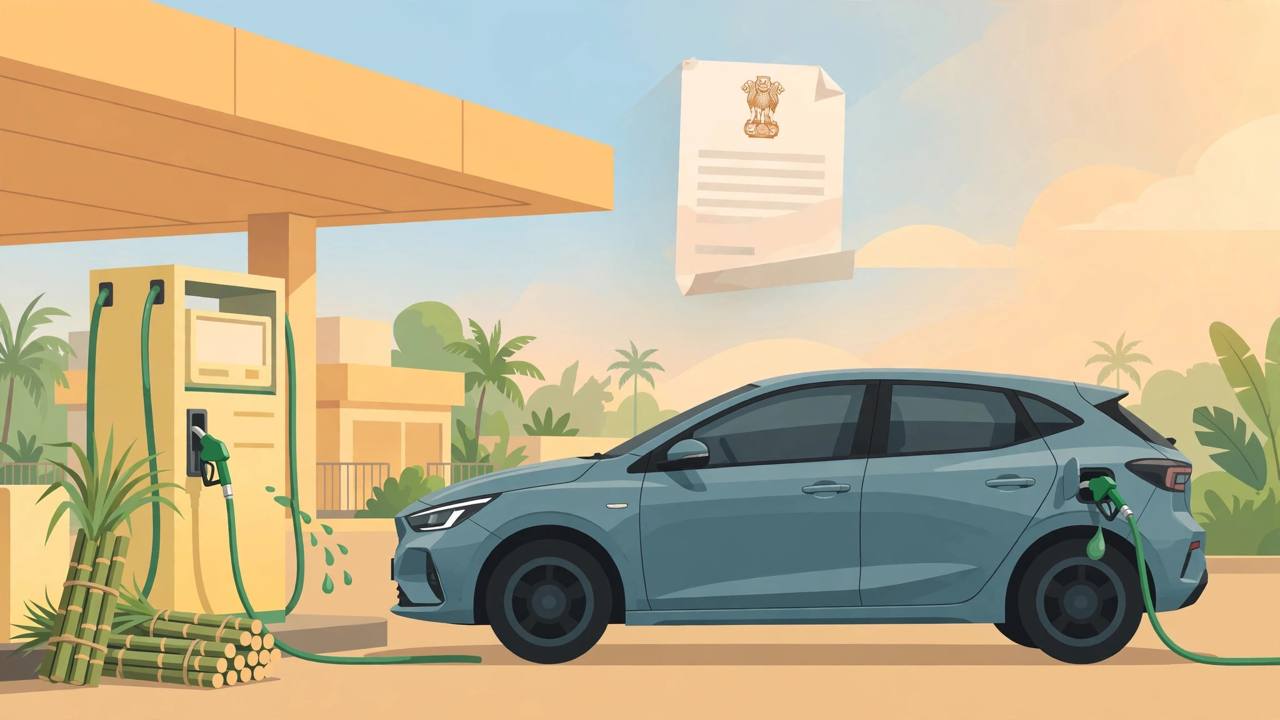
The government has amended the Central Motor Vehicles Rules, 1989, introducing changes to vehicle emission and fuel-related standards, including provisions for vehicles using 100 per cent ethanol (E100) fuel in flex-fuel vehicles, effective from Monday, October 26, news agency IANS reported, citing a notification issued by the Ministry of Road Transport and Highways.
Source: IANS
Under the amendments, references to E85 — a petrol-ethanol blend containing up to 85 per cent ethanol — have been replaced with “E85 or E100” in specified emission tables of Rule 115, The Hindu BusinessLine reported. E100 refers to near-pure ethanol fuel. The notification, dated October 23 and published in the Gazette of India on October 26 as G.S.R. 911(E), also inserts an explanatory note stating that E85 or E100 shall be used only in vehicles designed by original equipment manufacturers (OEMs) as flex-fuel vehicles.
Source: The Hindu BusinessLine
The rules also revise certain fuel and vehicle classifications, including raising the gross vehicle weight threshold in one emission table to 3,500 kg from 3,000 kg, changing the B10 biodiesel entry to B100 and updating gasoline references to E10 and E20, according to the notification details reported by ChiniMandi. The final rules follow draft amendments published on April 27, 2026, with the ministry saying objections and suggestions received from the public had been considered.
Source: ChiniMandi
What changes for car buyers
The change is about vehicle capability and certification, not about the fuel sold at ordinary pumps. E20, which contains 20 per cent ethanol blended with petrol, remains the nationwide base fuel, and in July the Petroleum Ministry had said no decision had been taken to raise the nationwide base blending level beyond 20 per cent, BusinessLine noted. Owners of existing vehicles are not required to switch fuels.
The distinction mattered in practice: when Maruti Suzuki launched its first flex-fuel passenger car in June, the company said the vehicle could operate on blends ranging from E20 to E100 but had been certified using E85 because the applicable rules then defined flex fuel as E20 to E85. Under the new notification, such models can now be certified up to E100, clearing the regulatory path ahead of planned E100 model launches.
Earlier this year, Union Road Transport and Highways Minister Nitin Gadkari had noted that switching to a car running entirely on ethanol could bring fuel costs down to the equivalent of around Rs 25 per litre, IANS reported. Separately, a Brickwork Ratings analysis cited by IANS estimated that India's ethanol demand under an E25 blending scenario could reach 17.9 billion litres by FY31 in the base case, against installed distillation capacity of 18.25 billion litres.