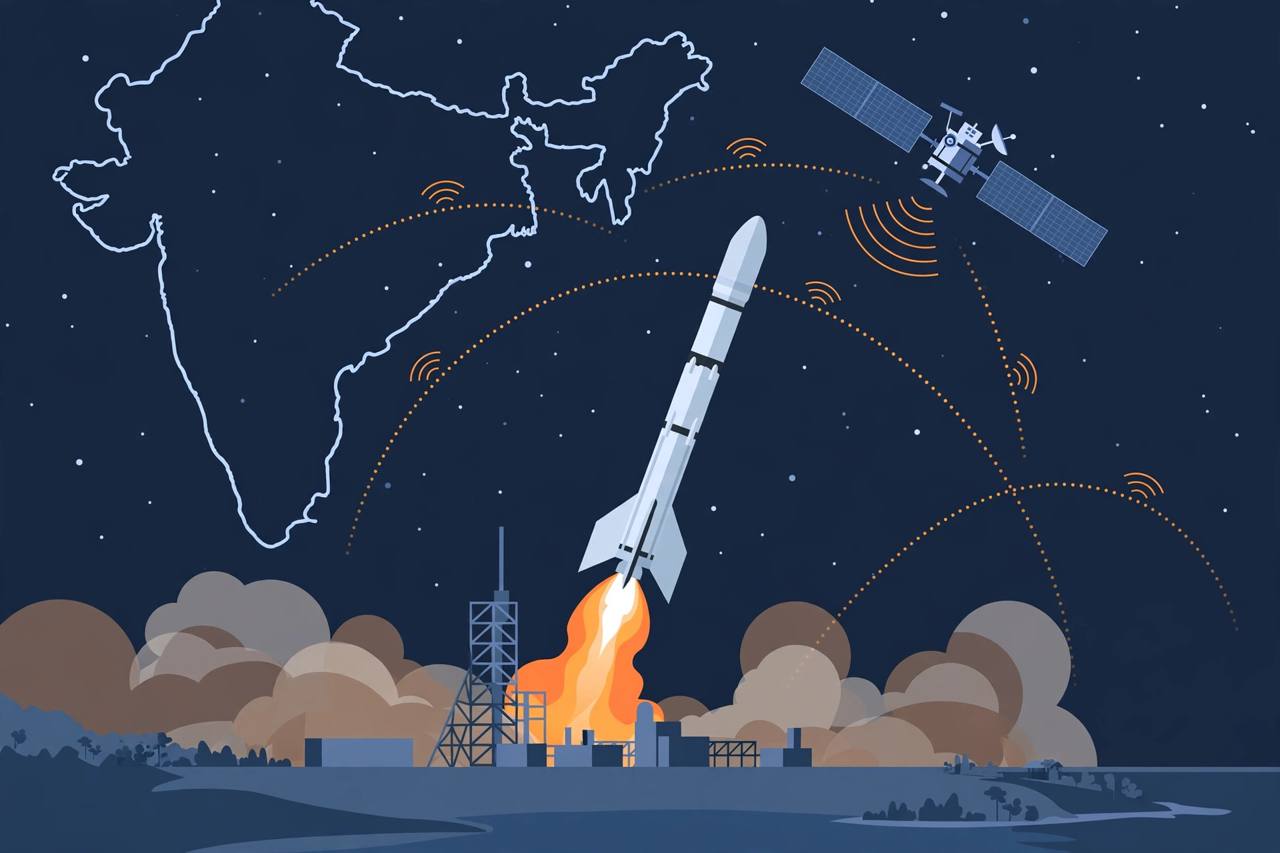
India's space agency ISRO successfully launched its next-generation navigation satellite NVS-03 aboard the GSLV-F18 rocket on Friday night, in the result that followed the mission's earlier announced launch schedule. The rocket lifted off at 11:51 pm IST on October 30 from the Second Launch Pad at the Satish Dhawan Space Centre in Sriharikota, Andhra Pradesh, news agency IANS reported, quoting ISRO's own launch update on X.
Source: IANS
The satellite was subsequently reported to have been placed in its designated Geosynchronous Transfer Orbit (GTO). From there, NVS-03 will carry out orbit-raising manoeuvres to reach its final geosynchronous slot at 32.5 degrees East, according to IANS.
Source: Dharmakshethra
Third second-generation NavIC satellite
NVS-03 is the third satellite in the second-generation NVS series built to augment the Navigation with Indian Constellation (NavIC), India's independent regional navigation system, and to ensure continuity of its services. The five second-generation satellites are envisaged to strengthen a system that covers the Indian landmass and a region extending about 1,500 km beyond it, ISRO said.
The satellite carries an indigenous atomic clock along with procured atomic clocks, and it adds the L1 navigation signal to the existing L5 and S signals, enhancing the system's capabilities. NavIC provides a Standard Positioning Service for civilian users and an encrypted Restricted Service for authorised users. The mission follows NVS-02, launched aboard GSLV-F15 on January 29, 2025.